

Accelerating Innovation: How McLaren Racing Drives F1 Performance with Stratasys 3D Printing
In the high-octane world of Formula 1, where milliseconds define victory and defeat, technological innovation is not merely an advantage—it is a necessity. For enthusiasts deeply rooted in both automotive excellence and cutting-edge manufacturing, the names McLaren Racing and Stratasys resonate with unparalleled significance. These two industry titans have forged a powerful partnership, collaborating to develop and integrate state-of-the-art equipment that pushes the boundaries of performance. At the core of Formula 1 success lies a singular, unyielding objective: speed. This imperative extends far beyond the race track, permeating every facet of vehicle development, particularly the critical realm of part production times. It is in this high-stakes race against the clock, off the asphalt, that additive manufacturing emerges as a game-changer, providing McLaren Racing with a vital edge.
McLaren Racing has adeptly navigated the stringent time and budget constraints imposed by the Fédération Internationale de l’Automobile (FIA) for vehicle production, particularly as outlined for the 2022 season and beyond. This remarkable feat is largely attributable to their strategic cooperation with Stratasys, a global leader in additive manufacturing solutions. Through this partnership, Stratasys empowers McLaren to manufacture tens of thousands of intricate parts annually by leveraging its advanced additive manufacturing technologies, most notably utilizing the high-performance Neo800 3D printer. This integration dramatically slashes the production time for critical model components and, crucially, accelerates the overall vehicle development cycle. By streamlining the prototyping and iteration process, McLaren can introduce design enhancements and performance upgrades at a pace previously unimaginable, directly translating into a competitive advantage on the grid.
Precision Parts and Diverse Applications: The Power of 3D Printing in F1
The global landscape of racing sport has faced unprecedented challenges in recent years, particularly due to the Covid-19 pandemic, which led to extended periods of revenue disruption. In response to these financial pressures and with a view to fostering greater sustainability and equitable competition, the FIA implemented a significant reduction in the budget cap. Initially set at $175 million, it was lowered to $145 million for the 2021 season, further reduced to $140 million for 2022, and slated for $135 million in 2023. These stringent financial limits compelled teams to rethink their operational strategies, demanding innovative solutions for efficiency and cost-effectiveness without compromising performance. It is within this challenging environment that McLaren Racing’s investment in 3D printing shines as a brilliant example of strategic foresight.
In response to these evolving regulations and the relentless pursuit of performance, McLaren has embraced industrial 3D printing as a cornerstone of its manufacturing strategy. The team now produces an impressive volume of up to 9,000 car parts annually. These critical components span various areas of the vehicle, including essential elements of the front and rear wings, as well as substantial sections of the side and upper bodywork. What’s truly remarkable is the efficiency of this process: these parts can be produced in as little as three days. According to the race team, these rapidly manufactured parts play a pivotal role in optimizing the car’s aerodynamics during rigorous wind tunnel testing. The precision afforded by 3D printing ensures that each part is crafted with exceptional accuracy, which is non-negotiable for airflow analysis. Beyond the superior quality, the significant reduction in production time and associated costs allows McLaren to iterate designs more frequently, testing more concepts and refining their vehicle’s aerodynamic profile at an accelerated pace. This capability directly contributes to a leaner, more agile development cycle and a stronger competitive position.
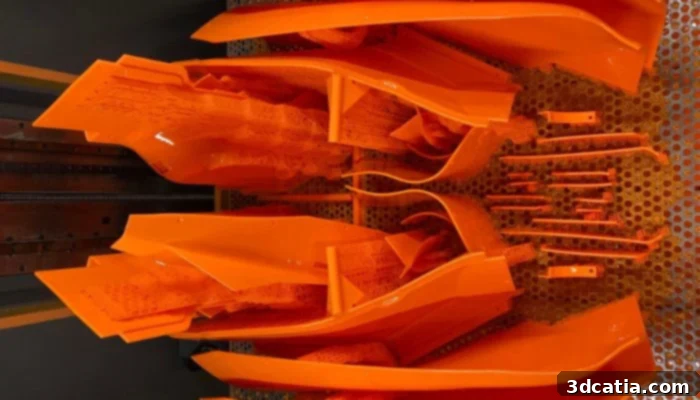
Pièce automobile imprimée en 3D (Image : Stratasys)
The implementation of 3D printing technology by McLaren Racing extends its advantages beyond mere performance and cost savings, offering significant benefits for environmental sustainability. By leveraging its own advanced Stratasys Neo series printers at its state-of-the-art facility in Woking, UK, McLaren can produce all its aerodynamic parts locally. This localized manufacturing strategy drastically curtails the need for long-distance delivery and transportation, which in turn reduces associated logistical costs and, crucially, minimizes the team’s carbon footprint and overall environmental impact. This approach aligns with a broader industry push towards more sustainable practices in motorsport. Furthermore, the versatility of additive manufacturing stretches far beyond direct automotive parts. McLaren’s team can also 3D print a wide array of essential manufacturing aids, such as custom fixtures and jigs, which are critical for precise assembly and quality control. They can even produce small molds that were traditionally milled from costly and time-consuming metal blocks. The stereolithography (SLA) process utilized in the Neo800 not only delivers exceptional detail and surface finish but also significantly saves on both time and raw materials, leading to substantial cost efficiencies. Tim Chapman, Head of Additive Manufacturing at McLaren Racing, enthusiastically explains the impact: “Our new Neo series of 3D printers have dramatically helped to reduce the lead times of our aerodynamic wind tunnel components and projects. The large bed size of the Neo800 allows very large parts to be built quickly and to a very high level of detail, definition, and repeatability. We find the high-definition components from our Neo machines require minimal hand finishing, which allows much faster throughput to the wind tunnel. Finishing cycle times have been reduced dramatically.” This quote underscores the multi-faceted benefits, from accelerated development to enhanced precision and reduced manual labor.
Leveraging 3D Printing for Unrivaled Performance Gains at McLaren
In the intensely competitive realm of Formula 1 racing, every fraction of a second is meticulously accounted for, and even the minutest performance increment can dictate the outcome of a race. To precisely quantify and evaluate these critical performance gains, wind tunnel tests remain the undisputed gold standard. According to Tim Chapman, these rigorous tests are paramount for assessing how all surfaces of the car interact with airflow, providing invaluable data for aerodynamic optimization. For printing the highly detailed and accurate wind tunnel models, McLaren specifically employs Somos® PerFORM Reflect resin, a material meticulously developed for such demanding applications. This specialized resin yields parts that are exceptionally robust and rigid, crucial characteristics for maintaining structural integrity under high-speed airflow conditions. Moreover, its unique properties contribute to a remarkable 30% reduction in the post-processing and finishing time required for the printed models, a significant factor in accelerating the iterative design process. The unparalleled precision of components produced by the Neo printers ensures minimal manual rework, thereby facilitating a much faster throughput of test articles into the wind tunnel. This efficiency allows McLaren to conduct a greater number of tests and gather more data within tighter deadlines.
Beyond sheer speed, the combination of Stratasys Neo printers and advanced resins enables McLaren to produce wind tunnel parts with extraordinarily high accuracy and intricate detail, along with an optimal surface finish. This level of fidelity is critical for ensuring that test results accurately reflect real-world aerodynamic behavior. By enhancing the quality and speed of their wind tunnel testing, the team is empowered to explore and implement new and innovative design ideas with greater confidence and efficiency, ultimately leading to tangible improvements in vehicle performance. The relentless pressure of Formula 1 means car delivery times for upcoming races are always incredibly tight. In this environment, even the smallest design adjustment, informed by rapid 3D printed prototyping, can mean the decisive difference between clinching a victory, avoiding a loss, or securing a more advantageous grid position. The ability to rapidly design, test, and refine components provides McLaren with a crucial competitive edge, allowing them to react quickly to track conditions, incorporate new learnings, and consistently push the boundaries of what’s possible in motorsport engineering.
What are your thoughts on the groundbreaking synergy between 3D printing and motorsport, particularly as demonstrated in the McLaren Racing cars? We’d love to hear your insights! Let us know your perspective in a comment below or engage with us on our LinkedIn, Facebook, and Twitter pages! Don’t forget to sign up for our free weekly Newsletter here to receive the very latest 3D printing news straight to your inbox! You can also find all our compelling videos and interviews on our YouTube channel, offering deeper dives into the world of additive manufacturing.