
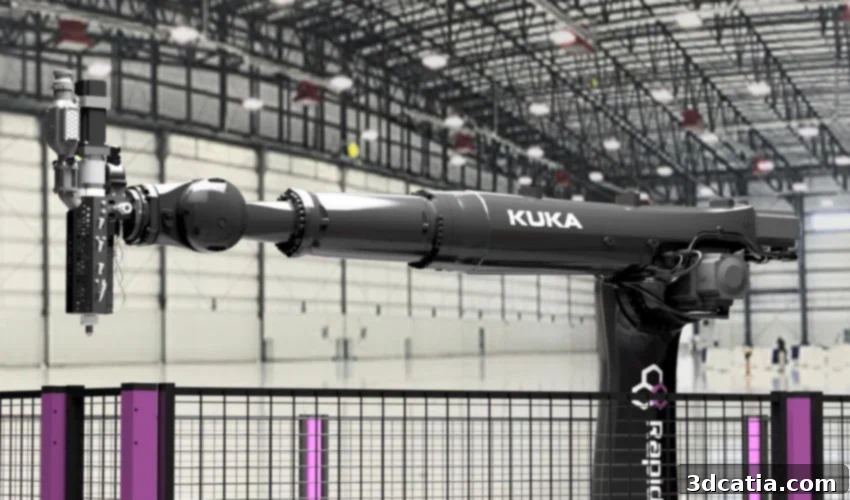
The landscape of polymer 3D printing has been unequivocally shaped by two transformative trends: the adoption of pellet-based materials and the significant expansion into large-format additive manufacturing (LFAM). In recent years, the industry has witnessed a dramatic increase in machine size, unlocking a vast array of new applications across demanding sectors such as maritime and automotive. Concurrently, polymer pellets have emerged as a highly favored extrusion material, not only due to their often superior cost-efficiency and broader property range compared to traditional filaments but also because of their intrinsic suitability for large-scale production. At the forefront of this innovation is Rapid Fusion, a pioneering company that has meticulously developed proprietary solutions designed to facilitate ambitious, large-scale projects. Their comprehensive offerings span from advanced extruders to their cutting-edge all-in-one manufacturing cell. We recently had the opportunity to speak with Jake Hand, the founder and managing director of Rapid Fusion, to delve deeper into the company’s vision and technological advancements.
Rapid Fusion Pioneers Large-Format Pellet 3D Printing: Revolutionizing Industrial Additive Manufacturing
The polymer 3D printing sector is currently experiencing a dynamic evolution, largely driven by advancements in large-format additive manufacturing (LFAM) and the increasing adoption of pellet extrusion. These two forces are converging to unlock unprecedented possibilities for industries requiring robust, cost-effective, and scalable production of large components. From the intricate demands of the automotive industry to the formidable challenges of the maritime sector, the ability to rapidly produce substantial parts with precise material properties is becoming a critical competitive advantage. Rapid Fusion stands at the intersection of these trends, leveraging innovative robotic additive manufacturing to deliver solutions that redefine what’s possible in industrial 3D printing. The company’s unique approach, centered around high-performance pellet extruders and integrated manufacturing cells, addresses long-standing limitations in traditional manufacturing, offering a pathway to enhanced efficiency, material versatility, and sustainable practices.
Meet Jake Hand: The Visionary Behind Rapid Fusion’s Advanced 3D Printing Solutions
Jake Hand, the esteemed founder and managing director of Rapid Fusion, is a driving force in the realm of advanced robotic additive manufacturing. Based in the UK, his leadership has propelled Rapid Fusion to the forefront of developing innovative solutions for large-scale 3D printing. Hand’s journey into additive manufacturing began with a clear vision: to bridge critical gaps in the market by offering robust, reliable, and scalable technologies. His deep understanding of the industry’s evolving needs, coupled with a passion for technological innovation, laid the groundwork for Rapid Fusion’s emergence as a key player in high-performance polymer extrusion for industrial applications. Under his guidance, the company is committed to pushing the boundaries of what is achievable with pellet-based 3D printing, empowering businesses to unlock new efficiencies and design possibilities for their most demanding projects.
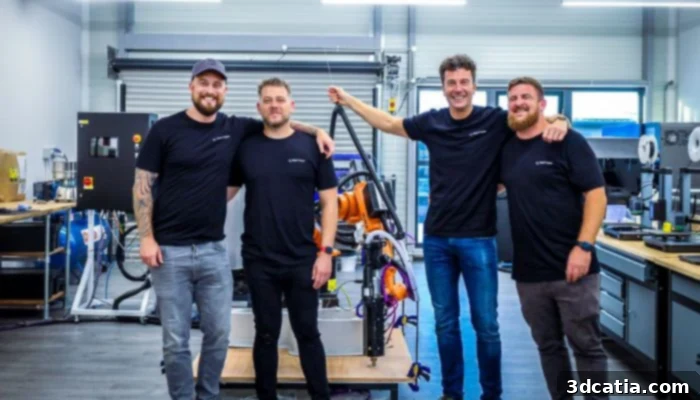
The Rapid Fusion team, including founder Jake Hand (on the far left)
From Vision to Reality: The Genesis of Rapid Fusion and the Apollo Cell
The narrative of Rapid Fusion begins with its sister company, Evo3D, which Jake Hand established in November 2021. Evo3D initially specialized in the resale of large-format additive products, providing invaluable insight into the burgeoning market. Through this experience, Jake and his team quickly identified a significant void: a need for manufacturers to produce their own robust and integrated large-scale additive manufacturing solutions. The aspiration was clear – to develop a proprietary robotic 3D printer system that could be seamlessly integrated and offered through Evo3D.
However, this exploration revealed a stark reality: the existing technology on the market for robotic 3D printing was often cumbersome, lacked refinement, and consistently delivered suboptimal results. The team recognized that for industrial clients to truly adopt this technology, it needed to be reliable and user-friendly, capable of functioning effectively right out of the box. This critical observation spurred Rapid Fusion’s mission: to design and engineer superior products that overcome these prevalent limitations.
The initial focus was on fundamental components. Rapid Fusion meticulously engineered its own advanced extruder and a sophisticated control panel. Through rigorous development and iterative refinement, these components were meticulously dialed in to create the high-performance system available today. This commitment to innovation led to the official formation of Rapid Fusion as a spin-off company in early 2023, approximately 18 months after the inception of Evo3D.
The company’s inaugural product, the PE320 extruder, quickly gained acclaim upon its launch. It stood out for its exceptional capabilities, notably being significantly lighter yet more powerful than its competitors. This reduction in weight is a crucial advantage for robotic applications, as the cost of industrial robots increases substantially with the payload they are required to carry. A lighter, more powerful extruder therefore translates into a more efficient and cost-effective overall system. The PE320’s successful reception, marked by industry awards, affirmed Rapid Fusion’s innovative approach.
Building on this success, Rapid Fusion then developed a comprehensive ecosystem designed to seamlessly transform an industrial robot into a fully functional 3D printing system. This complete package includes every necessary component: the robotic arm, the pellet extruder, an intuitive control system, an air-plus kit, a protective enclosure, and various essential accessories. This expansive range paved the way for the creation of their flagship solution, the Apollo cell. Apollo represents an all-in-one, fully integrated manufacturing solution, which Rapid Fusion is now actively deploying with customers.
Customers now have the flexibility to choose between acquiring individual, high-performance components developed by Rapid Fusion or opting for the complete Apollo system. This versatility has generated significant interest across a diverse spectrum of industries. Rapid Fusion’s solutions are finding applications in sectors ranging from furniture manufacturing, where bespoke designs and rapid prototyping are paramount, to complex industrial applications such as the creation of creative molds, which constitute a massive market segment. Molds are integral to numerous industries, including demanding environments like maritime and automotive, where the rapid production of large, custom shapes is essential. Rapid Fusion’s advanced technology offers substantial benefits, significantly reducing costs and streamlining the manufacturing process for its clients.
Unlocking Potential: The Multifaceted Advantages of Polymer Pellets in 3D Printing
The adoption of polymer pellets in 3D printing introduces a paradigm shift, primarily by providing access to an extraordinarily wider array of base polymers than typically available in filament form. This expansive material palette empowers users to innovate by blending different materials, creating novel composites with tailored properties for highly specific applications. A compelling example of this is the development of r-UltraMarathon 3D, a material specifically engineered for the marine sector. This unique blend offers superior UV resistance, essential for components exposed to prolonged sunlight on boats, and incorporates antimicrobial and antifungal properties to prevent the accumulation of moss or other biological growth on submerged parts. Such sophisticated material development is only feasible through the blending capabilities afforded by pellet extrusion.
Beyond material versatility, pellets significantly enhance the recyclability of polymers, fostering a more sustainable, circular economy in additive manufacturing. Materials like PETG, commonly found in plastic bottles, can be efficiently granulated back into pellet form and re-extruded multiple times without significant degradation. This capability is particularly vital for industries grappling with plastic waste. Car manufacturers, for instance, often generate considerable amounts of waste plastic and are actively seeking innovative ways to reintroduce these materials into their production lines. Pellet technology provides a tangible solution, enabling the conversion of industrial plastic waste into printable parts for vehicles, thereby reducing reliance on virgin materials. This approach not only makes additive manufacturing more environmentally friendly but also cultivates a more robust and economical material lifecycle.
Furthermore, the properties achievable with pellet-based materials are virtually limitless. The integration of additives like graphite and carbon into polymers can yield parts with extraordinary strength-to-weight ratios, offering the best of both worlds – robust performance without the typical associated bulk. Traditionally, achieving high structural strength often meant accepting increased weight. Pellet technology challenges this convention, allowing for the creation of lightweight yet incredibly strong components using advanced engineering-grade polymers.
The advancements extend to specialized applications, with fire-resistant and lightweight polymer pellets now available. These materials hold immense potential for industries such as maritime, where every gram of weight on a vessel, particularly a warship, translates into millions of dollars in operational costs over its lifetime. Imagine the profound benefits of producing a simple fire extinguisher holder from a fire-resistant polymer instead of metal; the weight savings and subsequent cost reductions are monumental. While there are always various factors to consider, the ability to rapidly blend and test new materials in pellet form significantly accelerates material development cycles, allowing innovators to bring these extraordinary materials to market faster and more efficiently.
Pellets and Large-Format Additive Manufacturing: A Perfect Synergy for Industrial Scale
The trajectory of the additive manufacturing market clearly points towards large-format production. We are already witnessing revolutionary applications, such as the 3D printing of entire car chassis, and the potential extends even further—imagine the additive manufacturing of ship hulls or train chassis. This shift towards larger parts demands a material delivery system capable of sustained, high-volume output, and this is precisely where polymer pellets excel. Pellets are inherently ideal for large-format printing because they enable users to extrude a substantial amount of material quickly and efficiently. In contrast, traditional filaments, with their predetermined size, require a longer melting process before they can be effectively deposited, which significantly slows down large-scale production. This inherent limitation of filaments makes them less suitable for the rapid throughput required in LFAM.
This fundamental advantage of pellet extrusion underscores why Rapid Fusion’s Apollo solution and its extensive range of products are so compelling for industries with specific material property requirements or a need for large-format manufacturing capabilities. By facilitating rapid material deposition and offering unparalleled material versatility, Rapid Fusion’s pellet-based systems empower businesses to tackle projects of scale that were previously impractical or prohibitively expensive with other additive manufacturing technologies. This synergy between pellets and large-format additive manufacturing is not just a trend; it’s a fundamental shift in how large industrial parts are conceived, designed, and produced, opening new frontiers for innovation and efficiency.
Rapid Fusion’s Strategic Growth and Future Innovations in Robotic AM
Rapid Fusion’s journey of innovation and expansion has been marked by significant milestones. In March 2023, the company received a prestigious award from Innovate UK, providing crucial funding for the development of an ambitious new machine that integrates pellet additive manufacturing with CNC capabilities. This cutting-edge machine is currently under construction and is anticipated to be available in early 2025. This project has not only solidified Rapid Fusion’s position as a leader in advanced manufacturing but also enabled a substantial expansion of its engineering team, attracting top talent to drive further product development and innovation.
What makes this particular project truly remarkable is the caliber of industry partners involved. Rapid Fusion is collaborating with a consortium of prominent UK manufacturers, including global giants like Rolls-Royce, GKN, and Baker Hughes. These esteemed companies are actively guiding the design and development process, providing invaluable insights into their specific industrial application needs for the new machine. This collaborative approach ensures that the technology will be precisely tailored to address real-world industrial challenges, further enhancing Rapid Fusion’s credibility and visibility within the advanced manufacturing community. This strategic collaboration has been instrumental in solidifying Rapid Fusion’s reputation and building a robust pipeline of customers eager to adopt their innovative technology.
This period of growth has also allowed Rapid Fusion to forge new connections and penetrate diverse international markets. The company has successfully established a global network of trusted resellers, extending its reach into key territories. Notable partners include CNC World in the UK, Hyperion in Australia, Maptec in Dubai, and ACCUFACTURE in the USA. These strategic partnerships are crucial for expanding Rapid Fusion’s footprint and making its advanced robotic AM solutions accessible to a broader international clientele.
Rapid Fusion attributes its rapid and sustained growth to a combination of factors: an unwavering commitment to launching high-quality, robust products, a deep understanding of market dynamics, and an acute awareness of industry demands. The company’s success is ultimately a testament to a powerful synergy between its talented technical team of designers and product engineers and its proactive sales and marketing departments. Looking ahead, Rapid Fusion is focused on continued global expansion, aiming to establish a strong presence in additional regions across the world, further cementing its role as a leading innovator in industrial additive manufacturing.
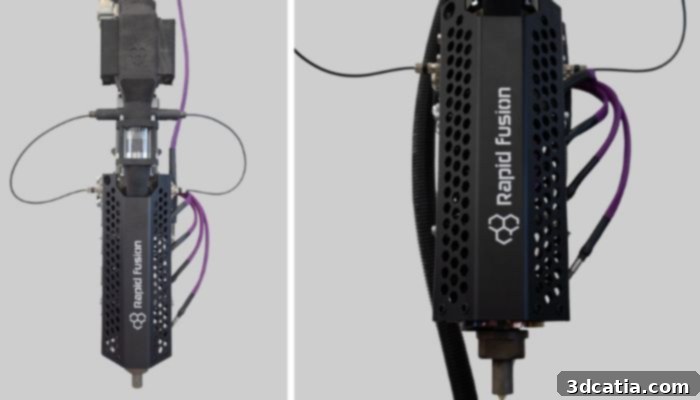
Rapid Fusion began its journey with the PE320 extruder and has since developed Apollo, its comprehensive full cell solution
Embracing the Future: Connect with Rapid Fusion for Your AM Needs
For businesses and innovators who are exploring the exciting possibilities of large-format additive manufacturing, or for those currently utilizing processes for producing large parts that are struggling to scale effectively, Rapid Fusion offers a comprehensive solution. Our dedicated team is ready to assist you in testing our advanced technology and gaining a thorough understanding of how our solutions can integrate into your operations. We warmly invite you to visit our state-of-the-art facility in Exeter, UK. During your visit, you will have the unique opportunity to witness our equipment in action through live demonstrations. Our experts will be on hand to engage in detailed discussions about your specific projects and collaboratively determine how Rapid Fusion can support you in making a seamless transition to utilizing additive manufacturing for your most demanding applications. We are genuinely excited about the prospect of working with you to unlock new efficiencies and capabilities. To learn more and initiate a conversation, please find additional information HERE.
What are your thoughts on Rapid Fusion’s innovative approach and their cutting-edge solutions for industrial 3D printing? Are you currently leveraging polymer pellets in your additive manufacturing processes? We encourage you to share your insights and experiences in the comments section below, or engage with us on our LinkedIn, Facebook, and Twitter pages! Don’t forget to subscribe to our free weekly newsletter here to receive the latest 3D printing news directly in your inbox. For more visual content and in-depth discussions, explore all our videos on our dedicated YouTube channel.