

UK Government’s Bold Stance: Criminalizing Digital Files for 3D Printed Weapons
The United Kingdom government is actively pursuing significant legislative changes aimed at enhancing the powers of law enforcement agencies to combat serious and organized crime. Central to these proposals is a direct focus on illicit 3D printed weaponry. The government is currently engaged in a public consultation regarding the potential criminalization of the ‘making, modification, supply, and possession’ of ‘articles for use in serious crime’. While the term ‘articles’ might seem broad, the government has specifically clarified that this encompasses the digital files – often referred to as blueprints or schematics – from which fully functional or component parts of 3D printed guns can be manufactured. This groundbreaking initiative marks a critical turning point in how nations plan to address the evolving threat posed by accessible additive manufacturing technology in the hands of criminals.
The concept of 3D printed weapons first emerged in 2013 in the United States, sparking a global debate about the future of firearm control. Initially, these homemade devices were often rudimentary and unreliable, seen more as experimental curiosities than genuine threats. However, their proliferation gained significant momentum during the COVID-19 pandemic. As international borders closed and traditional smuggling routes became severely disrupted, criminals and individuals seeking to bypass conventional firearm acquisition laws increasingly turned to do-it-yourself (DIY) manufacturing methods, including 3D printing. This period accelerated the development and refinement of 3D printable firearm designs, transforming them from unreliable prototypes into legitimate and growing concerns for police forces worldwide. The inherent unregulated nature of these weapons presents a formidable challenge. Beyond the existing illegality of unlicensed firearms in many countries, including the UK, the primary concern lies in the unprecedented ability of ordinary individuals to produce firearms at home, thus circumventing established legal restrictions and dramatically reducing their chances of detection by authorities. The cultural impact of this technology is undeniable; for instance, the Victoria and Albert Museum in London proudly displays the world’s first 3D printed handgun, famously known as “The Liberator,” symbolizing this pivotal moment in technological and societal history.

The Liberator, the world’s first 3D printed handgun, is on display at the V&A Museum. (Photo credit: Victoria and Albert Museum, London)
Addressing the Digital Threat: What Concerns Does the UK Government Outline?
The UK government’s proposals stem from a clear recognition of a significant loophole in current legislation: the lack of robust legal repercussions for individuals involved in the production and dissemination of digital designs for criminal purposes. They highlight that existing laws are often ill-equipped to deal with the intangible nature of digital files, which can be shared globally with ease and anonymity. A particularly acute threat, as emphasized in the consultation documents, comes from “hybrid firearm designs.” These weapons combine easily 3D printed components with readily accessible metal parts, often sourced from common hardware or existing weapon components. This blend of technologies makes detection harder and the resulting firearms more robust and reliable than purely plastic variants, significantly escalating their danger to public safety. Indeed, the National Crime Agency (NCA), the UK’s lead agency against organized crime, has now unequivocally stated that 3D printed guns represent a “credible” and evolving option for criminals, underscoring the urgency of legislative action.
This proactive stance by the government is driven by several critical factors. Beyond the immediate threat of homemade firearms, there’s a broader concern about the erosion of traditional gun control measures. The ability to manufacture firearms at home circumvents background checks, licensing requirements, and official registries, making it virtually impossible for authorities to track their origin or ownership. Furthermore, the accessibility of sophisticated 3D printing technology, which continues to become more affordable and user-friendly, means that the barrier to entry for producing these weapons is constantly lowering. The consultation documents delve into the logistical challenges faced by law enforcement, who must contend with a burgeoning black market for digital blueprints and the practical difficulties of interdicting individual manufacturing operations that can be set up in any private residence. The proposals aim not just to react to current criminal trends but to pre-empt future developments by establishing a strong legal framework that addresses the digital origins of this threat, thereby protecting communities and bolstering national security against this modern form of illicit weaponry.
Navigating the Complexities: Public Consultation and International Challenges
The UK government’s consultation process is a vital component of developing this new legislation, seeking comprehensive feedback from a diverse range of stakeholders. This includes not only law enforcement agencies, who are on the frontline of tackling serious crime, but also businesses involved in the 3D printing industry and, crucially, the general public. The government aims to understand the potential impact of this legislation on each group, both in their professional capacities and personal lives. For instance, questions are being raised about the implications for legitimate 3D printing businesses that might inadvertently host or facilitate the sharing of problematic files, or for hobbyists whose activities could be misinterpreted. A significant challenge lies in the prosecution of involved parties, especially considering the international nature of the digital world. Many popular file-sharing websites that host 3D printable designs, including well-known platforms like Thingiverse, Cults3D, and MyMiniFactory, operate internationally and are open to creators and users from across the globe. This raises complex jurisdictional questions: how can UK law enforcement effectively prosecute an individual or entity based outside its jurisdiction for sharing a digital file?
A particularly noteworthy aspect of this proposal is the intention to hold responsible not only those who ultimately use the digital files to manufacture weaponry but also those who create or distribute these files. This marks a significant shift from traditional law enforcement approaches, which typically focus on the end-user or the physical weapon itself. By targeting the source of the digital blueprints, the government aims to disrupt the supply chain at its earliest possible stage. While this proposal is currently under consideration and not yet official, its ramifications are expected to play out over the coming years, potentially setting a global precedent. Indeed, other nations have already taken similar steps. For example, Singapore outlawed the unauthorized possession of digital files for guns or gun parts as early as 2021, demonstrating a proactive stance on regulating this nascent threat. These international precedents offer valuable insights into the legal and practical challenges of enforcing such laws, from identifying illicit files amidst a vast ocean of legitimate 3D printing data to securing international cooperation in investigations and prosecutions. The outcome of the UK’s consultation will likely influence how other countries approach the regulation of 3D printed weapons, shaping the future landscape of global firearm control.
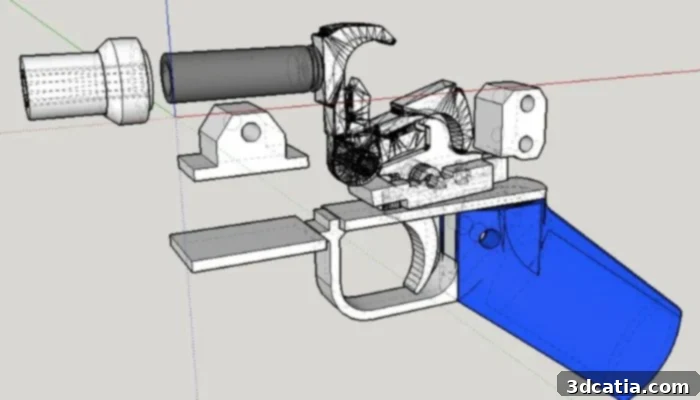
A 3D printable blueprint of a test gun created by American gunsmith Michael Crumling. (Photo credits: Michael Crumling)
The Broader Implications: Public Safety, Innovation, and the Future of Regulation
The UK government’s bold move to regulate digital files for 3D printed weapons carries substantial broader implications, touching upon public safety, technological innovation, and the very future of how additive manufacturing is perceived and controlled. From a public safety perspective, this legislation is designed to mitigate the growing risk posed by untraceable, homemade firearms. Success in criminalizing these digital blueprints could significantly hamper criminals’ ability to acquire weapons outside conventional channels, potentially reducing gun violence and enhancing the security of communities across the UK. It sends a clear message that the digital realm is not a lawless frontier and that those who facilitate serious crime through digital means will face legal consequences. This proactive approach seeks to stay ahead of criminal ingenuity, preventing the widespread proliferation of easily manufactured illicit firearms before they become an even greater societal problem.
However, the legislation also presents a delicate balancing act for the vibrant 3D printing and open-source communities. While the intent is to target malicious use, there are concerns that overly broad regulations could inadvertently stifle legitimate innovation, research, and educational activities within the additive manufacturing sector. Many 3D printing enthusiasts and developers champion the open-source ethos, believing in the free exchange of digital designs for positive purposes. Distinguishing between benign and malign files, and ensuring that legitimate users are not unduly impacted, will be a critical challenge in the implementation of these laws. The UK government must carefully define the scope of ‘articles for use in serious crime’ to avoid unintended consequences and maintain a supportive environment for responsible technological advancement. The consultation process aims to gather these diverse perspectives, ensuring that the final legislation is both effective in combating crime and proportionate in its impact on the wider 3D printing ecosystem.
Moreover, this initiative places the UK at the forefront of an international effort to define the boundaries of digital ownership and responsibility in the context of potentially dangerous technologies. The ramifications could extend far beyond the UK’s borders, influencing regulatory frameworks in other countries grappling with similar issues. It highlights the ongoing cat-and-mouse game between technological advancement and legal oversight. As 3D printing technology continues to evolve, becoming faster, more precise, and capable of handling a wider range of materials, the need for agile and forward-thinking legislation becomes paramount. The outcome of this consultation and the subsequent legislative actions will not only shape the future of firearm control in the UK but will also contribute significantly to the global discourse on how societies manage emerging technologies that possess dual-use capabilities – technologies that can be harnessed for immense good, but also exploited for serious harm.
You can find the full proposal on the UK government website HERE. What are your thoughts on this significant proposal to make 3D printing files for guns illegal in the UK? We encourage you to share your perspective in a comment below or join the conversation on our LinkedIn, Facebook, and Twitter pages! Don’t forget to sign up for our free weekly Newsletter here, ensuring you receive the latest 3D printing news directly to your inbox. You can also explore all our insightful videos on our YouTube channel.
*Cover photo credits: Metropolitan Police/PA Wire/BBC News).