

Revolutionizing Mental Healthcare: How AI and 3D Printing Transform Schizophrenia Diagnosis and Treatment
Artificial Intelligence (AI) has rapidly evolved from a subject of intense debate to an indispensable and incredibly powerful tool for humanity. Its integration into various sectors, particularly medicine, has been nothing short of transformative. In healthcare, AI is already making significant strides in areas such as precision disease diagnosis, the personalization of drug therapies, and enhancing medical imaging analysis, always under the crucial supervision of medical professionals. This advanced technology has paved the way for numerous successful disease diagnostics across diverse fields, including orthopedics and oncology. More recently, the innovative combination of AI with 3D printing technology is extending its reach into the complex domain of mental health, offering new hope for understanding and treating debilitating conditions like schizophrenia.
A groundbreaking recent study delved deep into the symbiotic relationship between AI and 3D printing, specifically investigating their potential to significantly aid in the treatment of challenging diseases such as schizophrenia. Schizophrenia, a severe chronic mental disorder, affects approximately 21 million people worldwide, according to data from the World Health Organization. This condition typically manifests during early adulthood, often between the ages of 18 for women and 25 for men, and is characterized by a range of symptoms including delusions, hallucinations, and significant cognitive impairments. Given the complexity and widespread impact of this illness, the potential for AI to assist medical practitioners is immense. AI could not only facilitate the early diagnosis of schizophrenia in high-risk individuals but also enable the creation of highly personalized treatment plans and medication regimens, moving beyond the traditional one-size-fits-all approach.

One of the most profound challenges associated with the diagnosis of schizophrenia lies in its highly heterogeneous symptomatology. Unlike many conditions in fields such as orthopedics or oncology, where objective biological indicators or clear imaging results often guide diagnosis, the manifestations of schizophrenia can vary dramatically from one patient to another. Furthermore, schizophrenia cannot be diagnosed through simple biological markers; instead, diagnosis relies predominantly on clinical symptoms established by standardized manuals such as the DSM (The Diagnostic and Statistical Manual of Mental Disorders) and the ICD (International Classification of Diseases). However, even these comprehensive guidelines are not always sufficient to recognize the less classical or subtle symptoms of the disease, leading to potential delays in diagnosis and treatment. This inherent variability and the reliance on subjective clinical assessment underscore the critical need for more objective and advanced diagnostic tools.
Leveraging AI for Enhanced Schizophrenia Treatment and Management
In light of these diagnostic complexities, AI presents an unprecedented opportunity for medical professionals to develop innovative methods for disease investigation and treatment. How does it achieve this? AI technology possesses an unparalleled ability to process and analyze vast quantities of extremely complex, multi-dimensional data – far beyond human cognitive capacity. This capability enables AI to identify subtle patterns and correlations in patient data that might otherwise go unnoticed, facilitating early diagnosis of schizophrenia in high-risk populations. Through the seamless integration of Machine Learning (ML) algorithms, AI can meticulously analyze data collected from patients, cross-referencing it with established clinical models. This process significantly limits human error that can arise from the manual calculation or interpretation of intricate data sets, leading to more accurate and reliable diagnostic predictions.
Beyond its data processing prowess, AI is characterized by its remarkable self-learning and self-optimization capabilities. This means that as AI systems are enriched with new patient data and clinical outcomes, they can continuously refine their algorithms, producing increasingly accurate predictions and insights. This iterative learning process makes AI an exceptionally useful tool for the diagnosis of diseases with highly heterogeneous symptomatology, such as schizophrenia. The more data AI processes, the better it becomes at recognizing the diverse ways the disease can manifest, leading to more precise and timely interventions. This adaptive nature of AI is crucial for conditions where a static diagnostic approach falls short.
Furthermore, AI’s analytical capabilities extend to detecting the onset of disease symptoms in patients through sophisticated analysis of their language and speech patterns. Schizophrenia can significantly impact a person’s language faculties, leading to observable changes in their tone of voice, elocution, coherence, and overall linguistic structure. AI algorithms, trained on vast datasets of speech, can identify these subtle yet critical shifts that might indicate the early stages or progression of the disease. Crucially, during the course of schizophrenia treatment, patients often experience co-occurring depressive symptoms. Unfortunately, these depressive episodes are frequently overlooked or not recognized early enough during the progression of the disease, leading to neglected antidepressant treatment. This oversight can profoundly impact patient quality of life and treatment adherence.
Thankfully, cutting-edge research has demonstrated the effectiveness of AI, especially when trained according to multimodal behavioral features and implemented with advanced Machine Learning techniques, in accurately distinguishing between healthy individuals, those suffering from schizophrenia, and patients experiencing major depressive disorder. Through meticulous language analysis, AI enables the early identification of subtle behavioral and linguistic changes in patients with schizophrenia. This early detection is paramount, allowing clinicians to intervene promptly with appropriate and personalized drug treatments, alongside other therapeutic strategies, thereby improving patient outcomes and mitigating the long-term impact of both schizophrenia and co-occurring depression.
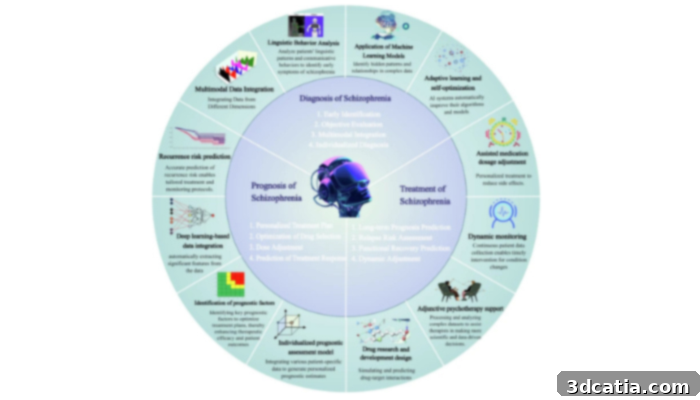
The diagram illustrates the application of AI for schizophrenia for diagnosis, treatment and prognosis
Finally, AI proves invaluable in the realm of creating highly personalized drug therapies. By intelligently collecting and analyzing comprehensive patient data – including genetic profiles, medical history, lifestyle factors, and previous treatment responses – and subsequently creating sophisticated clinical models, AI can make remarkably accurate predictions about individualized drug dosages for each patient. This moves beyond standard dosing protocols, accounting for the unique physiological characteristics of every individual. Furthermore, in addition to calculating precise dosages, AI technology can identify key biological and environmental factors that profoundly influence drug metabolism and response. This deep understanding allows clinicians to anticipate and comprehend how each patient will uniquely respond to a specific therapy, enabling them to fine-tune treatment strategies. As a direct result, AI is not only capable of developing bespoke drug therapies but also optimizing both drug selection and dosing, leading to more effective treatments with fewer side effects and improved overall patient well-being.
3D Printed Electronic Devices: Pushing the Boundaries of Neurological Research
In recent years, the convergence of AI with other advanced technologies, particularly 3D printing, has opened up entirely new avenues for experimenting with AI-enhanced approaches for the treatment of schizophrenia and other neuropsychiatric disorders. As highlighted in a significant recent research study, 3D printing was employed to fabricate an advanced electronic neural interface device. This device falls under the cutting-edge field of Brain-Computer Interfaces (BCI), which aims to establish a direct communication pathway between the brain and an external device. The 3D-printed neural interface was specifically designed to decode neurophysiological signals associated with brain activity in mice. Thanks to the precise customizability offered by 3D printing, this device was created as an implantable and biocompatible component, allowing for the accurate and continuous monitoring of the prefrontal cortex activity in the mice, a brain region critically implicated in cognitive functions and psychiatric disorders.
The primary objective of this pioneering research was to meticulously analyze the effects of various experimental therapies for neuropsychiatric disorders on neural activity. This advanced neural prosthetic interface was engineered not only to record brain activity but also to modulate it and classify specific electrophysiological biomarkers associated with these complex disorders. The compelling results of the research demonstrated that the 3D-printed prosthesis could effectively monitor and modulate brain activity in both healthy mice and those exhibiting neurological impairments. This remarkable capability offers a promising new tool, paving the way for the development of highly personalized treatment strategies for neuropsychiatric disorders, potentially revolutionizing how we approach these conditions in the future.
As extensively reported by various research initiatives, AI has, without a doubt, ushered in unprecedented possibilities for both the accurate diagnosis and effective treatment of schizophrenia. The sophisticated analytical power of AI offers insights that were previously unattainable. Still, it is crucial to acknowledge that the technology, in its current state, remains subject to certain limitations. For now, AI serves more as a powerful auxiliary tool for clinicians, enhancing their diagnostic capabilities and treatment planning, rather than acting as a true substitute for human medical expertise and judgment. The nuanced understanding of patient context, ethical considerations, and the human element of care remain irreplaceable.
Despite AI being “fueled” by continuous data collection and consequently becoming increasingly efficient, current AI-based applications still encounter shortcomings when it comes to the direct application of actual clinical therapies in real-world scenarios. The transition from algorithmic prediction to practical clinical implementation requires careful validation and integration. These difficulties are further amplified when dealing with complex medical data, such as that associated with schizophrenia, where diagnostic criteria and symptom presentation differ greatly from one individual to another. Moreover, a significant number of existing studies have predominantly focused on retrospective analyses, relying on historical data collected primarily for algorithm training and testing purposes. While invaluable for development, this approach doesn’t always fully replicate the dynamic and unpredictable nature of prospective clinical environments.
Nevertheless, despite the current challenges inherent in the widespread use of AI for schizophrenia treatment, the incredible speed with which this technology is evolving allows for optimistic speculation. It is highly probable that many of the existing problems and limitations will soon be addressed and overcome, leading to an even broader and more impactful implementation of AI in the treatment of various psychiatric illnesses. What is unequivocally certain is that the ongoing and intensifying human-computer interaction is bringing forth numerous groundbreaking innovations to the medical field. These advancements promise to revolutionize patient care and disease management, making them subjects truly worth investigating and embracing in the future. To delve deeper into how AI can further assist physicians in the intricate treatment of schizophrenia, please click HERE.
What are your thoughts on the groundbreaking use of AI and 3D printing for the treatment of Schizophrenia? We invite you to share your insights and opinions in a comment below or join the conversation on our LinkedIn, Facebook, and Twitter pages! Don’t forget to sign up for our free weekly Newsletter here to receive the latest 3D printing news straight to your inbox! You can also find all our compelling videos on our YouTube channel.
*All Photo Credits: Nature