
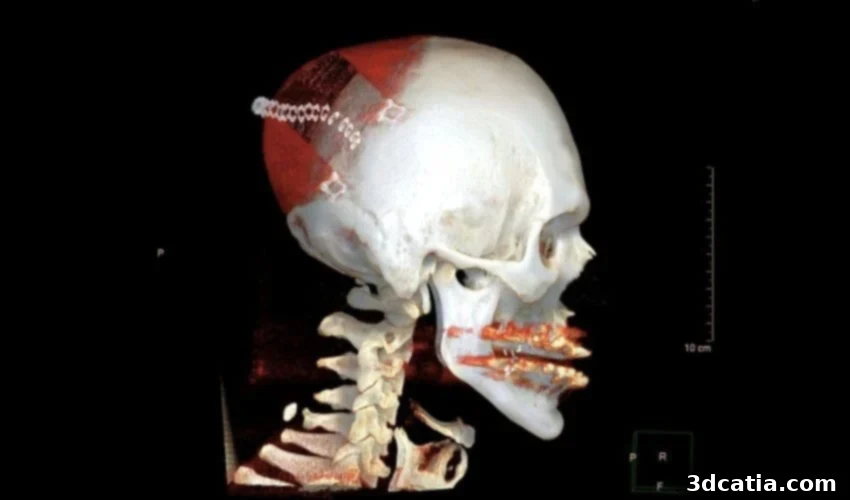
Revolutionizing Neurosurgery: The Impact of 3D-Printed Cranial Prostheses in Personalized Patient Care
The integration of additive manufacturing, commonly known as 3D printing, into the medical field marks a significant paradigm shift in how patient care is approached. This innovative technology is not merely a tool but a catalyst for profound improvements in treatment efficacy, surgical precision, and ultimately, a better quality of life for countless individuals. Its ability to create highly customized, complex geometries with unparalleled accuracy is transforming various medical disciplines, from dentistry and orthopedics to the intricate realm of neurosurgery.
A compelling testament to this transformative power comes from the University Hospital of Salzburg, Austria. In a groundbreaking and unprecedented operation in Europe, surgeons successfully implanted a state-of-the-art 3D-printed cranial prosthesis into a patient, showcasing the immense potential of personalized medicine. This milestone not only highlights the advanced capabilities of modern medical technology but also offers a beacon of hope for patients facing complex anatomical challenges.
Addressing Craniostenosis: A Patient’s Journey Towards a Normal Life
The recipient of this pioneering implant was a 55-year-old patient suffering from craniostenosis. This rare and debilitating condition, typically diagnosed in newborns, occurs when the bones of the skull fuse prematurely. While the condition primarily affects infants, leading to deformities as the rapidly growing brain tries to expand within a rigid skull, its long-term effects can persist and cause severe complications in adulthood. The fundamental issue isn’t abnormal bone growth itself, but rather the rapid expansion of the brain during the first year of life, which, when restricted, can lead to a host of serious health problems.
For individuals affected by craniostenosis, the consequences can be profound and life-altering. The restricted cranial volume can lead to increased intracranial pressure, a condition that, if left untreated, can result in significant neurological damage. This pressure can manifest as problems with vision, potentially leading to blindness, and cognitive impairments or mental disabilities. Beyond the physical and neurological challenges, the visible deformity of the skull can also cause considerable psychological stress and social discomfort for patients throughout their lives. In such high-stakes and complex surgical scenarios, where traditional solutions often fall short in achieving optimal anatomical fit and aesthetic outcomes, the precision and customization offered by 3D printing are proving to be invaluable.
Meticulous Planning and Advanced Surgical Techniques
The success of such a complex procedure hinges on meticulous planning and innovative surgical techniques. Professor Alexander Gaggl, the esteemed head of the University Clinic for Oral and Maxillofacial Surgery (MKG) at Salzburg University Hospital, elaborated on the strategic approach taken: “We planned from the outset to replace the missing occiput with a prosthesis. However, we noticed that the scalp is very taut and barely stretchable.” This observation presented a significant challenge, as a taut scalp would make it difficult to accommodate the new implant without excessive tension, risking complications, and compromising the aesthetic result.
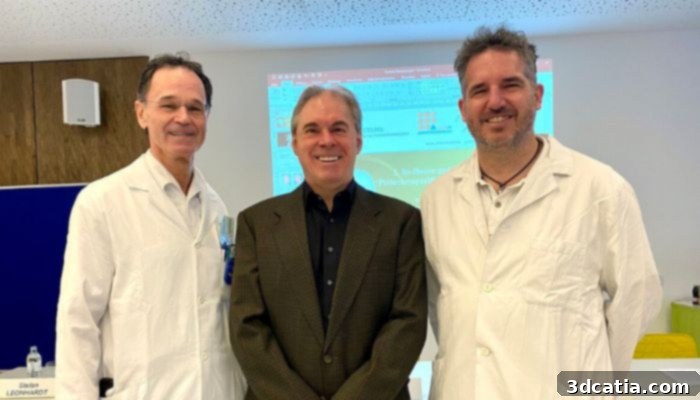
Mr. Trummer (center) had a 3D printed prosthesis implanted at the University Hospital of Salzburg
To overcome this obstacle, a clever and patient-centric solution was devised. One year prior to the definitive prosthesis transplantation, a plastic balloon was surgically implanted under the patient’s scalp. Over the course of the subsequent treatment period, a saline solution was gradually added to this balloon, allowing for a controlled and gentle expansion of the scalp tissue. This pre-surgical tissue expansion was crucial, preparing the area to comfortably accommodate the exact size and shape of the desired 3D-printed prosthesis. This innovative two-stage approach exemplifies the careful consideration and planning that characterize cutting-edge medical interventions, ensuring both functional and aesthetic success.
In-House Innovation: From CT Scans to Personalized Implants
The transplantation of this pioneering 3D-printed cranial prosthesis marked a significant first for the Salzburg clinic, underscoring their commitment to advancing medical technology and patient care. What makes this case even more remarkable is that the prosthesis itself was developed entirely in-house, showcasing the institution’s growing expertise and capabilities in medical additive manufacturing. This localized development process allows for greater control over design, materials, and quality assurance, crucial factors in medical implant fabrication.
Advanced Imaging and Design
The journey from patient anatomy to finished implant began with high-resolution computed tomography (CT) images. These detailed scans provided precise, slice-by-slice imaging of the different parts of the patient’s skull, allowing surgeons to visualize tissues of varying densities and identify the exact contours of the deformity. This rich anatomical data was then used as a template to create a highly accurate three-dimensional computer model of the missing occiput. Computer-aided design (CAD) software played a critical role in designing a patient-specific implant (PSI) that would perfectly conform to the unique anatomy of the patient’s skull, ensuring an optimal fit and integration.
State-of-the-Art 3D Printing Technology
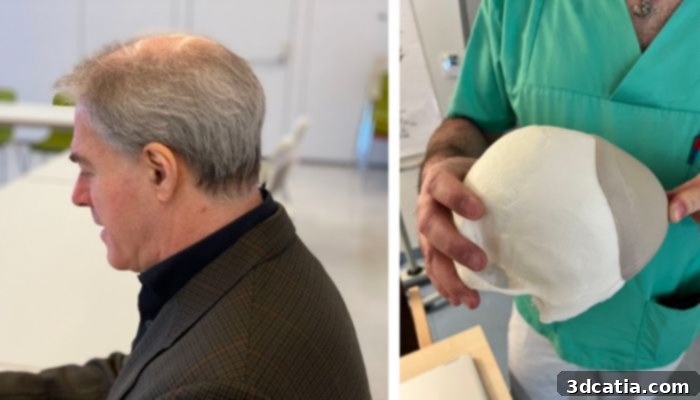
For the actual fabrication of the prosthesis, the Kumovis R1 3D printer was utilized. This particular machine was chosen for its advanced capabilities and, crucially, its ability to meet the stringent requirements of medical device manufacturing. The Kumovis R1 is specifically designed for industrial and medical applications, guaranteeing a sterile process—an absolute necessity for implantable devices. Its precision and reliability were key factors in transforming the digital design into a physical, biocompatible implant. The manufacturing process, from loading the digital model to producing the final implant, took approximately 10 hours, a remarkable turnaround time for a custom medical device.
The Material of Choice: PEEK
The selection of material is paramount for any medical implant. In this case, the prosthesis was printed with PEEK (Polyether Ether Ketone). PEEK is a high-performance thermoplastic polymer widely recognized and increasingly used in the medical industry due to its exceptional properties. It offers excellent biocompatibility, meaning it is well-tolerated by the human body and does not provoke adverse reactions. Furthermore, PEEK boasts an impressive strength-to-weight ratio, providing mechanical properties similar to cortical bone, which is ideal for cranial implants that need to withstand daily stresses. Its radiolucency allows for clear imaging of surrounding tissues post-implantation, and its sterilizability ensures patient safety. The durability and long-term stability of PEEK make it an optimal choice for permanent implants, contributing significantly to the success and longevity of the prosthesis.
A New Lease on Life: The Patient’s Perspective
The ultimate measure of success for any medical intervention lies in its impact on the patient’s well-being and quality of life. Six weeks after the operation, with the surgical wounds largely healed, the patient, Rainer Brummer, expressed profound satisfaction with the outcome. His words beautifully encapsulate the transformative power of this personalized surgical approach: “I don’t feel like I have an implant in my head, I feel like I have a completely ‘normal’ head now. This is the realization of a lifelong dream for me.”
This testimonial goes beyond mere physical recovery; it speaks to the deep psychological and emotional relief experienced by someone who has lived with a significant deformity. The feeling of having a “normal” head represents not just restored physical form but also renewed confidence, an end to self-consciousness, and the promise of a fuller, unburdened life. For individuals suffering from conditions like craniostenosis, the ability to restore normal cranial contours can dramatically improve their social interactions, self-esteem, and overall mental health, truly achieving a lifelong dream.
Salzburg University Hospital: A Pioneer in Medical Additive Manufacturing
The University Hospital of Salzburg has firmly established itself as one of Europe’s leading pioneers in integrating 3D printing technology into hospital settings for complex medical procedures. Their commitment extends beyond simply adopting new tools; it encompasses rigorous research, development, and adherence to the strictest regulatory frameworks governing medical implants. After a comprehensive and meticulously documented procedure, ensuring all national and international guidelines were followed, the clinic received the necessary authorization to independently print and transplant implants. This achievement underscores the hospital’s dedication to patient safety, ethical practices, and innovation, setting a benchmark for other medical institutions aspiring to leverage additive manufacturing.
The Future of Personalized Healthcare with 3D Printing
The success story from Salzburg is a powerful illustration of the future of personalized healthcare. Additive manufacturing’s ability to create patient-specific solutions is unlocking new possibilities across numerous medical specialties. From custom surgical guides that enhance precision during operations to anatomically accurate prosthetics and even bioprinted tissues for regenerative medicine, the applications are continuously expanding. This technology promises to reduce surgical times, minimize risks, improve recovery outcomes, and ultimately provide tailored treatments that were once unimaginable. As materials science advances and 3D printing technologies become more sophisticated and accessible, we can anticipate an even broader integration of these techniques into routine medical practice, truly enhancing the quality of life for patients worldwide.
We’d love to hear your thoughts on this remarkable 3D-printed cranial prosthesis and the advancements in medical additive manufacturing. Share your comments below or connect with us on our LinkedIn, Facebook, and Twitter pages! Don’t forget to sign up for our free weekly Newsletter here to get the latest 3D printing news delivered straight to your inbox! You can also find all our compelling videos on our YouTube channel, offering deeper insights into this revolutionary technology.
*All Photo Credits: Salzburg University Hospital