
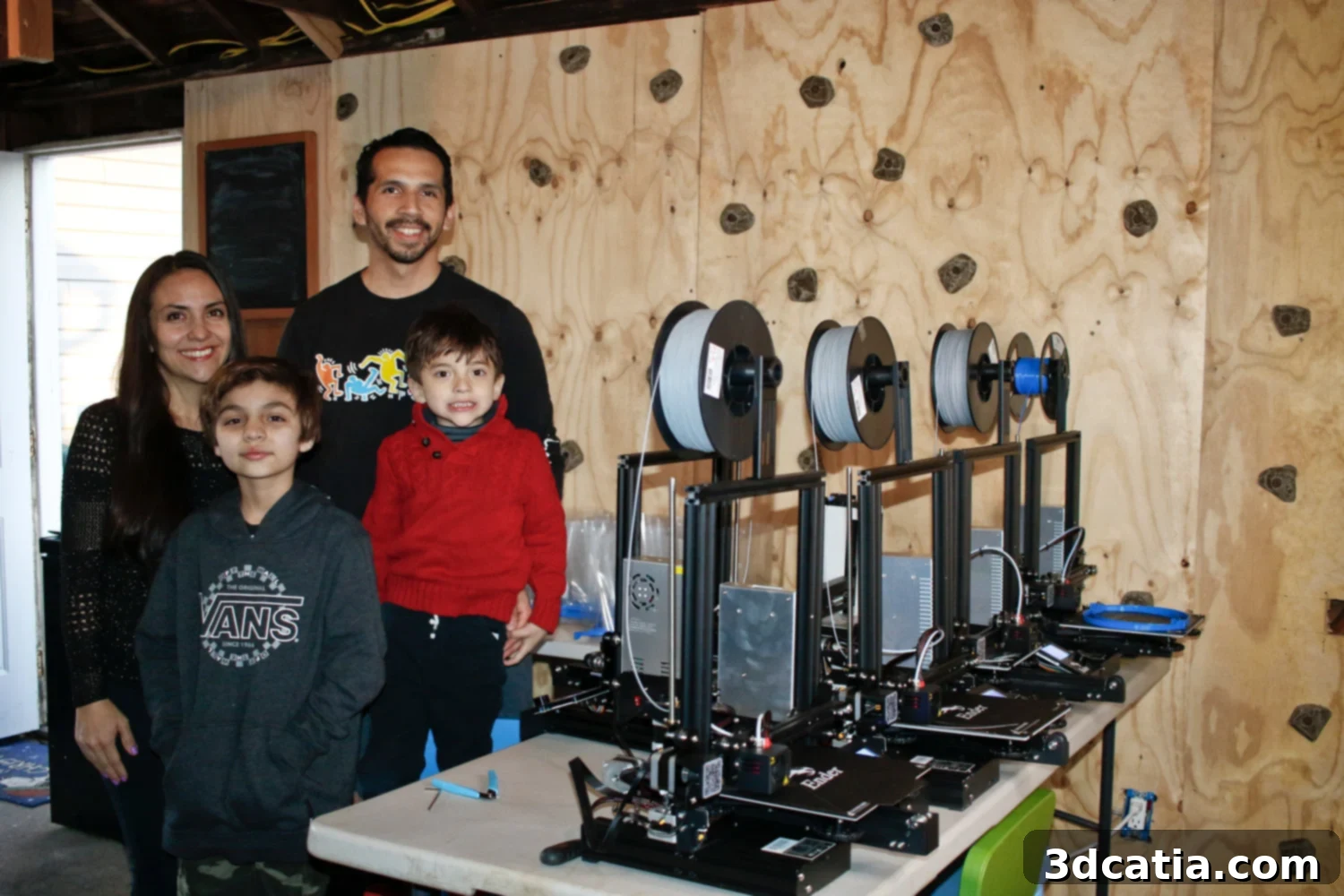
The Unsung Heroes: How the Global Maker Community Leveraged 3D Printing to Combat the COVID-19 PPE Shortage
The rapid global spread of COVID-19 swiftly transformed from an epidemic into an unprecedented pandemic, triggering a ripple effect of challenges across every sector. Among the most critical and immediate crises was the severe shortage of Personal Protective Equipment (PPE) in hospitals worldwide. Healthcare systems, even in the most developed nations, found themselves ill-equipped to meet the skyrocketing demand for essential protective gear. This critical vulnerability quickly became a harsh reality, leaving frontline healthcare workers exposed and communities anxious. In this climate of urgency and uncertainty, the 3D printing industry emerged as a pivotal player, demonstrating remarkable agility and innovative solutions. Over the past year, numerous additive manufacturing companies responded with exceptional innovations, rapidly retooling production lines to produce vital PPE. However, the response wasn’t limited to established corporations. A powerful, decentralized force arose from the grassroots maker community, which not only reacted with incredible speed but also mobilized on an epic scale, transforming homes, schools, and workplaces into makeshift PPE factories to protect those on the front lines.
The Global PPE Crisis: A Call to Action for Innovators
The initial shockwaves of the pandemic exposed deep flaws in global supply chains, particularly for essential medical supplies. Traditional manufacturing models, often reliant on just-in-time inventory and concentrated production in a few regions, proved inadequate for a crisis of this magnitude. As borders closed and demand surged exponentially, the global supply of PPE — including crucial items like N95 masks, face shields, gowns, and gloves — dwindled to critical levels. This “market failure,” as described by experts, meant that governments and large institutions struggled to procure sufficient supplies through conventional channels, leaving healthcare providers dangerously unprotected.
In the United States, for instance, a federal goal set in May 2020 aimed to acquire 300 million N95 masks for frontline workers. By mid-November of the same year, this ambitious target was less than halfway achieved, with only 142 million masks secured. The gravity of the situation was further underscored by a survey from National Nurses United, the largest union of registered nurses in the U.S., which revealed in late November that a mere 16% of hospital nurses reported having universal PPE available in their emergency departments. Alarmingly, by November, roughly 70% of facilities had run out of one or more types of PPE for the third consecutive month. These stark statistics painted a grim picture: the global supply shortage was worsening, not improving, and traditional methods were failing. Ali Raja, an emergency-room doctor and co-founder of Get Us PPE—a leading nonprofit dedicated to distributing donated PPE—lamented the “astounding disconnect between what’s purported to be in the stockpile and the needs on the front-line.” This dire situation underscored the urgent need for alternative, agile manufacturing solutions, and the maker community stepped up to fill that void.
The Maker Movement’s Unprecedented Mobilization
The response from the global maker community was nothing short of extraordinary. Fuelled by a spirit of innovation and civic responsibility, volunteer makers banded together to form a powerful, distributed manufacturing network. A landmark report compiled by Open Source Medical Supplies (OSMS) and Nation Of Makers (NOM) vividly captured the scale of this effort. It documented over 42,000 citizen responders and 1,869 local response groups spanning 86 countries. Collectively, these volunteers delivered an astounding 48.3 million units of medical supplies, valued at over $270 million, directly to those in need. Crucially, 32.4% of these vital supplies were produced using 3D printing technology, highlighting the transformative power of additive manufacturing in crisis response.
This massive mobilization was significantly enabled by the efforts of several non-profit organizations. These groups played a critical role in developing streamlined methods to connect individual makers, providing them with vetted designs and clear instructions for producing medical-grade PPE. OSMS, for example, rapidly established an extensive open-source design library and comprehensive guidance to help local groups effectively organize their fabrication and distribution efforts. Their aim was to meet the hyper-local demand for COVID-19 supplies, ensuring that designs were not only practical but also medically reviewed to minimize infection risks. This rigorous approach allowed volunteer makers to optimize their PPE production, ensuring that safety and efficacy remained paramount even in an emergency. You can explore their invaluable design library here, a testament to collaborative ingenuity.
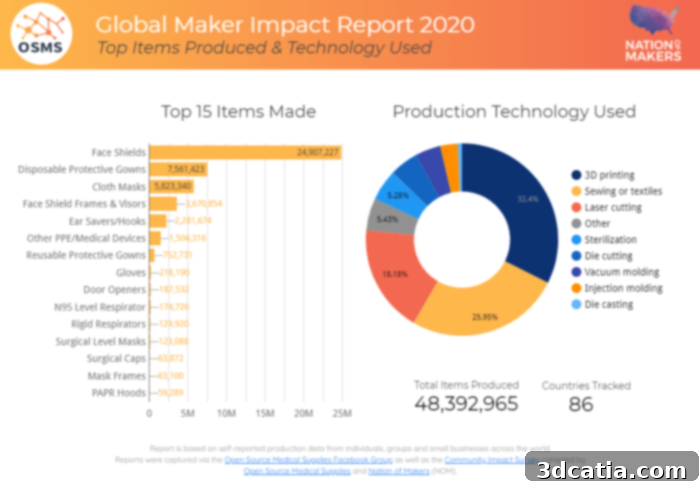
Global Maker Impact Report 2020 (Credit: Open Source Medical Supplies & Nation of Makers)
Pivotal Maker Community Initiatives and Collaborative Networks
The maker community’s ingenuity extended beyond individual production to the creation of robust networks designed to facilitate widespread collaboration and distribution. Platforms like #FindTheMakers and Get Us PPE rapidly developed interactive maps, cataloging over 895 volunteer groups globally, with 237 specifically utilizing 3D printing technology. These platforms simplified the process for individual makers to locate nearby volunteer opportunities, fostering a sense of collective purpose and efficiency. You can discover your closest volunteer makers group here, and see the power of localized action.
Get Us PPE, a non-profit established at the very outset of the pandemic, played a dual role: it not only helped makers manufacture PPE but also ensured these critical supplies reached the frontline workers who needed them most. Their logistical framework was instrumental in bridging the gap between distributed production and centralized distribution points. Another outstanding example is the C19 Coalition, which boasts an incredible track record, having delivered over one billion units of PPE to frontline workers since March 2020. The C19 Coalition exemplifies the power of crucial partnerships, uniting state governments, corporations, manufacturers, non-profits, and individuals to build an efficient, unified supply chain for PPE and life-saving medical devices. Their success was a collaborative effort, achieved in partnership with organizations like Get Us PPE, and even well-known 3D printing companies such as HP and FormLabs, demonstrating that even industry giants recognized and supported the vital role of the maker movement.
3D Printing: A Game-Changer for Rapid Response
Recognizing the immense potential of the maker community to directly combat the PPE shortage, several leading 3D printing companies themselves stepped forward. Manufacturers like FormLabs, Prusa, and NanoHack proactively shared open-source STL files and detailed instructions for printing various types of PPE, most notably face shields. This act of open-source collaboration democratized access to manufacturing, empowering anyone with a consumer-grade 3D printer to contribute to the cause. A research report published earlier in the week, “Review on 3D printing: Fight against COVID-19,” specifically highlighted how the widespread availability of these files enabled individuals to produce hundreds of face shields within a single week. The accessibility and effectiveness of this approach were vividly demonstrated by a 9-year-old boy who, when schools first shut down, began 3D printing masks for local frontline workers, illustrating that impact knows no age limit. You can watch his inspiring story in the video below:
The Enduring Impact and Lessons Learned
The profound gratitude for the maker community’s efforts resonated deeply within the healthcare sector. David Rainosek, MD, Associate Medical Director of St. Vincent Rehabilitation Hospital in Arkansas, eloquently summarized the sentiment of countless healthcare professionals: “It meant the world and literally, in some cases, probably our lives to have this equipment and protective equipment produced and distributed by this army of volunteers. And…I don’t know that we can ever say thank you enough.” This powerful testimonial underscores the tangible impact of these volunteer initiatives, which filled critical gaps in the conventional supply chain and, in many instances, provided the only available protection for those battling the virus firsthand.
The COVID-19 pandemic served as a stark reminder of the vulnerabilities inherent in globalized, centralized supply chains. However, it also catalyzed a remarkable demonstration of resilience and innovation from the maker community. The rapid, decentralized response of makers utilizing 3D printing offered invaluable lessons for future crises. It highlighted the potential for localized, agile manufacturing to supplement, and even in some cases, replace traditional production methods during emergencies. The open-source ethos, combined with accessible technology, created a powerful model for rapid prototyping, on-demand production, and community-driven problem-solving. This era cemented the maker movement’s place not just as hobbyists or innovators, but as a critical component of national and global resilience, capable of rapidly deploying solutions when conventional systems falter. The networks forged, the designs created, and the spirit of collaboration demonstrated during this crisis continue to serve as a blueprint for how communities can leverage technology to overcome seemingly insurmountable challenges.
What are your thoughts on the incredible response of the maker community to the pandemic? How do you envision the future role of 3D printing and decentralized manufacturing in crisis response? Share your insights and comments below or engage with us on our Facebook and Twitter pages! Don’t miss out on the latest 3D printing news – sign up for our free weekly Newsletter here, delivered straight to your inbox!