
Rapid Deployment Drones: How 3D Printing is Revolutionizing Military Logistics and Battlefield Aid
In the unpredictable and often perilous environments of combat zones, the swift and secure delivery of vital aid and supplies remains a formidable challenge. Traditional logistical methods are frequently too slow, too visible, or too dangerous, putting both personnel and crucial resources at significant risk. This inherent difficulty often leads to critical delays, potentially resulting in severe injuries and even fatalities for those awaiting assistance. However, a groundbreaking initiative by U.S. Air Forces Central engineers, in collaboration with leading innovation partners, is set to transform this landscape. They believe they have discovered a lifesaving solution embedded within the capabilities of additive manufacturing technology – a game-changer for military operations.
This pioneering effort has culminated in the unveiling of a revolutionary unmanned aerial system (UAS). Developed through a powerful collaboration between Task Force-99, the Air Force’s forward-thinking Blue Horizon program, and California-based aerospace innovator Titan Dynamics, this new system promises to redefine the benchmarks for speed and efficiency in drone deployment. By harnessing state-of-the-art software that can design and 3D print complete airframes within mere hours—a drastic reduction from the typical days or even weeks—the project aims to fundamentally alter drone manufacturing and distribution for allied forces across the globe. This rapid, on-demand capability is not just about speed; it’s about drastically reducing the inherent risks associated with aerial support missions on the battlefield, providing timely aid and intelligence where and when it’s most needed.
The Vision: Instant Design, Immediate Deployment
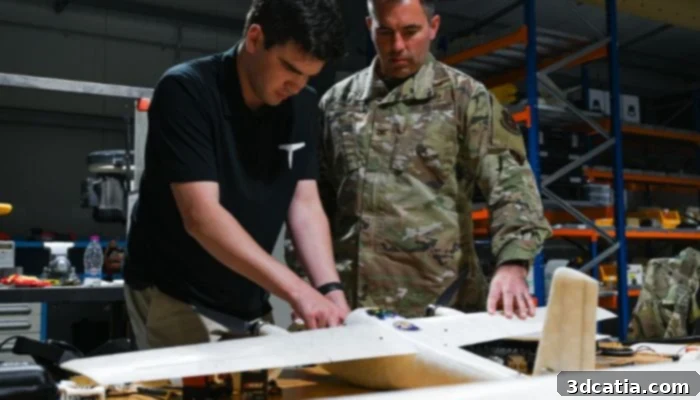
The ambitious goals of this project, known as Project Black Phoenix, were articulated by Col. Dustin Thomas, a distinguished Fellow with Blue Horizons and a pivotal member of the team. He emphasized the core objective: “The goal of our project was to be able to quickly design a fixed wing small UAS within minutes, build it within hours, be able to employ it in the same day, and do that in the field right at the point of need.” This vision represents a profound shift from traditional drone procurement and deployment models, moving towards a highly agile, responsive, and localized manufacturing process. Imagine a scenario where a specific mission requirement emerges, and within the span of a single operational cycle, a bespoke drone can be conceptualized, fabricated, and launched directly from the front lines.
The seeds of this revolutionary innovation were sown in early February of this year. It was then that TF-99, Blue Horizons, and Titan Dynamics converged their expertise on a project that, under conventional engineering paradigms, would have typically consumed a full week of intensive development and design efforts. However, by seamlessly integrating Titan Dynamics’ advanced 3D printing software into their workflow, they achieved a remarkable feat: reducing that extensive timeframe to a mere matter of minutes. This dramatic acceleration underscores the transformative power of intelligent software coupled with additive manufacturing, paving the way for unprecedented agility in military technology development.
Unlocking Unprecedented Efficiency: Cost and Speed Advantages
Beyond sheer speed, additive manufacturing has empowered Task Force-99 to achieve staggering reductions in production costs, slashing them by up to an astonishing 95%. This monumental cost-saving is primarily attributed to the strategic employment of lightweight, highly cost-effective synthetic plastic materials. By opting for these innovative materials, the project bypasses the substantial expenses traditionally associated with sourcing, machining, and assembling conventional metal and carbon fiber components. This shift not only democratizes access to advanced drone technology but also fundamentally alters the economic landscape of military drone development, paving the way for a more economical, sustainable, and widely deployable future in defense technology. The ability to produce mission-specific drones at such a low cost means that forces can afford to deploy them more freely for a wider array of tasks, without the hesitation often imposed by high unit costs.
While still in its alpha development phase, the proprietary software at the heart of this project already exhibits impressive versatility and user-friendliness. The operational simplicity is a key factor in its battlefield utility: users are required to input only their specific mission needs – parameters such as desired payload weight, overall drone size, operational range, and target speed. With these inputs, the sophisticated software rapidly designs a small airframe that is perfectly tailored to the precise requirements of that particular mission. This bespoke design capability, coupled with on-demand 3D printing at the push of a button, drastically minimizes lead times, a critical advantage in high-stakes environments where every second counts. Lt. Col. Peter Dyrud, another insightful Fellow with Blue Horizons, underscored the system’s unparalleled adaptability, explaining, “We are creating a system that adapts aircraft to the effect you want to employ. We want to provide a system that puts in the warfighters’ hands the ability to create and really do something unique and specific to their mission.” This level of customization means that forces are no longer limited by off-the-shelf drone capabilities but can innovate and adapt in real-time to evolving threats and opportunities.

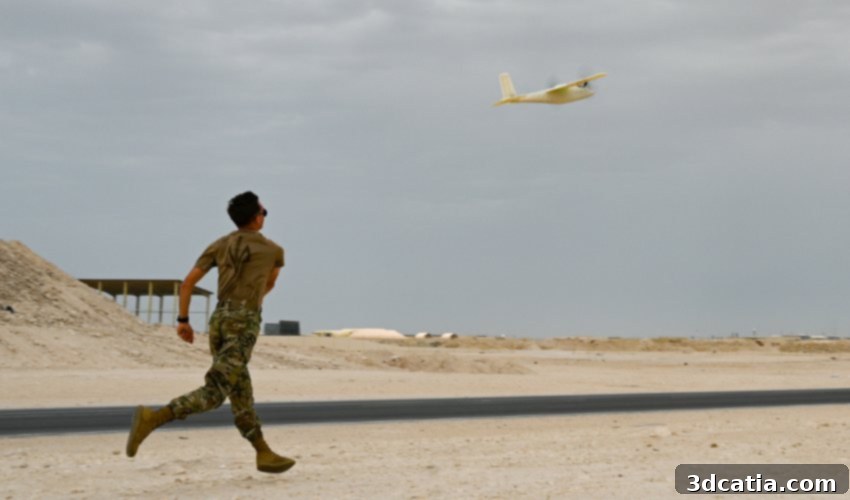
Operation of the 3D printed UAS.
Proving Grounds: Successful Field Tests and Real-World Impact
The efficacy and agility of this new additive manufacturing approach were quickly demonstrated in a series of rigorous field assessments. Following an initial flight assessment, Task Force-99 moved swiftly to test a second UAS. This particular drone was specifically customized to meet an entirely different set of mission parameters, and remarkably, it was ready for deployment in under 48 hours. This rapid iteration and customization capability highlights the disruptive potential of the technology. During its mission, the drone successfully delivered a simulated first-aid package over an impressive distance of more than 30 miles to its designated destination. This successful delivery showcased not only the mechanical reliability of the 3D printed airframe but also the agility and efficacy of rapid customization and deployment strategies made possible through on-demand 3D printing. Such a capability can be instrumental in reaching injured personnel in remote or dangerous locations, minimizing exposure for ground crews, and delivering critical supplies precisely when they are most needed.
Transforming Military Operations Beyond Aid Delivery
The implications of this innovative approach extend far beyond the direct delivery of medical supplies. While its potential to support hard-to-reach, injured service members is profoundly significant and could save countless lives, this innovation is poised to fundamentally alter the broader landscape of ground and aerial warfare. Its applications are not confined to immediate combat scenarios but can significantly enhance military operations as a whole, ushering in an era of unprecedented adaptability and responsiveness. Task Force-99 has already expressed clear intentions to leverage this versatile software for a diverse array of military applications. These range from crucial intelligence gathering and surveillance missions, providing real-time situational awareness, to establishing robust communication relays in contested environments where traditional networks may be compromised. Furthermore, the capacity for on-demand drone production could support logistics, reconnaissance, target spotting, and even act as decoys, offering tactical flexibility that was previously unimaginable.
This ability to rapidly design, produce, and deploy mission-specific unmanned aerial systems fundamentally changes the strategic calculus for military planners. It reduces dependence on complex, often vulnerable, global supply chains for drone parts and platforms. Instead, it fosters self-sufficiency and immediate response capabilities at the tactical edge. Forces can adapt to new threats and operational requirements almost instantaneously, prototyping and iterating solutions directly in the field. This empowers warfighters with bespoke tools tailored to the unique challenges of their mission, enhancing effectiveness and reducing risks. The future of military logistics and tactical deployment is being reshaped by the fusion of additive manufacturing and advanced software, leading to smarter, safer, and more efficient operations globally. To learn more about this groundbreaking project and its future trajectory, click here.
What do you think of this pioneering project by Task Force-99? We invite you to share your thoughts and insights with us! Let us know in a comment below or join the conversation on our LinkedIn, Facebook, and Twitter pages! For those eager to stay abreast of the latest developments and innovations in the rapidly evolving world of 3D printing, don’t forget to sign up for our free weekly newsletter here for news delivered straight to your inbox! You can also find all our engaging videos and in-depth analyses on our dedicated YouTube channel.
*All Photo Credits: United States Air Forces Central