
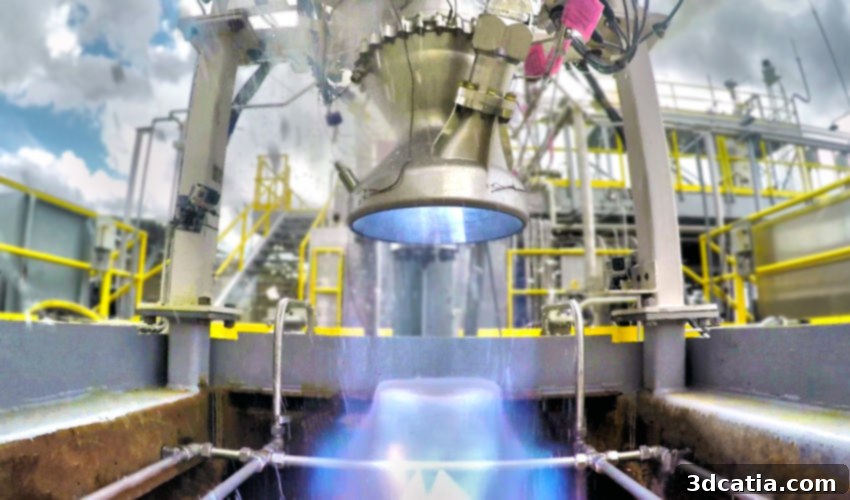
Relativity Space: Pioneering the Future of Rocket Manufacturing with Advanced 3D Printing
Additive manufacturing is rapidly transcending terrestrial boundaries, pushing the limits of innovation and venturing into the cosmos. A prime example of this revolutionary shift is Relativity Space, an American startup that has developed a groundbreaking 3D printing method to fabricate entire rockets. These innovative vehicles are poised to launch within a few years, fundamentally transforming space exploration and accessibility.
At the heart of Relativity’s process lies “Stargate,” their proprietary robotic 3D printing technology. Stargate promises to manufacture a complex rocket in an astonishing 60 days, significantly reducing costs and accelerating production timelines compared to conventional manufacturing techniques. Tim Ellis, co-founder and CEO of Relativity Space, is a staunch advocate for 3D printing, firmly believing it represents the future of aerospace manufacturing. We had the opportunity to speak with him to delve deeper into his vision, the company’s ambitions, and the cutting-edge technology that underpins their audacious goals.
The Genesis of Relativity Space: A Vision for Automated Rocket Production
“My name is Tim Ellis, and I am the co-founder and CEO of Relativity. Our mission at Relativity is to forge an entirely new paradigm for building and flying rockets,” Ellis began. He elaborated on his journey leading up to Relativity: “Before establishing Relativity, I served as a propulsion development engineer at Blue Origin, Jeff Bezos’s space company. There, we frequently operated under incredibly demanding deadlines to complete projects. To meet these stringent timelines, I initiated the use of metal 3D printing for the first parts at Blue Origin, a decision that proved incredibly successful.”
Witnessing the undeniable efficiency and success of these early 3D printed components, Ellis quickly recognized the broader potential of this technology. “After seeing their success, I developed a comprehensive business case and roadmap to establish a dedicated metal 3D printing division within Blue Origin. I then pitched this vision to senior management and Jeff Bezos himself, advocating for its full implementation,” he recounted. This experience was pivotal. “Observing just how much faster and more cost-effective this process was, my co-founder, Jordan Noone (formerly of SpaceX), and I began to ponder a more ambitious question: Why limit this technology to just a few parts when we could apply it to an entire rocket?” This profound realization sparked the initial idea to found Relativity Space. The company quickly gained momentum, securing early funding from prominent investors like Y Combinator and Mark Cuban, and has since raised over $10 million to realize their ambitious goal of automating rocket production through robotic 3D printing of complete rockets.

Tim Ellis, co-founder and CEO at Relativity Space.
Unveiling Relativity’s Revolutionary Rocket Manufacturing Process: Stargate
Ellis detailed Relativity’s innovative approach to rocket manufacturing, emphasizing the transformative role of metal 3D printing. “We utilize metal 3D printing for over 95% of the components that comprise our rockets,” he explained. This extensive application of additive manufacturing dramatically streamlines the production process. “This significantly reduces the total number of individual parts required, plummeting from approximately 100,000 in traditional rocket manufacturing to a mere 1,000 with our new method. This simplification extends beyond just assembly, profoundly impacting design complexity, analytical processes, supply chain management, and rigorous testing protocols. Fewer parts mean fewer interfaces, fewer potential points of failure, and a much more agile design and manufacturing cycle.”
To address the unique challenge of fabricating incredibly large structures integral to rockets, such as massive fuel tanks and airframes, Relativity engineered its own groundbreaking technology. “To achieve very large structures like rocket tanks and airframes, we invented our own advanced robotic 3D printing technology, which we aptly named Stargate,” Ellis proudly stated. Stargate is distinguished as the largest metal 3D printer in the world, capable of building structures of unprecedented scale. “It employs sophisticated robotic arms coupled with our proprietary print head, advanced sensors, custom software, and specialized alloys to precisely deposit high-strength aluminum, forming the robust backbone of our rocket structures. For smaller, more intricately detailed parts, we integrate components produced using powder-bed metal 3D printers, adding them to this larger, 3D printed framework.” This hybrid approach leverages the strengths of different additive manufacturing techniques to optimize for both scale and detail.
This innovative methodology represents a highly scalable and exceptionally fast manufacturing approach for what is traditionally an incredibly complex aerospace product. Ellis highlighted the profound implications: “Once fully developed and optimized, our streamlined process will enable us to build a complete rocket, conduct all necessary testing, integrate a satellite payload, and launch it into orbit – transitioning from raw material to flight readiness – all within an astonishing timeframe of under 60 days. This accelerated production cycle promises to revolutionize launch frequency and significantly lower the barriers to space access.”
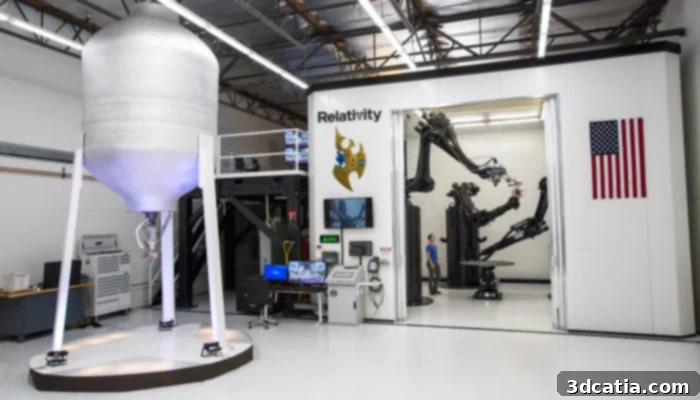
The Stargate 3D printer, claimed to be the largest metal 3D printer in the world.
Relativity’s Grand Vision: 3D Printing the First Rocket on Mars
Relativity Space harbors an ambitious long-term objective that extends far beyond Earth’s orbit. “Relativity’s long-term goal is nothing less than to scale and sustain an interplanetary society,” Ellis revealed. “This ambitious vision includes the ultimate goal of 3D printing the very first rocket directly on Mars.” He acknowledged the inspiration drawn from other pioneers in space: “We were deeply inspired by SpaceX’s admirable goal of sending humans to Mars for permanent settlement. However, we firmly believe that achieving this grand vision will require the contributions of dozens, if not hundreds, of other companies. These enterprises will need to focus on developing the foundational technologies essential for building housing, establishing industry, fostering an economy, developing transportation systems, and ultimately, creating rockets capable of launching payloads back to Earth from Martian soil.”
Ellis emphasized Relativity’s unique position in this emerging interplanetary ecosystem: “To date, very few companies beyond SpaceX have been founded with the core mission of settling Mars. We see a tremendous opportunity to contribute significantly to making this future a reality by providing critical manufacturing capabilities.” He elaborated on the practicalities of Martian manufacturing: “It turns out that what is most critically needed to produce a wide range of products on Mars, utilizing local materials, is a small, lightweight, flexible, intelligent, and highly automated factory. Such a factory would need to be compact enough to be launched efficiently from Earth aboard a rocket.”
The solution, Ellis believes, is inherent in their current technology. “We are convinced that this ideal Martian factory happens to bear a striking resemblance to a 3D printer,” he asserted. “Thus, our near-term business plan – focused on more affordably and quickly launching satellites with our 3D printed rockets from Earth – is perfectly aligned and reasonably on path to the same monumental goal of printing rockets made directly on Mars. This strategy allows us to perfect the technology here, laying the groundwork for its eventual deployment in an extraterrestrial environment, leveraging in-situ resources to enable true space colonization.”
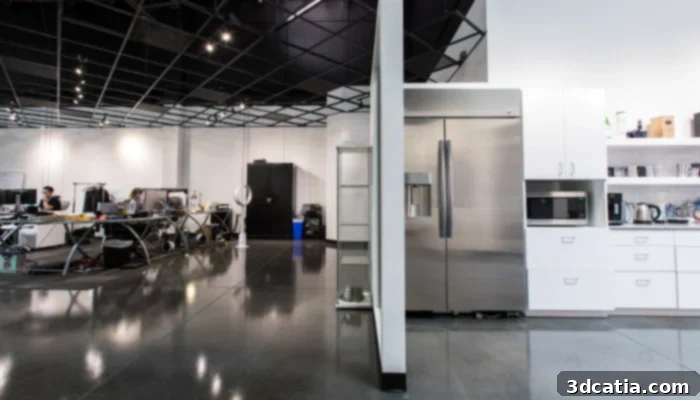
The Relativity Space offices.
Strategic Partnerships and Collaborations in the Space Sector
Relativity Space is not operating in isolation but is actively forging vital alliances within the dynamic space sector. “We are experiencing significant customer contract interest for launching various satellites to orbit,” Ellis confirmed, indicating a robust demand for their cost-effective and rapid launch services. This commercial interest underscores the market’s recognition of 3D printing’s advantages in space access.
Beyond commercial ventures, Relativity has also secured a crucial strategic partnership with NASA. “We also maintain a valuable partnership with NASA, which is instrumental for testing our 3D printed rocket engines, large tank structures, and complete rocket vehicles,” Ellis explained. This collaboration provides an invaluable resource: “This partnership grants us access to existing, state-of-the-art test facilities and extensive infrastructure owned and maintained by NASA. This arrangement offers immense benefits, saving us both considerable time and significant financial resources by negating the need for us to construct and maintain our own elaborate testing facilities. It accelerates our development cycle and allows us to focus our capital and engineering efforts on refining our additive manufacturing processes and rocket designs.” This symbiosis between a nimble startup and an established space agency creates a powerful synergy for advancing the state of the art in aerospace manufacturing.
Relativity Space’s Future Trajectory: Towards Orbital Flight and Beyond
Looking ahead, Ellis outlined the company’s immediate and strategic objectives. “This year, our primary focus is to seamlessly integrate our engine development efforts with the fabrication of the large, 3D printed structures produced by Stargate,” he stated. This critical integration phase is a major step towards realizing their ambitious goals. “This integration brings us considerably closer to our overarching goal of achieving orbital flight by 2021,” Ellis noted, highlighting the aggressive timeline the company was working towards at the time of the interview. “Successfully demonstrating this integration will serve as undeniable proof that we have developed robust 3D printing technologies capable of working in concert to create a highly complex and functional aerospace product.”
Beyond these technical milestones, Relativity Space was also anticipating significant corporate growth. “We have a lot more exciting news to announce this year as well, including substantial growth initiatives that we are incredibly enthusiastic about,” Ellis concluded, hinting at expansions in capabilities, team size, and perhaps new strategic partnerships or funding rounds that would further accelerate their mission to redefine rocket manufacturing.
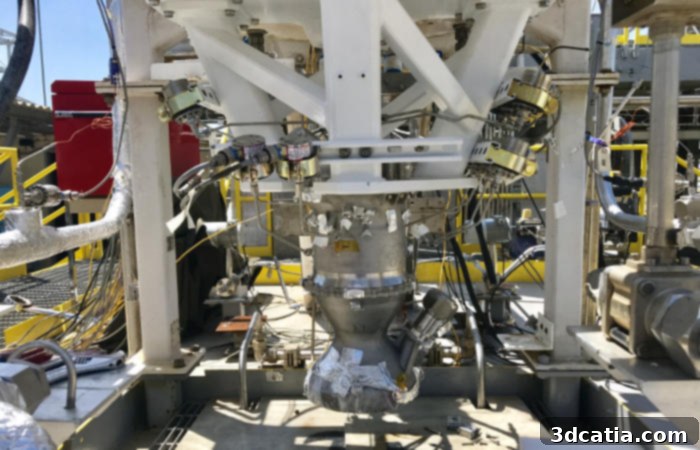
Relativity Space use NASA test facilities to save money compared to building their own.
Why 3D Printing is the Undisputed Future of Aerospace Manufacturing
In his concluding remarks, Tim Ellis powerfully articulated why he believes 3D printing is not just an alternative, but the fundamental future of manufacturing in the aerospace industry. “We are absolutely convinced that 3D printing is the future of manufacturing in aerospace,” he asserted. His reasoning lies in a unique economic and physical alignment: “Because 3D printed products are built up layer by layer from nothing, they inherently print faster and are more cost-effective the lighter-weight they are. This represents a fundamental alignment of physics and economics that simply does not exist with traditional, subtractive manufacturing methods.”
He elaborated on this critical distinction: “Traditionally, manufacturing aerospace components often involves starting with a large block of metal and meticulously sculpting away material through machining processes. This subtractive method means that it takes longer and costs significantly more to achieve a very thin, highly optimized, and lightweight component – which are precisely the characteristics most desired in aerospace applications. The more material you remove to achieve lightness, the more expensive and time-consuming the process becomes.”
In contrast, additive manufacturing excels at creating complex geometries and lattice structures that optimize for strength-to-weight ratios without incurring additional cost penalties. “Thus, we believe that 3D printing is fundamentally superior and offers unparalleled advantages for anything that flies,” Ellis concluded. This paradigm shift not only promises lighter, stronger, and more efficient rockets but also enables rapid iteration, reduced waste, and unprecedented design freedom, all critical factors for advancing humanity’s reach into space.
To discover more about Relativity Space and their groundbreaking work, we encourage you to visit their official website here.
What are your thoughts on Relativity Space’s innovative approach to rocket manufacturing and their ambitious plans for space exploration? We invite you to share your insights in a comment below or join the conversation on our Facebook and Twitter pages! Don’t forget to sign up for our free weekly Newsletter to receive all the latest news and developments in 3D printing directly to your inbox!