
Top 5 3D Printing Innovations: Revolutionizing Industries from Sustainable Tires to Life-Saving Medical Devices
Welcome to this week’s exciting roundup of the most captivating developments in the world of 3D printing! Additive manufacturing continues to push the boundaries of what’s possible, impacting an incredibly diverse range of sectors. From groundbreaking environmental solutions in automotive design to life-saving advancements in medical technology, and from enhancing industrial efficiency to gaining crucial competitive edges in high-performance racing, 3D printing is at the forefront of innovation. This edition of our Top 5 Videos showcases incredible ingenuity, demonstrating the profound and versatile applications of this transformative technology. Prepare to be amazed as we delve into how 3D printing is not just improving existing processes but actively creating entirely new paradigms across various fields. Don’t forget that a fresh set of Top 5 Videos is published every Sunday, so make sure you’re back next week to catch the latest breakthroughs!
1 – Goodyear Oxygene: The Revolutionary 3D Printed Tire with Living Moss
Imagine a tire that doesn’t just transport you but also cleans the air as you drive. American tire manufacturing giant Goodyear has unveiled the extraordinary concept of the Oxygene tire, a partially 3D printed innovation designed with sustainability at its core. What makes this tire truly unique is its integrated living moss structure. This ingenious design allows the moss embedded within the tire’s sidewall to perform photosynthesis, actively absorbing carbon dioxide from the air and releasing oxygen. This process not only contributes to cleaner urban environments but also generates electricity. The energy produced through photosynthesis helps power the tire’s internal electronics, including integrated lights around the wheels, enhancing visibility and safety. The use of 3D printing in its construction enables the creation of a complex open structure that supports the moss’s growth while maintaining the tire’s structural integrity and performance. This visionary concept highlights how additive manufacturing can facilitate truly innovative, eco-friendly solutions, transforming conventional products into active contributors to a healthier planet and paving the way for a new era of sustainable mobility, especially in increasingly dense urban environments. The unique structure possible with 3D printing allows for both the delicate ecosystem of the moss and the robust demands of a tire to coexist seamlessly, showcasing the immense design freedom of this technology.
2 – Stratasys: Pioneering Industrial 3D Printing Across Key Sectors
Stratasys stands as a colossal figure in the 3D printing industry, boasting a rich history as one of the very first companies to enter the additive manufacturing market back in the late 1980s. With decades of experience, this American pioneer has consistently driven innovation, making significant strides with its FDM (Fused Deposition Modeling) and PolyJet technologies. Today, Stratasys leverages the power of industrial 3D printing to provide advanced solutions across an impressive array of critical industries, often in conjunction with sophisticated 3D design platforms. In sectors like space travel and aeronautics, their technology is instrumental in creating lightweight, complex components that are vital for rockets, satellites, and advanced aircraft, enabling faster prototyping and the production of flight-ready parts that meet rigorous performance and safety standards. For medical research, Stratasys 3D printers facilitate the creation of highly accurate anatomical models for surgical planning and education, as well as patient-specific surgical guides and custom prosthetic parts that improve patient outcomes. Beyond these, they also serve automotive, consumer goods, and educational sectors, offering unparalleled precision, material versatility, and the ability to produce functional prototypes and end-use parts with speed and cost-efficiency. Stratasys’s enduring legacy is defined by its commitment to pushing the boundaries of what’s achievable through additive manufacturing, empowering engineers and designers worldwide to transform ideas into tangible realities with industrial-grade reliability and performance.
3 – Bombyx Prod’s 10-Headed 3D Printer: A Leap in Scalable Manufacturing
In the quest for greater efficiency and throughput in additive manufacturing, Bombyx Prod has introduced a truly remarkable innovation: a new 3D printer featuring an incredible 10 independent print heads. This technological marvel represents a significant leap forward, allowing for the simultaneous creation of ten different parts, or ten sections of a single, larger component, all within the same build cycle. The primary benefit of such a multi-head system is a dramatic increase in production speed and efficiency, ushering in new possibilities for scalable manufacturing previously unattainable with single-head systems. For businesses, this translates to drastically reduced lead times, significantly higher volume capabilities for small to medium batch production, and ultimately, lower costs per part due to optimized machine utilization. Furthermore, this printer ingeniously addresses one of the common challenges in 3D printing – the size limitation of the build volume. By intelligently orchestrating multiple print heads, it enables the production of very large parts through a modular approach, where smaller, manageable sections are printed individually with precision and then seamlessly assembled. This not only expands the potential applications for additive manufacturing to items like architectural models, industrial tooling, custom furniture, or even large art installations but also optimizes material usage and logistical handling for oversized components, making large-scale 3D printing more accessible and practical than ever before. This innovation truly demonstrates how advanced engineering can unlock new levels of productivity and flexibility in additive manufacturing.
4 – 3D Printed Aortas: Advancing Personalized Cardiovascular Medicine
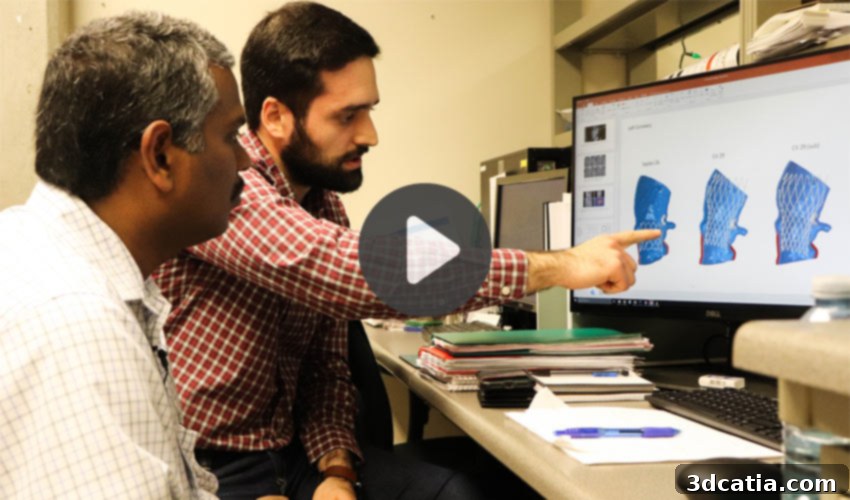
The realm of medical innovation continues to be profoundly impacted by 3D printing, and a compelling example comes from the Ohio State University, where a collaborative team of engineers and doctors has achieved a significant milestone in cardiovascular medicine. Their groundbreaking work involves the 3D printing of an aortic valve designed to connect to a patient’s heart. This multidisciplinary approach is crucial, combining engineering expertise in design and biocompatible materials with the intricate anatomical knowledge of medical professionals. The primary goal of this initiative is to create patient-specific models and, eventually, functional implants that precisely match an individual’s unique anatomy, thereby improving surgical outcomes and reducing risks associated with standard, off-the-shelf devices. Prior to any surgical intervention, these engineers and doctors meticulously recreate and mimic the exact physiological conditions of the patient’s body using the 3D printed replica in a lab setting. This crucial pre-surgical testing allows them to rigorously evaluate how the 3D printed part will interact within the complex and dynamic environment of the human circulatory system, simulating blood flow, pressure, and tissue interaction. Such rigorous validation ensures optimal fit, function, and significantly reduces the potential for complications during actual surgery, offering surgeons an invaluable tool for planning, practicing complex procedures, and ultimately enhancing patient safety. This innovation underscores the immense potential of bio-printing and patient-specific medical devices to revolutionize personalized healthcare, providing hope for more effective treatments for complex heart conditions and paving the way for future advancements in regenerative medicine.
5 – 3D Printing in Racecars: Team Penske’s Pursuit of Unrivaled Performance
In the intensely competitive world of motorsports, every fraction of a second and every millimeter of design improvement can mean the difference between victory and defeat. Team Penske, a legendary racing team renowned for its relentless pursuit of excellence, embodies this philosophy by constantly aiming for “marginal gains” to outperform its rivals. Recognizing the transformative power of additive manufacturing, they have strategically integrated 3D printing into their development process for their high-performance racecars. The core advantage lies in the ability to create faster iterations of prototypes. Traditional manufacturing methods are often slow, costly, and restrictive in terms of geometric complexity. In contrast, 3D printing allows Team Penske engineers to rapidly design, print, and test highly complex parts, accelerating their innovation cycle significantly. This acceleration is particularly critical for aerodynamic components, intricate intake manifolds, cooling ducts, and other parts designed for optimal airflow and drastic weight reduction. Engineers can experiment with intricate geometries that were previously impossible or impractical to produce, quickly evaluating different designs for optimal airflow, downforce, and structural integrity. By leveraging 3D printing, custom parts can be produced with unprecedented speed and precision, enabling rapid testing on the track and immediate feedback loops for further refinement. This agile development cycle means that innovative, performance-enhancing components can be integrated into their racecars much faster, giving Team Penske a significant competitive edge and contributing to their remarkable record of winning races in record time. It’s a testament to how advanced manufacturing techniques are driving the pinnacle of automotive performance and engineering excellence in a high-stakes environment.
We hope you enjoyed this week’s exploration into the cutting-edge applications of 3D printing! The innovations we’ve showcased, from sustainable tires and industrial giants to multi-head printers, personalized medical devices, and high-performance racecar components, truly highlight the incredible versatility and transformative impact of additive manufacturing. It’s clear that 3D printing is not just a technology of the future, but a powerful force shaping our present across countless industries, fostering sustainability, efficiency, and life-changing advancements. What did you find most impressive in this week’s Top 5 Videos? Share your thoughts and reactions with us in a comment below, or connect with our vibrant community on our Facebook and Twitter pages! For those eager to stay ahead of the curve and receive curated insights, news, and analyses directly to your inbox, don’t miss out – remember to sign up for our free weekly Newsletter, delivering all the latest breakthroughs in 3D printing straight to you!