
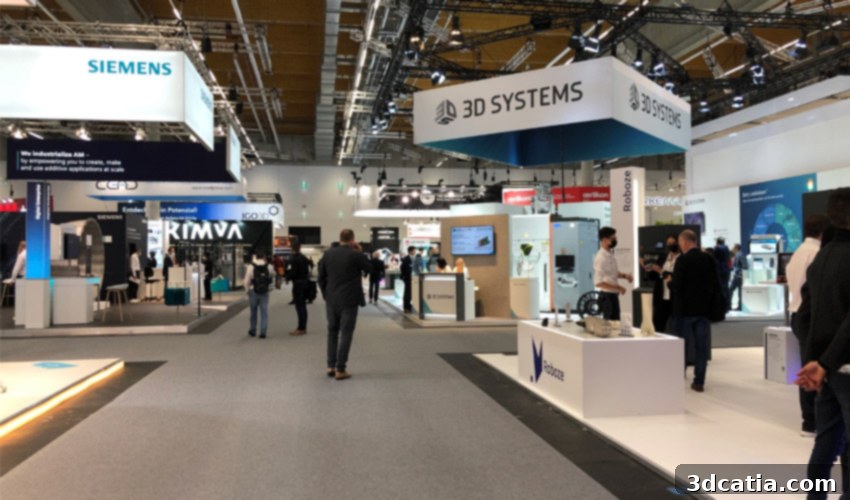
Formnext 2021: Charting the Course for Industrial Additive Manufacturing & Sustainability
Formnext 2021, the premier international trade fair for additive manufacturing and industrial 3D printing, successfully concluded its four-day run in Frankfurt last Friday. This landmark event brought together an impressive 600 exhibitors from 35 different countries, spanning three bustling halls of the Frankfurt Messe. Attracting approximately 17,800 visitors from 76 nations, this edition served as a critical barometer for the global additive manufacturing industry. A central theme that resonated throughout the exhibition was “sustainability,” a multifaceted concept that extends beyond environmental considerations to encompass crucial social and economic dimensions. Attendees witnessed an increasing number of groundbreaking machines, many of which demonstrated capabilities to seamlessly integrate additive and subtractive manufacturing solutions, alongside advanced post-processing technologies designed to facilitate process automation. Furthermore, significant advancements in materials for additive manufacturing were evident, aiming to provide a comprehensive and robust offering for all users. The overarching message from Formnext 2021 was unequivocally clear: additive manufacturing is rapidly progressing towards widespread industrialization and deeper integration into mainstream production processes.
This particular edition of Formnext was undeniably unique, unfolding amidst lingering global uncertainties. Just days before its commencement, significant doubts loomed regarding expected visitor numbers and the practical implications of various health restrictions. Despite these challenges, and while the exhibitor count might have been slightly lower compared to pre-pandemic years, Formnext 2021 emerged as a resounding success. Although overall visitor numbers may not have reached the peaks of 2019, exhibitors consistently reported a noticeable shift in visitor demographics: the attendees were deemed “more mature.” This translated into a higher proportion of visitors actively engaged with specific projects, having well-defined applications, and articulating precise needs for implementing additive manufacturing solutions. Conversations with exhibitors revealed an unprecedented level of pre-scheduled appointments, a strong indicator of serious business intent. This qualitative improvement in engagement signals exceptionally positive news for the additive manufacturing market, which is now beginning to solidify its structure and mature in a truly in-depth manner.
Janusz Berger, Head of Market Communication at Evonik, succinctly summarized the sentiment, stating, “We can draw a very good conclusion from Formnext. We were expecting far fewer visitors, so we are very satisfied. However, it was clear that Asia is missing, both among visitors and exhibitors. So we were certainly missing a third of the fair’s visitors.” This observation, while acknowledging the success, also highlights the global interconnectedness of the industry and areas for future growth and inclusion as travel restrictions ease.
XXL Machines: Expanding the Horizons of Additive Manufacturing at Formnext 2021
A dominant visual trend at this year’s Formnext was the prevalence of large-format additive manufacturing machines lining the exhibition aisles. The industry’s trajectory is clearly moving towards the production of increasingly large parts, catering to diverse material needs across polymers, composites, and metals. This expansion in build volume unlocks new possibilities for industries like automotive, aerospace, and construction, enabling the creation of larger components, functional prototypes, and even tooling with reduced assembly requirements. Beyond sheer size, many machines showcased impressive versatility by combining multiple manufacturing techniques. Hybrid systems integrating 3D printing with subtractive methods like milling or machining were a significant highlight, offering the best of both worlds: the geometric freedom of additive manufacturing coupled with the precision and surface finish capabilities of traditional machining.
For instance, the Italian manufacturer CMS captivated visitors with its large-format machine, engineered to extrude both standard and technical thermoplastics. A key innovation was its interchangeable head, allowing operators to switch to milling capabilities in a mere 30 seconds, demonstrating a commitment to efficiency and integrated production workflows. Similarly, the Fraunhofer Institute showcased advanced robotic arm systems, mirroring the presence of similar solutions from companies like Yizumi. These robotic platforms highlight the industry’s push towards greater automation and flexible manufacturing cells. Indeed, a recurring sentiment among the trade show visitors interviewed was their genuine surprise and excitement regarding the sheer scale and advanced functionality of the 3D printers on display, underscoring the rapid evolution of manufacturing capabilities within the sector.
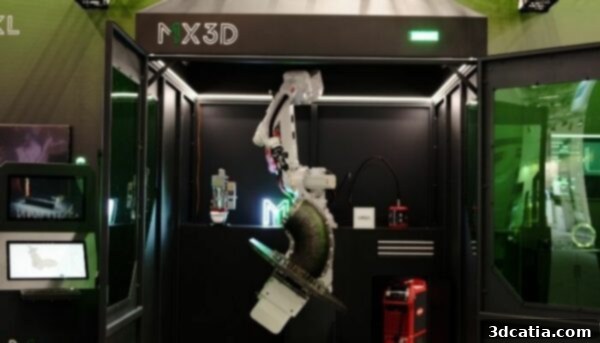
MX3D’s robotic arm offers a large 3D printing volume (photo credits: 3Dnatives)
Beyond simply enabling large-format additive manufacturing, the overarching trend observed was the relentless drive towards the industrialization of additive manufacturing processes. This signifies a maturation of the technology, moving it decisively from a prototyping tool to a robust solution for end-part production across various sectors. Erik Erickson, Dental Business Manager EMEA at Stratasys, elaborated on this critical shift: “What has really changed is that after just talking about moving into industrial applications in 2019, it’s now really happening. Everyone here has moved into industry and none of the larger players are talking about rapid prototyping anymore. Even in the Dental Sector, we are focused more on end-use parts.” This sentiment underscores a pivotal moment where additive manufacturing is no longer just a futuristic concept but a tangible, integrated part of industrial production lines, delivering real-world components.
The halls of Formnext 2021 were replete with machines and solutions specifically engineered to automate and streamline manufacturing workflows, encompassing every stage from design to manufacturing and crucial post-processing. The core objective behind these innovations is to simplify these complex steps for the user, fostering a repeatable, reliable, and scalable process that is suitable for a wide array of industrial applications. This push towards automation is essential for AM to compete effectively with traditional manufacturing methods. Timm Woszidlo, Application & Technology Support Manager at INTAMSYS, astutely identified three converging trends driving this evolution: “Software, automation, speed: this is the feedback we get from our customers. They are very satisfied with our technology, they now want to speed up and automate the production process. That’s why the trend is also moving towards software, a trend we’ve been seeing for several years now.” Advanced software solutions are proving instrumental in optimizing designs, simulating processes, and controlling automated systems, thereby enabling faster production cycles and greater efficiency.
Photo Credits: 3Dnatives
Innovations in Materials: Fueling the Next Generation of Additive Manufacturing
While Formnext 2019 saw a strong emphasis on showcasing metal 3D printing solutions, this year demonstrated a significant shift: metal processes have become increasingly democratized and accessible. A growing number of players are now developing advanced metal powders specifically adapted for various 3D technologies, including powder bed fusion and binder jetting. This expansion of material options is critical for broadening the applicability of metal additive manufacturing across diverse industries. Adeline Riou, Global Sales Manager – Metal Powders at Aubert & Duval, provided valuable insight into this evolution: “Initially, additive manufacturing users were working with the same design methods and materials as conventional manufacturing processes. Then they started to explore the possibilities in terms of design, but they stayed with the same material. Now we are at a stage where we are combining new materials with new design techniques. Manufacturers are imagining applications that were totally unexploited and they can design parts with much more extreme conditions of use. We are at the beginning of a revolution: we are accessing a new generation of materials to develop the applications of tomorrow.” This new paradigm allows engineers to rethink design constraints entirely, creating components with optimized performance for scenarios involving high temperatures, corrosive environments, or extreme mechanical stresses, previously unachievable with traditional methods.
This profound observation regarding material development extends well beyond metals. In the realm of polymers, advancements are proving even more numerous and rapid, leading to the creation of entirely new applications and product functionalities. Additive manufacturing innovators are meticulously engineering polymeric materials with mechanical, thermal, and chemical properties that closely rival, and in some cases surpass, those of established injection molding materials. This enables the production of end-use parts with characteristics previously limited to conventional manufacturing. Sascha Petereit, Sales Manager Additive Manufacturing at Arburg, further emphasized this trend: “The diversity of materials is very important for our industry. I also sense a revival in terms of plastics. In recent years, metal has been very present. Now we are again seeing more innovations in plastics, in processes as well as in materials. One reason for this is that the range of possibilities has expanded.” This revival in plastics is opening doors to more sustainable solutions, lightweighting opportunities, and cost-effective production across various consumer and industrial goods sectors, cementing the crucial role of materials in the ongoing evolution of additive manufacturing.
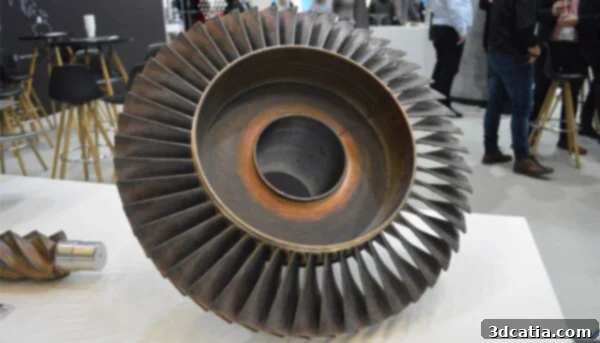
The development of materials allows the creation of innovative applications (photo credits: 3Dnatives)
Sustainability: A Core Pillar of Future Additive Manufacturing
Undoubtedly, one of the most prominent and impactful trends at Formnext 2021 was the pervasive focus on sustainability. This dimension, increasingly critical across all industries, resonates particularly strongly within the 3D printing market due to its inherent advantages. The environmental benefits of additive manufacturing are well-documented and widely accepted by the majority of market players, as evidenced by the numerous conferences and discussions centered around this vital theme. Additive technologies inherently offer significant advantages in reducing material consumption through near-net-shape manufacturing and optimized part geometries, which drastically minimizes waste compared to traditional subtractive methods. Furthermore, the ability to produce lighter parts contributes to a reduced carbon footprint throughout the product lifecycle, from manufacturing to transportation and operational use. The potential for utilizing recycled materials and facilitating the recycling of unused powders and support structures further enhances the sustainable credentials of 3D printing.
The industry is now moving beyond merely acknowledging these benefits towards a more proactive and transparent approach. Björn Hannappel, Head of Sustainability at EOS, articulated this evolving imperative: “The next step is to be transparent about what we do in terms of sustainability. We can’t just say we have a more environmentally friendly approach. We now have to prove it and show what we are doing.” This calls for tangible metrics, verified processes, and clear communication regarding sustainability efforts, such as life cycle assessments (LCAs) for products, investments in energy-efficient machines, and robust supply chain traceability. The key message emanating from Formnext 2021 was a resounding call for collaborative action: sustainability is not merely an ethical consideration but a powerful lever for innovation, competitive advantage, and ultimately, accelerated growth within the additive manufacturing sector. By working together to establish and adhere to sustainable practices, the industry can collectively drive a more responsible and resource-efficient future.
*Cover Photo Credits: 3Dnatives
What were your key takeaways from Formnext 2021? Did you find the insights from the 3D Daily Show #4 valuable? We invite you to share your thoughts and experiences in a comment below or join the conversation on our LinkedIn, Facebook, and Twitter pages! Don’t miss out on the latest advancements in 3D printing – subscribe to our free weekly Newsletter here to get all the news delivered straight to your inbox. You can also explore our extensive library of videos on our official YouTube channel for more in-depth content.