

Relativity Space Secures $500M to Revolutionize 3D Printed Rocket Production and Pave the Way for Mars
Relativity Space, a pioneering company distinguished as the first to successfully 3D print an entire rocket, has announced a monumental achievement: the successful closing of a $500 million Series D equity funding round. This significant investment, spearheaded by Tiger Global Management, serves as a powerful validation of Relativity’s leading momentum within the aerospace sector, acknowledging its exceptional progress across commercial execution, crucial technical milestones, and substantial talent growth. This influx of capital is strategically earmarked to dramatically accelerate the company’s ambitious planned initiatives, which include the further development of its groundbreaking factory of the future, the advanced evolution of its next-generation launch vehicles, and the continuous innovation of its cutting-edge 3D printing technologies. For over five intensive years, Relativity Space has been relentlessly pursuing its visionary goal: to engineer and build the foundational infrastructure for humanity’s multi-planetary future, starting with a fundamental shift in how rockets are manufactured.
Tim Ellis, CEO and co-founder of Relativity Space, highlighted the company’s trajectory amidst global changes: “This past year, marked by unprecedented global shifts, drove profound change in every industry, and aerospace was no exception. With this pivotal new Series D funding, we are now empowered to dramatically accelerate the development of our long-term strategic plans. This investment is not just capital; it’s a testament to the belief in our mission and our unique approach to space manufacturing.” The company’s innovative spirit and relentless pursuit of efficiency are setting new benchmarks in an industry traditionally characterized by long lead times and immense complexity.
Since its inception in 2015, the US-based company has been a formidable disruptor in the aerospace industry. Relativity Space didn’t just adapt existing methods; it invented an entirely new paradigm for designing, building, and ultimately flying its own rockets. At the forefront of this revolution is Terran 1, celebrated globally as the world’s first entirely 3D printed rocket. The fabrication of Terran 1 is a testament to Relativity Space’s proprietary large-format Stargate 3D printer, a technological marvel capable of printing an entire rocket structure. This innovative manufacturing process drastically reduces the total number of parts required by an astonishing 100x compared to traditional methods. Such a reduction translates directly into a significantly streamlined production timeline, shrinking the manufacturing duration to an impressive 60 days from raw material to launch-ready vehicle. This represents an incredible milestone for the entire aerospace sector and unequivocally demonstrates how supply chains can be optimized and made vastly more efficient through the strategic application of Additive Manufacturing technologies. The ability to iterate designs rapidly and produce complex geometries with fewer components offers unparalleled advantages in terms of cost, speed, and performance.
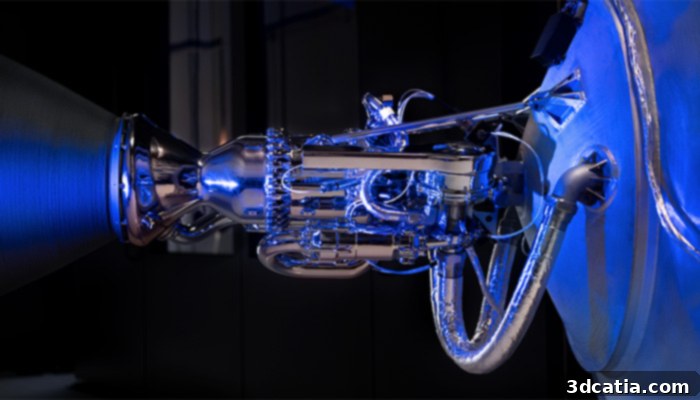
Terran 1 is the world’s first entirely 3D printed rocket | Image via Relativity Space
This recent funding round builds upon a strong foundation of investor confidence. Many will recall that in October 2019, the company successfully raised $140 million, at which point it was already laying out ambitious plans for the first orbital flight of Terran 1, targeting February 2021. Following this latest, substantial Series D funding round, Tim Ellis further emphasized the company’s impressive trajectory: “Throughout 2020, despite global challenges, Relativity achieved unprecedented growth, attracted some of the industry’s top talent, and consistently stepped up to deliver remarkable results on our technical and operational milestones. We are firmly on track to launch our first Terran 1 rocket to orbit next year, a feat we can confidently achieve with the existing capital already secured on our balance sheet.” This statement underscores not only the company’s financial stability but also its unwavering commitment to hitting its operational targets, demonstrating a clear path from innovation to tangible spaceflight capabilities. The meticulous planning and execution behind these milestones reflect a mature and rapidly advancing aerospace enterprise.
Building the Future of Humanity in Space: A Multi-Planetary Vision
Launching the world’s first entirely 3D printed rocket to orbit is far more than just a single mission for Relativity Space; it is merely the groundbreaking first step in a much grander, long-term vision. This audacious plan aims to fundamentally upgrade humanity’s industrial base on Earth, making it more efficient, adaptable, and sustainable, while simultaneously establishing a robust industrial infrastructure on Mars. At the absolute core of making this expansive, multi-planetary vision a tangible reality lies additive manufacturing. This revolutionary technology isn’t just a tool; it’s the very foundation upon which Relativity plans to build the future.
Relativity Space isn’t just focused on rockets; the company is concurrently pursuing an ambitious project to build the factory of the future. This state-of-the-art facility is designed to radically revolutionize how rockets are not only built but also how they are flown. This visionary project is already well underway at one of NASA’s historic sites, symbolizing a powerful collaboration between private innovation and public exploration. Beyond transforming terrestrial manufacturing, Relativity’s ultimate goal is to establish a permanent and self-sustaining industrial base on Mars. The company has articulated a clear strategy for this monumental undertaking, explaining that in the nascent days of Martian settlement, intelligent automation and lightweight, compact 3D printing technologies will be absolutely fundamental. These technologies will be crucial for quickly establishing a new society, constructing vital infrastructure, and enabling resource utilization in an environment characterized by scarce traditional resources and extreme logistical challenges. The ability to print tools, habitats, and even replacement parts on-demand, using local Martian materials, will be indispensable for the pioneers of the red planet.
Tim Ellis provides profound insight into the underlying philosophy driving Relativity’s innovation: “At its heart, 3D printing is fundamentally an automation technology. It’s a process that brilliantly transforms physical complexity into streamlined software, achieving this by seamlessly stitching together what would traditionally be countless discrete components into single, integrated structures. The compounding rate of improvement and iteration possible through our disruptive, software-driven approach will be unlike anything previously witnessed in heavy industry. If humanity is truly going to live and thrive on Mars, it is not merely advantageous but absolutely inevitable that this ‘factory of the future’ must exist. It will be the critical engine for building humanity’s industrial base once we arrive there, enabling us to become a truly multi-planetary species. At Relativity, we are incredibly excited and deeply committed to furthering this iconic new technology, leveraging its full potential to build the future of humanity in space, and to do so with unprecedented speed and efficiency.”
This perspective highlights how additive manufacturing transcends simple fabrication; it represents a paradigm shift towards highly adaptable, software-defined production. This approach promises not only faster development cycles and reduced costs but also enables the creation of designs previously impossible to achieve with conventional manufacturing methods. For space exploration, where every gram matters and every delay is costly, this efficiency is paramount. The vision extends beyond just building rockets; it’s about building an entire civilization’s future off-world, leveraging the unique capabilities of advanced manufacturing. By integrating AI and robotics, Relativity’s factory can operate with minimal human intervention, a crucial factor for operations in remote or hazardous environments like Mars. This automation also ensures consistent quality and allows for continuous production, providing the resilience needed for long-term space colonization.
The recent $500 million Series D financing round is not just an investment in a company; it’s an investment in a future where space travel is more accessible, sustainable, and where humanity’s reach extends far beyond Earth. It positions Relativity Space at the forefront of a new era of aerospace manufacturing, demonstrating that bold visions, backed by groundbreaking technology and substantial capital, can indeed redefine what’s possible. This funding empowers them to continue pushing the boundaries of what 3D printing can achieve, from Earth to Mars and beyond. You can find more comprehensive information about this latest funding round and its strategic implications HERE.

Factory of the future
What are your thoughts on this monumental funding round for Relativity Space and its implications for the future of space exploration and manufacturing? We encourage you to share your insights in a comment below or join the conversation on our Facebook and Twitter pages! For all the latest news and updates in the fascinating world of 3D printing, don’t forget to sign up for our free weekly Newsletter, delivered straight to your inbox.
*Cover Image: Artist rendering of Relativity’s Terran 1 rocket via Relativity Space