
Revolutionizing Surgical Outcomes: The Impact of 3D Printed Medical Implants and Personalized Healthcare
The medical sector is currently witnessing a profound transformation, with additive manufacturing, commonly known as 3D printing, at its forefront. In recent months, significant advancements have underscored the immense potential of this technology to revolutionize patient care. Each new application represents a crucial step forward, showcasing the evolving capabilities and increasing adoption of 3D printing in clinical settings. One of its most compelling advantages lies in the ability to create highly personalized medical devices, meticulously tailored to meet the unique anatomical and functional requirements of each patient. This level of customization is ushering in a new era of bespoke medicine, promising more effective treatments and improved patient outcomes.
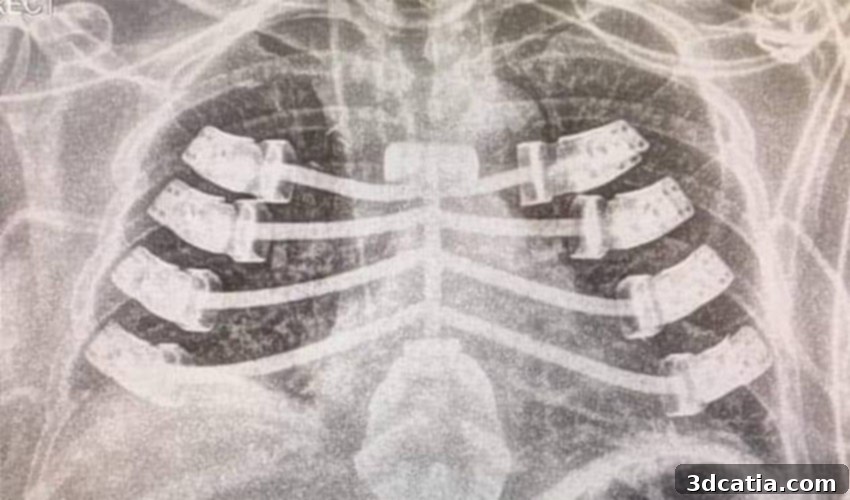
A compelling example of this innovative approach recently emerged from the United Kingdom, where a patient successfully received a 3D printed rib cage implant. This groundbreaking surgery took place at Queen Elizabeth Hospital in Birmingham, involving 52-year-old Linda Edwards. Her case not only highlights the remarkable progress in medical 3D printing but also offers a beacon of hope for countless individuals facing complex medical challenges that traditional methods struggle to address.
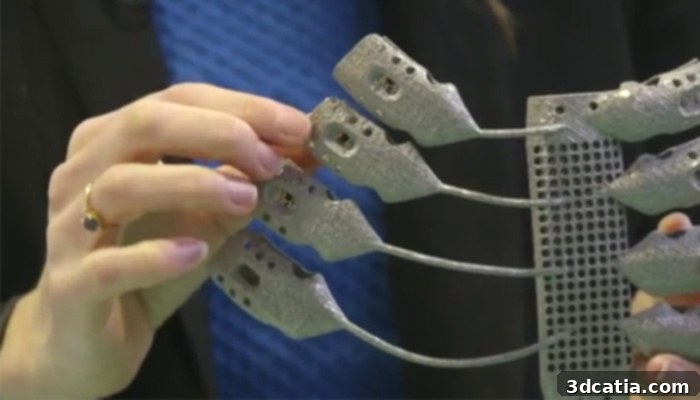
The specialized rib implant designed for Linda Edwards was meticulously crafted from titanium, a material renowned for its exceptional biocompatibility. This means titanium can coexist with living tissue in the body without causing adverse reactions, making it an ideal choice for permanent implants. During the intricate operation, the surgical team, led by consultant thoracic surgeon Mr. Ehab Bishay, carefully replaced the damaged portion of Linda’s rib cage with the custom-made 3D printed titanium device. The implant was designed to provide crucial structural support and restore the integrity of her chest wall. Linda Edwards’ case was particularly rare; she became only the sixth person in the world to undergo such a pioneering procedure, marking a significant milestone in personalized orthopedic surgery.
A Custom Solution for a Complex Medical Challenge
Linda Edwards’ journey to receiving her 3D printed rib cage was fraught with challenges, underscoring the severity of her condition and the limitations of conventional treatments. Her medical ordeal began with a collapsed breastbone, a debilitating consequence of issues stemming from a previous heart operation. Initially, she faced the disheartening news that her rib cage was deemed beyond repair. Her symptoms, including persistent indigestion and heartburn, had emerged in 2016 following a surgical procedure where surgeons had to cut her sternum to access her heart. Though her sternum was initially repaired using wires, this solution proved insufficient, leading to its eventual collapse. A subsequent similar surgery in 2017 again resulted in her sternum collapsing, leaving her in considerable pain and with limited options.
In her growing desperation to find a viable solution, Linda learned about Mr. Ehab Bishay’s pioneering work with 3D printed transplants through a documentary. This discovery offered a glimmer of hope. She recounted her state of mind at the time, stating, “It was out of sheer desperation that I contacted Dr. Bishay because the situation with my rib cage was critical. It was getting steadily worse and I couldn’t see a way forward.” Her story is a poignant illustration of how advanced technologies can provide answers when traditional medical pathways have been exhausted, offering patients a renewed chance at a normal life.
The critical surgery, performed in July 2019 at Queen Elizabeth Hospital, showcased the superior properties of the custom 3D printed titanium implant. This advanced medical device was designed not only for structural support but also to resist infection, remain fully functional, exhibit exceptional strength, and maintain a lightweight profile—all crucial attributes for long-term patient comfort and health. Mr. Ehab Bishay expressed his satisfaction with the outcome: “It’s fantastic to see that Mrs. Edwards is doing extraordinarily well given the complexity of the procedure she has undergone. That is due in part to the collaborative working of three highly-skilled surgical teams and their focus on improving long-term outcomes for patients by developing its capacity and experience to undertake these highly-complex procedures.” This collaborative spirit among medical professionals, combined with cutting-edge technology, proved instrumental in achieving such a positive result.
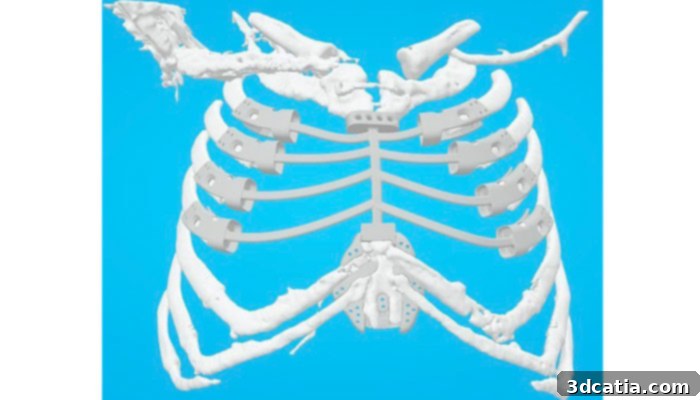
The successful implementation of such a complex implant requires seamless coordination across multiple surgical disciplines. Mr. Bishay further elaborated on this synergy: “The plastic surgery team, led by Mr. Haitham Khalil, harvested several muscle flaps to cover all the extensive components of the prosthesis, a fundamental step in this operation.” This intricate process of tissue grafting was vital for ensuring the implant was properly integrated and protected within Linda’s body, minimizing risks and promoting healing. He also acknowledged the rarity and difficulty of managing such complications: “Fortunately, complications such as those experienced by Mrs. Edward’s following previous heart surgery are rare but are notoriously difficult to manage.” Linda’s case underscores the need for innovative solutions when standard approaches fall short, reinforcing the value of pioneering surgical techniques and materials. More information on this groundbreaking case can be found HERE.
The Broader Impact of 3D Printing in Modern Medicine
Linda Edwards’ successful surgery is a powerful testament to the transformative potential of 3D printing in medicine, yet it represents just one facet of a rapidly expanding field. Beyond custom implants, additive manufacturing offers a myriad of applications that are reshaping how healthcare is delivered. For instance, it allows for the creation of patient-specific surgical guides, which surgeons can use to meticulously plan and execute operations with unprecedented precision, reducing operative time and improving accuracy. In dentistry, 3D printing is widely used for producing crowns, bridges, and aligners, perfectly fitted to individual patient anatomies. Prosthetics, too, have seen immense benefits, with custom-designed and lightweight limbs being produced more affordably and efficiently, significantly enhancing the quality of life for amputees.
The technology also plays a crucial role in medical education and pre-surgical planning. Realistic 3D printed anatomical models allow medical students to practice complex procedures and surgeons to rehearse intricate operations on exact replicas of a patient’s anatomy, thereby mitigating risks during actual surgery. Looking ahead, the field of bioprinting — the 3D printing of biological tissues and organs using living cells — holds immense promise for addressing organ shortages and developing new drug testing platforms. While still in its early stages, bioprinting could one day lead to the creation of functional organs for transplant, marking a monumental shift in personalized medicine.
The advantages of 3D printing for medical applications are multifaceted. The ability to produce complex geometries and internal structures that are impossible with traditional manufacturing methods allows for designs that mimic natural bone structures, promoting better integration and healing. The precision and repeatability of digital manufacturing ensure high quality and consistency, while the capacity for rapid prototyping accelerates the development cycle for new medical devices. Furthermore, for highly specialized or rare conditions, 3D printing can sometimes offer a more cost-effective solution than traditional bespoke manufacturing, which often involves extensive manual labor and specialized tooling.
However, the widespread adoption of 3D printed medical devices also presents challenges, primarily in regulatory approval, material science innovation, and ensuring long-term clinical effectiveness. As the technology evolves, stringent testing and validation processes are paramount to guarantee patient safety and implant longevity. Despite these hurdles, the trajectory of 3D printing in medicine is undeniably upward, propelled by success stories like Linda Edwards’. It signifies a clear movement towards a healthcare paradigm where treatments are not just effective, but uniquely suited to the individual, promising a future of truly personalized and transformative medical care.
What are your thoughts on these incredible developments in 3D printed implants and the future of personalized medicine? We’d love to hear your insights. Feel free to leave a comment in the section below or engage with us on our Facebook and Twitter pages! Don’t miss out on the latest news and advancements in additive manufacturing—sign up for our free weekly Newsletter and get all the essential updates delivered straight to your inbox!