

Unlocking True 3D Printing: Revolutionizing FDM with Non-Planar Technology and nonplanar.xyz
Traditional Fused Deposition Modeling (FDM) 3D printers, while possessing movement capabilities across three axes – X, Y, and Z – rarely utilize them simultaneously for creating complex geometries. In the vast majority of cases, the printer nozzle primarily operates within the X and Y planes, building objects by stacking a series of two-dimensional layers to form a three-dimensional shape. This conventional approach, often referred to as 2.5D printing, falls short of leveraging the full potential of a true 3D manufacturing process. The Z-axis, instead of being an active participant in path generation, is typically reserved for incremental vertical movements between layers. However, a transformative shift is on the horizon, promising to unlock a wealth of new possibilities for FDM 3D printing by harnessing the Z-axis in an entirely novel way.
This revolution is being spearheaded by Gabriel Boutin, the visionary founder of Kupol Inc., a company renowned for its innovative 3D printed bike helmets. Boutin’s latest endeavor, nonplanar.xyz, is set to redefine the landscape of FDM by enabling truly three-dimensional tool paths. This pioneering startup offers a comprehensive platform designed to allow users to fully capitalize on the benefits of non-planar 3D printing. nonplanar.xyz provides specialized elongated nozzles, meticulously engineered to facilitate these advanced printing techniques. Furthermore, it offers ready-to-use G-codes and comprehensive tutorials, empowering users to program their desktop 3D printers for custom non-planar applications. But what exactly are the profound advantages that non-planar 3D printing brings to the table? To delve deeper into this exciting technology, we had the opportunity to speak with Gabriel Boutin himself.
3DN: Can you introduce yourself and elaborate on your connection with 3D printing?
My journey has always been fueled by an unyielding passion for progress and a commitment to self-learning. Since my initial discovery of industrial design and the immense capabilities offered by modern software tools, I have consistently challenged my own limits, striving to evolve into a more proficient and innovative creator. My entrepreneurial path began in 2007, where I focused on providing specialized services to various companies across Canada. During this period, I became deeply involved in the development of numerous bicycle helmets. This experience profoundly illuminated the urgent need for a radical reinvention within the helmet industry – a sector ripe for innovation. It was during the summer of 2016 that I experienced a profound epiphany regarding 3D printing. The technology’s unparalleled ability to craft intricate, complex structures, particularly those adept at absorbing and dissipating energy, struck me with immense force. Inspired by this realization, I immediately conceptualized and formulated a groundbreaking method for creating a truly revolutionary helmet design, promptly securing an international patent for my innovation.
Eager to bring this vision to life, I ventured onto Kickstarter in the summer of 2018, aiming to secure funding for production. While the campaign ultimately fell short of its target, this setback only served to intensify my resolve, prompting me to meticulously re-evaluate the critical elements required for success. This led to a strategic relocation to Montreal, where I successfully assembled a formidable team comprising four highly skilled and specialized companies. Together, we are now poised to enter the rigorous NFL helmet challenge at the close of 2019. Our ambitious goal for 2021 is to emerge victorious in this prestigious competition, presenting a fully 3D printed flexible liner that is engineered to not only meet but dramatically exceed the performance benchmarks of every helmet currently available on the market. This commitment to pushing boundaries through advanced 3D printing underscores my dedication to impactful innovation.

3DN: What motivated you to create nonplanar.xyz?
The genesis of nonplanar.xyz can be traced directly back to my persistent quest for the ideal manufacturing process – one that would ultimately enable 3D printing to become a truly accessible and affordable solution for a global audience. To be candid, I had, for many years, largely dismissed FDM technology. My prior perception was that it simply lacked the inherent capability to consistently produce high-quality finished products that met my stringent standards. I now realize how profoundly mistaken I was in that assessment. For too long, the industry, myself included, remained largely content with the characteristic layered appearance generated by the myriad of look-alike slicer software prevalent in the market. We operated under the tacit assumption that this was the definitive limitation of FDM, without truly recognizing the immense, untapped potential of the Z-axis. It became clear to me that the problem wasn’t FDM itself, but rather our collective adherence to predefined, conventional limits. The key to unlocking superior results lay simply in pushing beyond these established boundaries. nonplanar.xyz represents my personal endeavor to democratize this profound discovery, making the transformative power of non-planar 3D printing readily accessible to all makers, from enthusiastic hobbyists to seasoned professionals, fostering a new era of creative and functional possibilities.
3DN: What specific benefits does non-planar printing offer to those who utilize FDM technology?
By its very nature, FDM employs raw thermoplastics, which inherently possess impressive strength along the flow of the extruded layers. However, a long-standing challenge and often the weaker point in FDM prints has been the adhesion between these individual layers. This inherent anisotropy, where material properties vary depending on direction, frequently limits the overall structural integrity of printed parts. But what if we could fundamentally alter this paradigm by curving those layers? Non-planar printing directly addresses this limitation. When we observe the elegance and efficiency of structures found in nature, we see a ubiquitous presence of perfectly efficient anisotropic designs. Consider the robust yet lightweight structures of trees, the delicate strength of leaves, the intricate architecture of bones, or the aerodynamic resilience of feathers. All of these are prime examples of anisotropic, curved alignments that yield maximum strength and minimal weight. Non-planar printing aims to emulate this biological wisdom, allowing FDM parts to achieve similar levels of optimized performance by aligning print paths with anticipated stress vectors, thereby significantly improving inter-layer adhesion and overall part strength.
To truly “leave the surface” – that is, to move beyond conventional planar layering – one must first relinquish the notion of a single “magic bullet” solution. Each object, due to its unique geometry and functional requirements, possesses its own truth, and consequently, demands its own specific “program” or sequence of tool paths. By “program,” I don’t refer to complex, arcane coding languages, but rather the precise sequence of lines that guide the print nozzle in three dimensions. The beauty of this approach is its accessibility; I am not a programmer by profession, nor do I aspire to become one, yet I’ve found this process to be remarkably intuitive. It’s a skill that anyone can acquire and master within a matter of days of dedicated study and experimentation. This paradigm shift empowers makers to design and print parts with previously unattainable levels of structural integrity, superior surface finish, and intricate details that transcend the limitations of traditional layer-by-layer fabrication, opening doors to truly optimized and aesthetically pleasing FDM outputs.
3DN: Who do you anticipate will be the primary users of nonplanar.xyz’s nozzles and resources?
Creating significant value in the realm of 3D printing becomes considerably easier and more impactful when one leverages affordable and widely accessible printers. For my personal and development work, I’ve deliberately chosen Creality products, primarily due to their exceptionally competitive price point combined with their well-earned reputation for reliability and quality. There’s a profound sense of satisfaction that comes from producing remarkable results using a tool that costs less than $300, proving that cutting-edge innovation isn’t solely reserved for industrial-grade, high-cost machinery. The versatility offered by these affordable platforms is also remarkable; depending on your specific objectives, you can readily modify your setup to extrude various soft filaments, dramatically expanding the universe of possibilities for material science and application. The comprehensive setup I advocate and propose for non-planar printing is designed to be equally accessible and beneficial to both the enthusiastic hobbyist embarking on their creative journey and the seasoned professional seeking advanced manufacturing solutions.
Undoubtedly, the specialized nozzle constitutes the most critical component within this entire equation. Its unique elongated design is ingeniously crafted to prevent collisions between the printhead and the previously deposited material, a common obstacle when attempting to perform intricate curved surface printing. This innovative design allows the printhead to navigate complex three-dimensional contours seamlessly, maintaining optimal extrusion and layer adhesion. We strongly encourage users to explore and experiment with different nozzle diameters. This iterative process of discovery will enable them to identify the perfect match for each specific application they aspire to create, whether it’s for aesthetic finishes, structural integrity, or specialized functional parts. The adaptability and affordability of this approach mean that advanced non-planar capabilities are now within reach for a broad spectrum of creators.
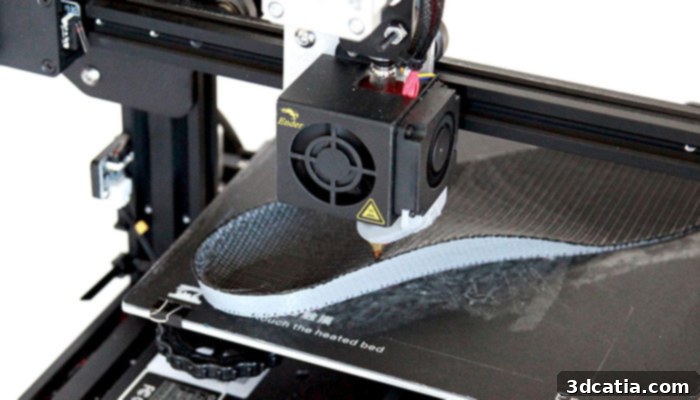
The specialized nozzle is paramount, designed to prevent printhead collision during the creation of curved surfaces, thus facilitating advanced non-planar 3D printing.
3DN: What is your perspective on the current FDM 3D printing market and its future trajectory?
My predictions for the future are inherently limited to what I can, to some extent, influence and understand. From my vantage point, the future for FDM, or Fused Filament Fabrication (FFF), is exceptionally bright and full of promise. It stands as a thoroughly proven technology, one that has consistently demonstrated its reliability and versatility over many years. However, despite its widespread adoption and continuous evolution, I firmly believe that FDM still holds a vast array of untapped potential and capabilities that have yet to be fully revealed to the broader market. We are only just beginning to scratch the surface of what FDM can achieve, particularly when innovative approaches like non-planar printing are integrated. The market is constantly expanding with new materials, more accessible hardware, and increasingly sophisticated software solutions, all of which contribute to FDM’s trajectory as a cornerstone of both personal fabrication and industrial prototyping. Its affordability, coupled with its ever-improving quality, positions FDM for sustained growth and widespread application across countless industries, from automotive to medical, and from consumer goods to specialized engineering components. The ongoing advancements in material science, combined with intelligent tool path generation, will continue to push the boundaries of what is possible with this fundamental additive manufacturing process.
3DN: What are the future plans for nonplanar.xyz?
Our vision for nonplanar.xyz is to establish it as the definitive global hub for all makers who aspire to participate in and drive the non-planar revolution. We envision it as the primary destination where creators will discover not just tools, but also inspiration, knowledge, and community support. To fulfill this ambitious vision, we are committed to offering a comprehensive ecosystem of resources. This will include, but not be limited to, advanced hardware components like our specialized nozzles, innovative software solutions for generating complex non-planar G-code, in-depth educational content such as tutorials and workshops, and a vibrant community forum where makers can share insights, collaborate, and troubleshoot. We will continuously evolve and expand our offerings, ensuring that whatever fits within the scope of enabling and advancing non-planar 3D printing will find a home on our platform. Our goal is to empower individuals and organizations to push the boundaries of FDM, transforming it from a 2.5D process into a truly three-dimensional manufacturing powerhouse capable of creating objects with unprecedented strength, aesthetics, and functionality. We are building the infrastructure for a new era of additive manufacturing.
3DN: Do you have any final words you’d like to share with our readers?
Absolutely. My message is simple yet profound: Layers are no longer confined to flat planes; they are meant to fly!
For more detailed information and to explore the possibilities, you can find nonplanar.xyz HERE.
What are your thoughts on nonplanar.xyz and the exciting potential of non-planar 3D printing? We invite you to share your insights, questions, and predictions in the comments section below, or engage with us on our Facebook and Twitter pages! To stay abreast of all the latest advancements, news, and innovations in the dynamic world of 3D printing, don’t forget to sign up for our free weekly Newsletter, delivering essential updates straight to your inbox.