
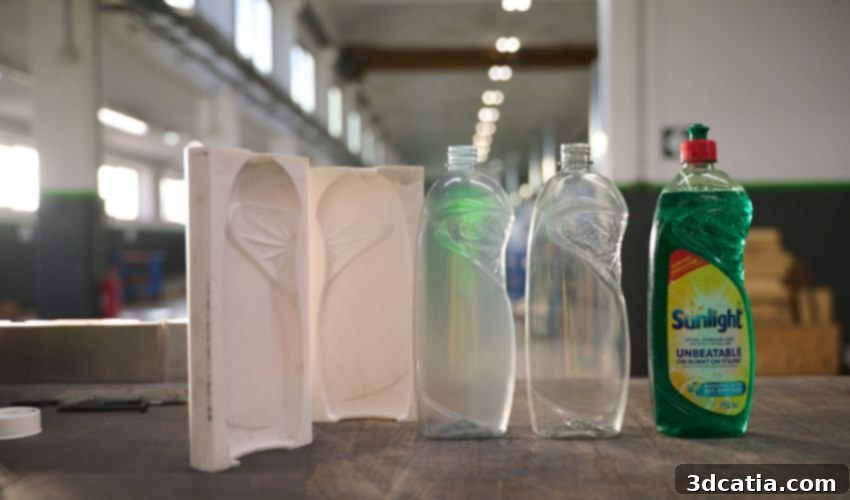
Unilever Revolutionizes Plastic Bottle Manufacturing with Advanced 3D Printed Molds
The packaging industry is increasingly witnessing a significant shift towards innovative manufacturing techniques, with 3D printing emerging as a transformative technology. Once considered a niche application, additive manufacturing has firmly established its presence in packaging, a market valued at an impressive $1.21 billion in 2023 and projected to more than double to $2.56 billion by 2023, according to Future Market Insights. This rapid growth underscores the industry’s need for efficiency, flexibility, and cost-effectiveness. Leading global brands like L’Oréal and Pepsi have already integrated 3D printing into their operations, recognizing its potential to accelerate product development and optimize production processes. Now, another industry giant, Unilever, is joining this forward-thinking movement, leveraging resin 3D printing technology from Formlabs to create high-quality molds for their vast array of plastic bottles.
Unilever, a name synonymous with household essentials, is a British multinational consumer goods company whose products are ubiquitous in daily life. While the company name itself might not always be top of mind, its iconic brands certainly are. From the refreshing scent of Axe body sprays to the indulgent flavors of Ben & Jerry’s ice cream, the gentle care of Dove soaps, and the comforting taste of Knorr foods, Unilever’s portfolio touches billions of consumers worldwide. As the largest producer of soap globally, this fast-moving consumer goods (FMCG) conglomerate boasts a staggering reach, with products distributed in over 190 countries. In such a fiercely competitive sector, sustained innovation is not merely an advantage but a necessity. Unilever is constantly seeking pioneering methods to enhance its operations, and its strategic adoption of 3D printing for bottle molds represents a significant leap forward in optimizing its manufacturing pipeline.
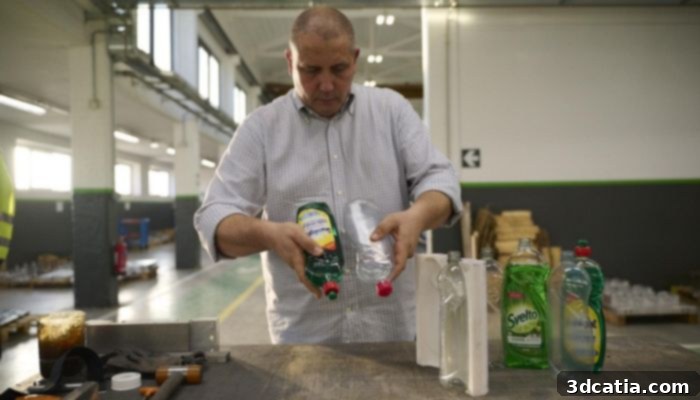
Comparing bottle prototypes made using the 3D printed mold for rapid design iteration and validation.
The imperative for speed and efficiency in the consumer goods market cannot be overstated. Stefano Cademartiri, CAD & Prototyping Owner at Unilever, eloquently articulates this philosophy: “A consumer goods company like Unilever must be on the market as soon as possible or before your competitors. You need to offer the best product at the best price in the shortest time possible to the consumers. 3D printing helps us speed up this process.” This statement perfectly encapsulates the driving force behind Unilever’s embrace of additive manufacturing. In an environment where consumer preferences evolve rapidly and market windows are tight, the ability to quickly develop, test, and launch new products is paramount. Traditional manufacturing processes often present bottlenecks that hinder this agility, making innovative solutions like 3D printing indispensable for maintaining a competitive edge.
How Unilever Transforms Bottle Manufacturing with 3D Printing
The traditional method of manufacturing plastic bottles is surprisingly time-consuming and fraught with limitations. The entire process, from initial design concepts to the creation of robust molds and subsequent blow molding, can often stretch over several months. This lengthy lead time is primarily due to the intricate and laborious nature of conventional mold making, which typically involves CNC machining or injection molding of metal. Crafting a single mold can take an estimated 6 to 8 weeks, a duration that significantly impedes design flexibility and iterative prototyping. Consequently, companies have limited opportunities to experiment with diverse prototypes and refine designs, as each iteration demands substantial time and financial investment, leading to slower product launches and higher development costs.
By strategically integrating 3D printing into their bottle manufacturing workflow, Unilever has drastically compressed these timelines and costs. The contrast is stark: a functional 3D printed mold can be produced in a mere two days, transforming the entire pilot testing phase into an incredibly efficient two-week cycle. This dramatic reduction in time directly translates to substantial cost savings. Flavio Migliarelli, R&D Design Manager at Serioplast Global Services, a key partner in this initiative, highlights the immense benefits: “With the 3D printed mold, we can save up to 70% time and 90% cost compared to the standard mold. In the past, [clients] had to wait up to 12 weeks just for one design, now we can make five designs.” This newfound agility allows Unilever to explore multiple design variations concurrently, ensuring optimal bottle ergonomics, aesthetics, and functionality before committing to mass production, thereby de-risking the entire development process.
It’s crucial to understand that Unilever’s approach is not about replacing traditional manufacturing entirely, but rather augmenting it with the power of additive manufacturing. This hybrid strategy combines the best of both worlds. Specifically, the high-precision molds are fabricated using a Form 3L 3D printer from Formlabs, renowned for its stereolithography (SLA) capabilities. The material of choice is Formlabs’ Rigid 10K Resin, a material specifically engineered for high stiffness and heat resistance under pressure. This combination allows for the creation of incredibly precise molds with exceptionally smooth surface finishes, which are critical for achieving high-quality bottle aesthetics and ensuring the integrity of the blow molding process. Furthermore, the inherent precision of SLA technology enables Unilever to incorporate intricate details, such as embossed logos, branding elements, and fine textures, directly into the bottle designs with outstanding clarity and fidelity, elevating the overall brand experience for consumers.
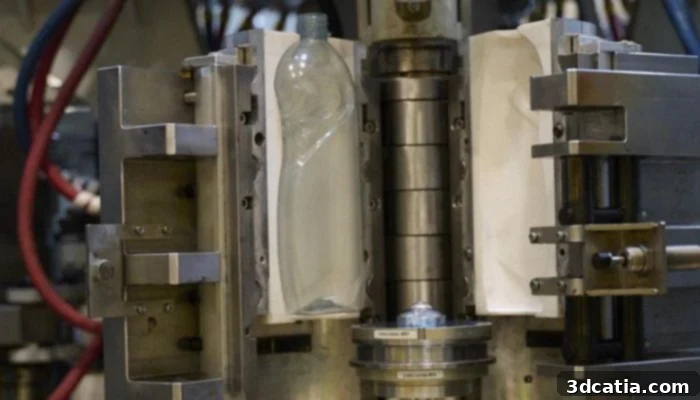
The 3D printed mold is attached to a metal apparatus and then can be used in conjunction with blow molding to create plastic bottles.
Once the advanced 3D printed mold is ready, it seamlessly integrates into the subsequent manufacturing stage: blow molding. In this application, Unilever utilizes stretch blow molding (SBM), a widely adopted technique known for producing high-quality, glass-clear PET (polyethylene terephthalate) containers. SBM is particularly favored for its ability to create bottles with excellent mechanical properties, uniform wall thickness, and superior aesthetic appeal. The synergy between 3D printed molds and SBM offers a multitude of strategic advantages. It enables Unilever to perform comprehensive early-stage testing of various aspects of the production line, as the bottles produced from these prototype molds closely mimic the characteristics of the final product. This includes validating the SBM process itself, assessing the performance of the PET preform, and crucially, accelerating the overall prototyping cycle. This integrated approach not only reduces development risks but also ensures that the final product meets stringent quality and performance standards efficiently. For those interested in a deeper dive into the technical specifics, more detailed information can be found in the comprehensive white paper from Formlabs on low-volume rapid stretch blow molding with 3D printed molds.
Unilever’s proactive adoption of 3D printing for plastic bottle molds signifies a pivotal moment for the packaging sector and the broader FMCG industry. It underscores the immense potential of additive manufacturing to drive unprecedented levels of speed, cost efficiency, and design flexibility in mass consumer goods production. This innovative strategy allows for quicker market responsiveness, greater customization capabilities, and a more sustainable approach to prototyping by minimizing waste associated with traditional mold-making processes. As other companies observe Unilever’s success, we can anticipate a ripple effect, leading to wider adoption of these advanced manufacturing techniques across various product categories. This move by a global leader like Unilever is a clear indicator that 3D printing is no longer just for niche applications but is becoming a mainstream tool for large-scale, competitive industries.
What are your thoughts on Unilever’s pioneering decision to embrace 3D printing for the production of plastic bottle molds? We invite you to share your insights in a comment below or join the conversation on our LinkedIn, Facebook, and Twitter pages! Don’t miss out on the latest advancements in additive manufacturing; sign up for our free weekly newsletter here to get essential 3D printing news delivered straight to your inbox! Additionally, explore our extensive library of videos and tutorials on our dedicated YouTube channel.
*All Photo Credits: Formlabs