
ROBOTOR & TorArt: Revolutionizing Sculpture with 3D Robotics and Digital Art Preservation
The convergence of cutting-edge 3D technologies is profoundly reshaping traditional industries, with 3D scanning, 3D modeling, and automation spearheading a revolution in both subtractive and additive manufacturing. This technological transformation is particularly evident and impactful in the realms of art and culture, especially sculpture. Giacomo Massari and Filippo Tincolini, the visionary founders of ROBOTOR and TorArt, exemplify this synergy. They have ingeniously combined advanced robotics with high-precision 3D scanning to serve the intricate world of sculptural art. Their groundbreaking anthropomorphic robots are not merely tools; they are sophisticated instruments capable of rapidly reproducing the most celebrated sculptures in history with unparalleled accuracy and intricate detail. Masterpieces such as Canova’s Amore e Psiche, Tersicore, the monumental Arch of Palmyra, and the revered Parthenon bas-reliefs are just a few of the invaluable works that TorArt has meticulously brought back to life. Their core mission is dual-faceted: to significantly simplify the demanding work of sculptors and, crucially, to vastly multiply the enjoyment and accessibility of masterpieces that are often sequestered in major museums worldwide or remain inaccessible to the general public. To delve deeper into their pioneering work and the remarkable synergy between their two companies, we had the privilege of interviewing the dynamic team behind ROBOTOR and TorArt.
 Introducing ROBOTOR and TorArt: Pioneering Robotics for Artistic Replication
 Introducing ROBOTOR and TorArt: Pioneering Robotics for Artistic Replication
ROBOTOR emerged from the extensive experience of its two co-founders, Giacomo Massari and Filippo Tincolini, who possess a profound background in both marble processing and the innovative application of robots for sculpture creation. This deep industry knowledge positioned ROBOTOR as a specialist in the integration of multi-axis industrial robots specifically engineered for stone milling – representing the pinnacle of technological solutions for automated production processes in this niche yet highly demanding field. The company excels at providing state-of-the-art robotic systems that deliver precision, efficiency, and consistency, transforming how large-scale sculptural works are produced.
Building on their expertise, in 2004, Massari and Tincolini further solidified their vision by establishing the TorArt laboratory. Strategically located within the historic Carrara marble quarries, TorArt leverages ROBOTOR’s advanced robotic capabilities to meticulously recreate and actualize the artistic visions of renowned artists and designers from across the globe. Over the years, TorArt has become a trusted partner for some of the most prominent names in contemporary art, including Jeff Koons, Barry X Ball, Francesco Vezzoli, Vanessa Beecroft, Giuseppe Penone, Zaha Hadid, and Maurizio Cattelan. Beyond individual artists, major museums and prestigious corporations have also turned to TorArt for the faithful reproduction of historical works of art, which have subsequently garnered international media attention and acclaim. This symbiotic relationship between ROBOTOR’s technological prowess and TorArt’s artistic application has set a new standard in the art world, marrying industrial precision with creative expression.
Our Core Mission: Elevating Sculpture Through Innovation and Accessibility
At the heart of our endeavors is a commitment to advancing the art of sculpture through technological innovation. Our primary goal is to not only sustain but also to significantly consolidate the global recognition of TorArt as a definitive benchmark for high-quality, large-scale sculptural production. Simultaneously, we are dedicated to amplifying ROBOTOR’s presence and reputation as the preeminent provider of “robots for sculpture, born by sculptors.” This unique positioning emphasizes that our robotic solutions are developed with an intimate understanding of the artistic process and integrate seamlessly into the operational workflow of any sculptural studio or workshop.
We strive to fundamentally transform the sculpting industry by eliminating the laborious, wear-and-tear-inducing work steps traditionally associated with sculpture. By doing so, we aim to drastically decrease lead times for complex projects, increase overall productivity, and consistently elevate the quality of finished works. A critical aspect of our mission is to make these advanced capabilities accessible. Thanks to ROBOTOR’s intuitive systems and the proprietary OR-OS© self-programming software, our technology empowers users to achieve exceptional results without requiring specialized programming skills. This democratization of advanced manufacturing means that artists and artisans can focus more on their creative vision and less on the arduous physical demands, fostering an environment where artistic potential is unbound by traditional limitations.
The Robotic Sculpting Process: Precision, Automation, and Artistic Freedom
The entire ROBOTOR project is underpinned by a meticulously developed philosophy, honed over 18 years of invaluable experience in stone processing. This profound understanding of the material and the artistic process has been the guiding force behind the evolution and development of every component within the ROBOTOR system. At the core of ROBOTOR’s innovation lies OR-OS, a proprietary, self-programming software designed for CNC milling, developed entirely in-house. This intelligent software is a game-changer, featuring intuitive interfaces that eliminate the need for any specific programming expertise. OR-OS empowers even novice users to operate the robot and execute highly complex sculptural tasks with ease and confidence.
The workflow with OR-OS is remarkably streamlined: it begins with a standard 3D file of the desired sculpture. The software then autonomously converts this digital model into precise toolpaths, requiring absolutely no operator intervention. This automated conversion process intelligently selects the optimal type of shape to be produced and the most efficient machining strategy, all while adhering to specific requirements for timing and desired quality. This ensures consistency and accuracy across every project, from intricate details to large-scale forms. The physical manifestation of ROBOTOR’s capabilities is an industrial robot mounted on a robust base, also designed in-house. This base is engineered to securely hold all necessary tools and withstand the extremely demanding conditions characteristic of stone processing, including vibrations, dust, and heavy loads. While the base is custom-built for durability, the robotic arm and milling head are sourced from leading partner technology companies, ensuring the highest standards of mechanical precision and reliability. Furthermore, integrated sensors meticulously monitor the milling process in real-time. This continuous, 24-hour processing capability allows for unprecedented control over production time and cost, optimizing efficiency and enabling rapid iteration and completion of even the most ambitious sculptural projects.

Marble from the Carrara Quarries is some of the finest marble in the world, ideal for robotic sculpting.
The Rebirth of Canova’s Tersicore: A Testament to Robotic Art Replication
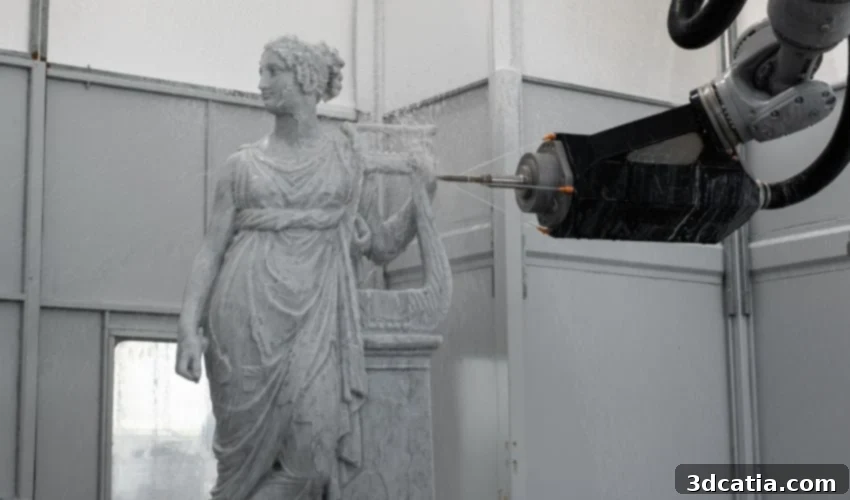
One of TorArt’s most compelling projects involved the faithful reproduction of Canova’s Tersicore, a magnificent work sculpted in white Carrara marble in 1811. This iconic statue, depicting Tersicore, the muse of dance and choral singing, is a prized possession of the Magnani Rocca Foundation in Traversetolo, Italy. The journey to recreate this masterpiece began with a meticulous 3D scan of the original statue, performed by TorArt’s expert team. This digital capture provided an incredibly detailed 3D file, serving as the blueprint for the robotic replication.
With the 3D file in hand, the intelligent OR-OS software took over, independently generating the complex program required for ROBOTOR to precisely work the stone. This automated process allowed the robot to “recreate” the statue with astonishing fidelity to Canova’s original vision. The resulting life-size reproduction, standing at an impressive 182cm tall, was then lent to the Isidoro Falchi Civic Archaeological Museum in Vetulonia (GR). There, it became a central feature of the exhibition “In Dance Time. In harmony, grace and beauty,” allowing a broader audience to experience the elegance and beauty of Canova’s work. Crucially, the Tersicore sculpted by the robot encapsulates all the intrinsic values and aesthetic qualities of the Canovan original. However, it also embodies a life and function of its own, serving as a powerful representation and “multiplication of memory.” To ensure a clear distinction between the original and the replica, a deliberate decision was made not to impose any hand finishing on the robotically produced sculpture, thereby preserving its identity as a faithful, technologically-driven reproduction.
Unlocking New Possibilities: Advantages of 3D Technologies in Sculpture
The integration of robotic and 3D technologies into the traditional sculptural workflow represents a paradigm shift, offering significant advantages over conventional methods. The process seamlessly begins with the creative ideation phase, whether it’s for a sculpture, an architectural element, or a design piece, culminating in an initial sketch. This sketch can either be directly conceived as a 3D digital file or can take the form of a traditional clay model, which is then precisely scanned to generate the necessary 3D digital data.
What fundamentally changes at this juncture is the execution phase. Instead of relying solely on the laborious and often physically demanding work of skilled artisans for every step, the robot takes over, performing all the wearisome and repetitive tasks with unwavering precision. This revolutionary approach yields multiple benefits: it completely eliminates physical fatigue for the sculptor or operator, drastically reduces the hours required for completion, and ensures a level of accuracy that is difficult to achieve manually, especially on large-scale projects. Furthermore, the robot operates continuously, 24 hours a day, allowing for accelerated production schedules. This enhanced efficiency frees up the operator to dedicate their valuable time and expertise to other critical tasks, such as conceptual development, intricate finishing touches, or managing multiple projects simultaneously. The robot handles the bulk of the material removal and shaping, acting as an extension of the artist’s vision, but with superhuman endurance and precision. This blend of traditional artistry with advanced technology not only speeds up the creation process but also opens doors to complex geometries and scales that were previously impractical or impossible.
Highlighting Iconic Projects and Future Visions with ROBOTOR and TorArt
Among the many remarkable projects we have undertaken, the replication of great historical artworks stands out as the most gratifying. These endeavors have not only provided immense satisfaction but have also garnered significant international visibility, underscoring the power of our technology in cultural preservation and accessibility. A notable example is the 2016 scale reproduction of two-thirds of the Monumental Arch of Palmyra. This Syrian monument, tragically destroyed by ISIS in 2015, became a global symbol of rebirth after conflict. Utilizing historical images of the arch taken prior to its destruction, our team meticulously created a precise 3D model. This digital blueprint was then fed to our ROBOTOR systems, which produced a perfect replica that captured worldwide attention and served as a poignant testament to resilience. Its success resonated globally, illustrating how technology can help reclaim lost heritage.
Another significant project involved the creation of a replica of the ancient Greek statue of Persephone Gaia of Tarentine, originally exhibited at the Altes Museum in Berlin. Through our advanced technology, we successfully brought home a faithful reproduction of this exquisite work, which is now proudly displayed at the National Archaeological Museum in Taranto, fostering cultural pride and access. Perhaps one of the most astonishing feats was achieved in 2020: in just over 10 days, we sculpted a marble replica of Cupid and Psyche, one of Canova’s most celebrated works. This master of Neoclassicism originally took five years to complete the original in 1793, highlighting the exponential leap in production speed that our robotic systems offer while maintaining artistic integrity.
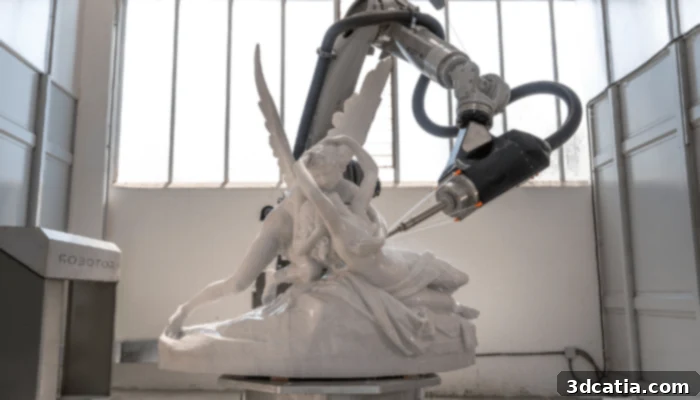
ROBOTOR meticulously sculpts a replica of Canova’s ‘Amore e Psciche’ from a block of Carrara marble.
For Cupid and Psyche, we began with a high-resolution 3D scan of the original artwork, which is housed at the Louvre in Paris. ROBOTOR’s sophisticated software then utilized this digital file to program the robot, guiding it through the intricate carving process. The replica, magnificently crafted from a massive 10-ton block of white Carrara marble, was subsequently displayed in Rome as a highlight of the “Eternal Beauty” exhibition, sharing the spotlight with 170 other priceless works from museums across the globe. This project powerfully demonstrated our ability to not only reproduce art with fidelity but also to significantly accelerate its production, allowing for wider exhibition and appreciation.
Currently, we are deeply engaged in a project that aims to address one of the longest-standing cultural controversies of over a century: the sculptures and bas-reliefs from the Parthenon and other classical Greek temples on the Acropolis in Athens, controversially brought to England in the early 1800s. While Greece asserts ownership and England maintains legitimate acquisition, a definitive resolution remains elusive. In the interim, our technology is being employed to create highly accurate replicas. These reproductions will facilitate the enjoyment and study of an invaluable artistic heritage dating back to 447 BC, bridging cultural divides through tangible art. More broadly, our ongoing collaborations with world-class artists like Jeff Koons consistently reaffirm the exceptional quality and unwavering reliability of our system. These partnerships prove our capability to produce works that were previously deemed impossible, especially considering the stringent timeframes and complex demands of modern society. Our technology is not just replicating; it’s enabling new forms of artistic expression and cultural engagement.
A Sustainable Future for Stone Processing: Final Thoughts from ROBOTOR and TorArt
The design philosophy underpinning the ROBOTOR project is rooted in a profound respect for the material and a commitment to sustainable practices. Rather than employing aggressive or violent actions on stone, our approach favors a “gentle” and incremental milling technique. This involves progressively finer diamond bits, ensuring a superior finish while minimizing material stress and waste. This method not only enhances the aesthetic quality of the final piece but also extends the life of our tools and the robotic system itself.
Beyond our milling techniques, we are also actively innovating in material science. We are at the forefront of developing and utilizing composite materials derived from recycled processing waste. This pioneering effort allows us to espouse genuinely sustainable solutions, significantly reducing our environmental footprint and ushering in a new, more eco-conscious era of stone processing. By transforming waste into valuable resources, we are contributing to a circular economy within the sculptural industry. We believe that technology should not only enhance artistic creation but also align with environmental stewardship. For those eager to explore the remarkable projects and cutting-edge technologies of TorArt and ROBOTOR in greater detail, we invite you to visit our official website HERE.
What are your thoughts on ROBOTOR and TorArt’s innovative approach to sculpture and art preservation? We encourage you to share your comments below or engage with us on our LinkedIn, Facebook, and Twitter pages! Don’t miss out on the latest advancements in 3D printing and robotic art – sign up for our free weekly Newsletter here, delivered straight to your inbox. You can also explore all our insightful videos on our YouTube channel for more visual content.
All photo credits: Laura Veschi/ROBOTOR/TorArt