
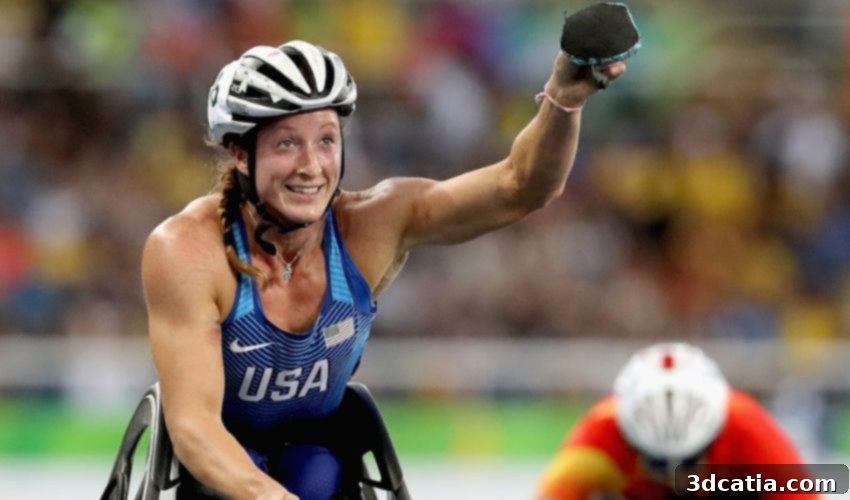
3D Printing Empowers Paralympic Athletes: Tatyana McFadden’s Road to Gold with Custom Gloves
The spirit of “Games Wide Open” encapsulates the excitement surrounding the 2024 Summer Olympic and Paralympic Games in Paris. As athletes from across the globe converge to showcase years of dedication and relentless training, the pursuit of coveted medals will undoubtedly push the boundaries of human potential. While innate talent, iron discipline, and an unwavering team are foundational to success, the right tools are equally indispensable. For Paralympic participants, this necessity is even more pronounced, as their equipment must be perfectly tailored to their unique needs and highly personalized to ensure fair competition and optimal performance. To achieve this level of precision and customization, many athletes and their outfitters are increasingly embracing innovation and cutting-edge technologies, with 3D printing emerging as a pivotal game-changer in high-performance sports equipment.
A compelling testament to this technological evolution comes from American Paralympic legend Tatyana McFadden. A celebrated figure in wheelchair racing, McFadden has announced her intention to compete in the 2024 Paralympic Games utilizing advanced 3D-printed gloves. These custom-engineered gloves are anticipated to play a crucial role in enabling the American record holder in the 400m distance to achieve peak performance and contend for the top honors in a sport where every fraction of a second and every ounce of efficiency matters. Developed in close collaboration with the renowned 3D printing service provider CRP USA, these gloves represent the pinnacle of personalized athletic gear, meticulously designed to meet McFadden’s exacting requirements and optimize her interaction with the racing chair.

Paralympic medalist Tatyana McFadden at the 4th West Asian Para Games in Sharjah, UAE, where she set two new world records and won six medals (photo credits: Tatyana McFadden)
For those unfamiliar with the demanding sport of wheelchair racing, the mechanics involve constant, forceful contact between the athlete’s hands and the handrims of the racing wheel. This continuous interaction generates immense frictional resistance and significant impact forces. Traditional gloves, often made from conventional materials and manufacturing processes, frequently struggle to withstand these extreme conditions for extended periods, leading to premature wear, reduced performance, and even discomfort or injury for the athlete. Beyond mere durability, athletes in this discipline require gloves that offer unparalleled precision in their grip, optimal comfort for prolonged exertion, and consistent performance across varying environmental conditions. These critical attributes—durability, precision, and comfort—are often difficult to achieve simultaneously and consistently with traditionally manufactured gloves, which tend to be generic in design rather than tailored to individual biomechanics.
McFadden’s journey with racing gloves highlights the persistent challenges athletes face in finding truly optimal equipment. She vividly recalls her early experiences: “My first wheelchair racing gloves were called ‘harness gloves’. They were shaped like thumbs and made of heavy-duty fabric with rubber padding. Their softness made me feel the impact every time I hit the hand ring.” The limitations of such basic designs quickly became apparent. By the 2008 Paralympic Games, McFadden and her team resorted to creating their own hard gloves. “We would take plastic beads, melt them in a pot of boiling water, and then mould the plastic to my hands. This process took days to perfect. Sometimes we would have to start over and throw the whole plastic glove back in the water. Once perfected, I did not let the gloves out of my sight because they would melt if left in the car or in the heat for too long. Over time, the plastic would wear down, so we made the gloves thick, but they were heavy,” McFadden explained, underscoring the laborious, inconsistent, and often impractical nature of these early, custom-made solutions.
The inherent shortcomings of traditional and makeshift glove manufacturing methods eventually led McFadden’s team to explore more advanced alternatives. In 2015, the potential of 3D printing began to gain serious consideration as a viable pathway to overcome these persistent equipment challenges. Just a year later, CRP USA, a leader in additive manufacturing solutions, was tasked with the ambitious goal of developing strong, durable, and truly personalized 3D-printed gloves specifically for McFadden. The requirements for these racing gloves were extraordinarily demanding; they needed to be not only exceptionally strong and durable to withstand immense forces but also remarkably light, stiff yet comfortable, and highly resistant to a wide array of weather conditions, from scorching heat to pouring rain. The latest iteration of these 3D-printed gloves, in particular, focused on significant improvements in grip performance and overall athlete comfort, addressing critical feedback from McFadden’s extensive racing experience.
McFadden herself articulated the complex demands placed on the new glove design during her collaboration with CRP USA. “When I met with the CRP USA team,” she recounted, “We also talked about heat, rubber, weather effects, and straps for the gloves so they can stay in my hands better. When competing outside, we face various weather conditions, and I want to be ready for anything. My gloves have cracked in the past. My strokes produce a lot of force when I hit the hand ring, and my previous gloves lasted less than a year. I also wanted a better way to add rubber to the hand rings. The CRP USA team listened to my needs and managed to satisfy them in the best possible way.” This candid feedback highlights the intricate balance required: the gloves needed to be robust enough to endure extreme mechanical stress, resilient enough to handle environmental variables, and ergonomic enough to provide secure comfort without hindering performance. The ability of CRP USA to translate these diverse requirements into a functional, high-performance product demonstrates the power of additive manufacturing in specialized sports equipment.
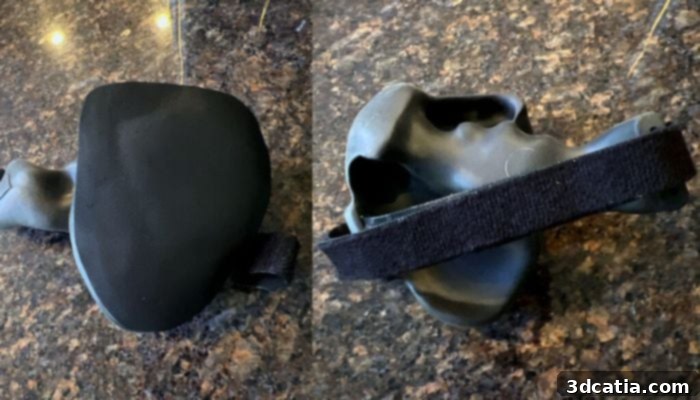
The 3D-printed racing gloves in Windform XT 2.0, used in training and competitions, front and back view (photo credits: Tatyana McFadden)
Revolutionizing Performance: The Technology Behind 3D-Printed Gloves
The successful development of Tatyana McFadden’s racing gloves hinged on the strategic selection of advanced materials and manufacturing processes. CRP USA chose selective laser sintering (SLS) as the primary 3D printing method, a powder bed fusion technology known for its ability to produce complex geometries with excellent mechanical properties. This process utilizes a laser to selectively fuse powdered material, layer by layer, creating robust and functional parts directly from a digital design. For the material itself, CRP USA opted for Windform XT 2.0, a high-performance composite material renowned for its outstanding mechanical characteristics, particularly its superior stiffness, strength, and impact resistance. These properties are critical for manufacturing components that must endure high frictional resistance and repetitive, powerful impacts, directly extending the service life and enhancing the overall durability of the gloves. The SLS process, combined with Windform XT 2.0, allowed for the creation of gloves that not only impress with their inherent strength but also offer a unique balance of flexibility, cushioning, and an exceptionally high level of comfort, tailored precisely to McFadden’s hand structure. In addition to the advanced 3D-printed structure, conventional rubber was integrated, meticulously cut to the athlete’s exact dimensions, and then precisely applied to the hand-contact areas of the gloves with a high-strength adhesive, ensuring optimal grip and energy transfer.
Beyond material selection and manufacturing, the CRP USA team also achieved a significant breakthrough in weight reduction for the glove model. This was accomplished through intelligent design strategies, specifically by hollowing out internal sections of the parts and integrating optimized internal lattice structures. These advanced design techniques, often leveraged in additive manufacturing, allow for the removal of unnecessary material without compromising structural integrity, leading to a substantial decrease in overall mass. The resulting Windform gloves weigh only approximately 100 grams, a remarkable achievement when compared to conventional racing gloves which can weigh 50% or more. This significant reduction in weight is not merely a number; it directly translates into tangible performance benefits for the athlete. Lighter gloves reduce fatigue, enhance agility, and contribute to increased speed during a competition by minimizing the inertia that McFadden must overcome with each powerful stroke. The initial testing phases of these innovative 3D-printed gloves yielded overwhelmingly positive feedback, confirming their potential to redefine performance standards.
McFadden herself highlighted the immediate impact: “I remember using the gloves in Windform XT 2.0 for the very first time on the track and on the road. I was so impressed by how light and durable they were. My hands felt so light, it felt like I wasn’t holding onto anything. When I first put my hands into the glove, it was so smooth. They had also built in two holes where I could strap on the gloves to my hands instead of using additional clips.” This immediate positive feedback underscores the transformative potential of customized, high-performance 3D-printed equipment.
The Broader Impact: 3D Printing Shaping the Future of Elite Sports
Tatyana McFadden’s experience serves as a powerful illustration of how 3D printing is revolutionizing elite sport. This technology is not merely an incremental improvement; it is fundamentally altering how sports equipment is designed, manufactured, and utilized, particularly for athletes with unique physical requirements like Paralympians. By enabling unparalleled levels of customization, 3D printing can create gear that perfectly conforms to an individual’s anatomy and biomechanics, directly translating into improved performance, enhanced safety, and greater confidence for the athlete. This innovative approach addresses longstanding manufacturing challenges, offering solutions that traditional methods simply cannot match in terms of precision, complexity, and rapid iteration. The ability to quickly prototype, test, and refine designs empowers athletes and engineers to achieve optimal results in significantly shorter development cycles. Furthermore, the use of advanced materials like Windform XT 2.0 pushes the boundaries of what is possible, allowing for the creation of components that are simultaneously lightweight, incredibly strong, and highly durable, resisting wear and tear under extreme conditions.
Beyond racing gloves, the application of 3D printing in sports is vast and continuously expanding. From custom prosthetics for runners and cyclists, optimized for aerodynamics and energy return, to personalized helmets and protective gear offering superior fit and impact absorption, additive manufacturing is becoming indispensable. It’s used to create custom insoles and footwear, precisely engineered for an athlete’s foot strike and arch support, enhancing comfort and preventing injuries. Even training aids and specialized components for bicycles, bobsleds, or archery equipment are being reimagined through 3D printing, offering lighter, stronger, and more efficient designs. This technological shift is democratizing access to high-performance equipment, particularly for Paralympic athletes, where bespoke solutions are often a prerequisite for participation and competitive fairness. It ensures that an athlete’s potential is limited only by their will and training, not by the limitations of their gear.
As Tatyana McFadden prepares for the Paris 2024 Paralympics, her journey with these custom 3D-printed gloves will undoubtedly be a focal point of innovation in sports. We will certainly be following along closely as she once again seeks to win gold, testament to the enduring human spirit and the power of technological advancement working hand-in-hand. This collaboration between an elite athlete and advanced manufacturing demonstrates a clear path forward for performance enhancement in competitive sports globally. You can find out more about CRP USA and their pioneering work in additive manufacturing HERE.
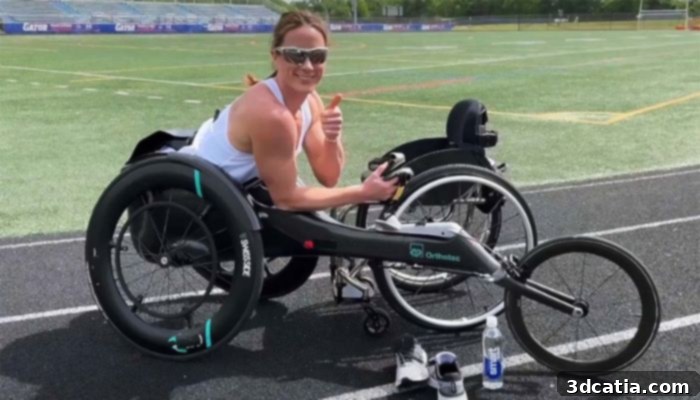
Tatyana McFadden is ready for the Paralympics thanks to her 3D-printed gloves (photo credits: Tatyana McFadden, Instagram)
What are your thoughts on the revolutionary 3D-printed gloves made for Tatyana McFadden and the broader impact of additive manufacturing in elite sports? Let us know in a comment below or on our LinkedIn, Facebook, and Twitter pages! Don’t forget to sign up for our free weekly newsletter here for the latest 3D printing news straight to your inbox! You can also find all our videos on our YouTube channel.
*Cover Photo Credits: Olympics.com