
Exploring the Cutting Edge: Our Top 5 Must-Watch 3D Printing Innovations This Week
Welcome to our weekly showcase of the most captivating advancements in the world of 3D printing. Each week, we meticulously scout for the most exciting, ambitious, and truly paradigm-shifting developments, distilling them into a concise and engaging summary just for you. From groundbreaking medical applications to sustainable manufacturing and personalized artistry, additive manufacturing continues to push the boundaries of what’s possible. Dive into this week’s curated selection of videos that highlight the dynamic evolution of 3D technologies. Beyond this compilation, remember that our extensive library of articles offers deeper insights into many of these emerging innovations, providing context and technical details that further illuminate their significance.
The ubiquity of 3D printing across diverse sectors – healthcare, automotive, fashion, and even food – underscores its transformative power. It’s no longer just a prototyping tool; it’s a catalyst for entirely new products, processes, and business models. This week’s roundup perfectly illustrates this versatility, featuring projects that promise to reshape industries and improve lives. So, settle in and enjoy our hand-picked list for this week, offering a glimpse into the future being built one layer at a time.
1 – Nottingham Trent University 3D Prints Realistic Human Spines for Enhanced Surgical Training
In a truly groundbreaking endeavor, a student at Nottingham Trent University has utilized advanced 3D printing techniques to meticulously recreate human spinal structures with remarkable accuracy. This fascinating video highlights the meticulous process involved in producing models that mimic the intricate details and biomechanical properties of real bone as closely as possible. The fidelity achieved in these 3D-printed spines is exceptionally high, making them invaluable tools for medical education and surgical preparation.
The immediate and profound benefit of these realistic models is their capacity to significantly enhance surgical training. Aspiring surgeons can now practice complex spinal procedures in a safe, risk-free environment, honing their dexterity and decision-making skills before they ever interact with a live patient. This hands-on experience, often difficult to obtain through traditional methods, is crucial for developing the precision and confidence required in delicate operations. By allowing repeated practice on high-fidelity anatomical replicas, 3D-printed spines are set to dramatically increase surgeon proficiency and, critically, reduce the incidence of complications and preventable medical deaths. This innovation represents a monumental leap forward in medical education, ensuring that future generations of surgeons are better prepared than ever before to tackle challenging cases and improve patient outcomes. Furthermore, the ability to create patient-specific models from scan data opens up possibilities for pre-surgical planning that can anticipate and mitigate potential issues unique to an individual, adding another layer of safety and effectiveness to surgical interventions.
2 – Modern Meadow Unveils “Zoa” Bio-Fabricated Leather: A Sustainable Revolution
For those deeply committed to environmental stewardship and ethical consumption, this video presents a truly inspiring breakthrough. Modern Meadow, an innovative startup at the forefront of sustainable material science, has officially launched its pioneering collection of bio-fabricated leathers, branded as “Zoa.” The core message behind their creation is crystal clear and compelling: these revolutionary materials are developed without any involvement in animal slaughter and, crucially, without generating the vast amounts of environmental pollution typically associated with conventional leather production.
Traditional leather manufacturing is notoriously resource-intensive, contributing significantly to deforestation, water pollution from tanning chemicals, and greenhouse gas emissions from livestock farming. Modern Meadow’s “Zoa” offers a radical alternative by leveraging cutting-edge bio-fabrication techniques, specifically utilizing cellular agriculture to grow collagen – the fundamental building block of leather – through fermentation, rather than from animal hides. This process allows for the creation of materials that possess the aesthetic and performance qualities of genuine leather, but with a drastically reduced ecological footprint. This represents a monumental step in the right direction for the preservation of our planet, offering a truly sustainable and ethical option for industries ranging from fashion and footwear to automotive interiors. The implications for a future where high-performance, aesthetically pleasing materials do not come at the cost of animal welfare or environmental degradation are profound, highlighting 3D printing and bio-fabrication as key drivers in the global shift towards a more sustainable economy.
3 – Rolls Royce Integrates 3D Printing into its Manufacturing Process for Unparalleled Luxury and Performance
Rolls Royce, a name synonymous with unparalleled luxury, exquisite craftsmanship, and engineering excellence, is consistently at the forefront of innovation to uphold its legendary standards of comfort, aesthetic appeal, and the ultimate driving or flying experience. In their relentless pursuit of perfection, 3D printing, or additive manufacturing, has emerged as a crucial technology. This insightful video features one of Rolls Royce’s expert technicians, who provides a detailed explanation of how the company is strategically integrating 3D printing into its complex manufacturing workflows, elucidating its diverse applications, and highlighting its transformative impact on their relentless drive for innovation.
For a brand where precision and bespoke customization are paramount, 3D printing offers significant advantages. It allows Rolls Royce to produce intricate, lightweight components with geometries that would be impossible or prohibitively expensive to create using traditional manufacturing methods. This includes complex internal structures for aerospace engine parts – where Rolls Royce is a world leader – that can improve fuel efficiency and performance, as well as highly customized components for their luxury automobiles. Additive manufacturing facilitates rapid prototyping, enabling designers and engineers to quickly iterate on designs, test new concepts, and bring sophisticated elements to fruition with unprecedented speed and accuracy. Beyond prototyping, 3D printing is increasingly used for end-use parts, tooling, and jigs, streamlining production, reducing material waste, and enhancing overall operational efficiency. This strategic adoption of 3D printing underscores Rolls Royce’s commitment to pushing the boundaries of engineering, ensuring their vehicles and engines continue to represent the pinnacle of luxury, performance, and technological advancement.
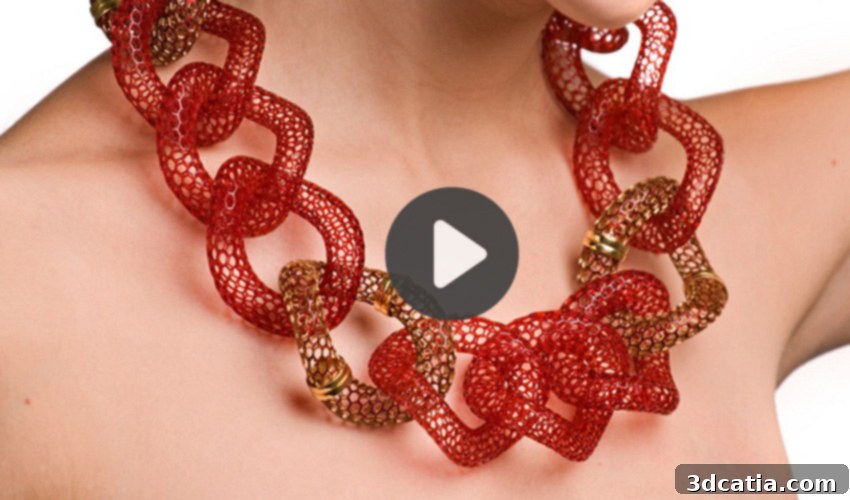
4 – Doug Bucci’s Artistic Vision: Elevating 3D Printed Necklaces Through Dyeing
Doug Bucci stands out as a pioneering artist who harnesses the sophisticated capabilities of 3D printing to create truly unique and thought-provoking necklace collections. This captivating video offers an intimate look into his creative process, specifically showcasing how he dyes his intricate 3D-printed necklaces. For Bucci, the act of dyeing is not merely about adding color; it’s a deliberate artistic statement, often used to symbolize profound concepts like the interplay between life and death. The video meticulously details the precise techniques and careful steps he employs to achieve his desired artistic effects.
These large-scale 3D-printed necklace structures are not just accessories; they are powerful testaments to the incredible intricacy and detail achievable with modern additive manufacturing technologies. The ability to precisely print complex patterns and highly detailed textures allows Bucci to translate his artistic vision into tangible, wearable art pieces. Each curve, every interlinking element, and the overall architectural form of his necklaces demonstrate the unparalleled design freedom that 3D printing offers to artists and designers. The dyeing process further enhances these pieces, adding depth, narrative, and a unique visual texture that makes each necklace a miniature sculpture. Bucci’s work exemplifies the exciting intersection of digital fabrication and traditional artistic expression, pushing the boundaries of contemporary jewelry design and showcasing 3D printing as a versatile medium for fine art and fashion, capable of producing beautiful designs with profound conceptual underpinnings.
5 – Savoring Innovation: 3D Printing Your Face as a Personalized Candy
Have you ever harbored a whimsical desire to, perhaps, eat your own face? While the notion might seem unconventional, the world of 3D printing now makes it a delightful reality! As demonstrated with remarkable ingenuity by the Magic Candy Factory, it is now entirely possible to 3D print your own customized structures – including highly detailed representations of your face – and then, quite literally, enjoy them as edible treats. This playful yet technologically advanced application showcases the lighter, more consumer-friendly side of 3D printing.
Food 3D printing utilizes specialized food-grade materials and precise extrusion technology to create intricate, edible designs that would be impossible to achieve through traditional confectionery methods. This innovative approach allows for unparalleled personalization, making custom candies and chocolates perfect for unique gifts, memorable party favors, or engaging promotional items. Beyond its novelty, this technology serves as an excellent gateway to introduce young children to the fascinating worlds of technology, engineering, and 3D printing in a fun, interactive, and deliciously tangible way. It transforms abstract concepts of digital design and manufacturing into something they can hold, examine, and ultimately, savor. The Magic Candy Factory’s approach not only delights with personalized sweet treats but also acts as an engaging educational tool, sparking curiosity and demonstrating the vast, imaginative potential of additive manufacturing across various industries, even those as universally loved as candy production. Imagine the possibilities for custom culinary creations, personalized nutrition, or intricate dessert art – food 3D printing is truly sweetening the future of fabrication.
This week’s collection of videos truly encapsulates the remarkable breadth and depth of innovation occurring within the 3D printing sector. From saving lives through advanced medical training and championing environmental sustainability with bio-fabricated materials, to refining luxury manufacturing, enabling artistic expression, and even bringing joy through personalized edible creations, 3D printing is continuously redefining what is achievable. Each story underscores the transformative power of additive manufacturing, impacting diverse fields and paving the way for a future that is more efficient, personalized, and sustainable.
We hope you thoroughly enjoyed this week’s “Top 5 Videos” and found inspiration in these incredible advancements. Don’t forget to tune in next Sunday for another exciting compilation of the latest and greatest in 3D printing innovation!