

Continuous Composites Sues Markforged: A Deep Dive into 3D Printing Patent Infringement
In the rapidly evolving landscape of emerging technologies, particularly within additive manufacturing (AM), the strategic importance of intellectual property (IP) cannot be overstated. Patents serve as a critical shield, safeguarding an inventor’s novel creations from unauthorized replication, thereby granting them the exclusive right to commercialize their product and reap the rewards of their innovation without immediate competitive threat. This dynamic environment is vividly illustrated by the sheer volume of patent filings each year, all aimed at securing a competitive edge in burgeoning markets. Data from IFI Claims Patent Services, a prominent authority in patent data analysis, underscores this trend, reporting over 800 new patents in the additive manufacturing sector in 2020 alone. Such a vigorous pace of innovation and patenting naturally elevates the risk of intellectual property disputes, as established and new market players navigate an increasingly complex patent thicket. This heightened risk appears to have materialized in the ongoing legal battle between Continuous Composites Inc., a company established in 2012, and Markforged, founded in 2013. Continuous Composites recently made headlines with a public announcement regarding the commencement of a patent infringement lawsuit against Markforged, signaling a significant development in the additive manufacturing space.
The Cornerstone of Innovation: Continuous Composites and CF3D® Technology
Continuous Composites Inc., an American innovator, has carved out a unique niche through its proprietary and patented 3D printing technology for composites, known as Continuous Fiber 3D Printing (CF3D®). This groundbreaking process masterfully integrates the advantages of continuous fiber composites with the precision of 3D printing. The result is the on-demand production of parts that boast exceptional strength-to-weight ratios, opening up new possibilities across various high-performance industries, including aerospace, defense, and automotive. The core innovation of CF3D® lies in its ability to print with continuous fibers, such as carbon fiber, Kevlar, or fiberglass, embedded directly into a polymer matrix. Unlike traditional composite manufacturing or even conventional 3D printing, which often uses chopped fibers or isotropic materials, CF3D® allows for the precise placement and orientation of continuous fibers along load paths. This structural optimization ensures that the printed parts achieve superior mechanical properties, making them significantly stronger, stiffer, and lighter than parts produced by other methods. This technological leap represents a paradigm shift for applications requiring high performance and durability, pushing the boundaries of what is achievable with additive manufacturing.
The foundation of Continuous Composites’ market position and technological leadership is firmly rooted in its robust intellectual property portfolio. The company proudly reports holding an impressive collection of 75 U.S. patents and 30 international patents, a testament to its sustained investment in research and development and its commitment to protecting its innovative breakthroughs. It is from this extensive IP base that the current legal action stems. Continuous Composites has formally filed a lawsuit alleging the infringement of four specific patents. These patents encompass a critical range of claims, covering both fundamental process methodologies and essential hardware components integral to continuous fiber 3D printing. Crucially, these foundational patents were originally registered as early as 2012, forming part of a larger initial group of nine patents. This timeline is particularly significant as it predates the founding of Markforged by a full year, laying the groundwork for Continuous Composites’ assertion of prior art and intellectual ownership. The central contention of Continuous Composites is that the underlying operational principles and mechanisms employed by Markforged’s continuous fiber 3D printers are directly derived from, and therefore infringe upon, the protected claims within their established patents.
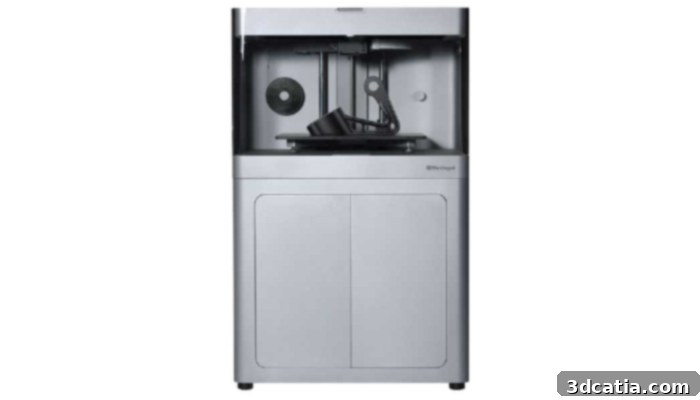
Markforged’s X7 is one of four continuous fiber printers that have infringed their patents, according to Continuous Composites. (Photo Credit: Markforged)
Markforged’s Continuous Fiber Ecosystem Under Scrutiny
Markforged, a prominent player in the additive manufacturing industry, offers a diverse product portfolio that extends beyond metal 3D printing with its Metal X system, and various polymer-based machines like the X3 and the Onyx One. However, the focal point of the current patent dispute lies squarely on four of their continuous fiber 3D printers: the Mark Two, the Onyx Pro, the X5, and the flagship X7. These machines are central to Markforged’s strategy of enabling manufacturers to produce robust, high-performance parts with embedded continuous fibers, mirroring the core application area of Continuous Composites’ CF3D® technology. The ability to reinforce polymer parts with continuous strands of carbon fiber, fiberglass, or Kevlar is a hallmark of these Markforged systems, allowing for the creation of components that offer significantly improved strength and stiffness compared to unreinforced polymers, thus expanding the utility of 3D printing into more demanding engineering applications.
According to Continuous Composites, the four aforementioned Markforged products—the Mark Two, Onyx Pro, X5, and X7—are in direct violation of their intellectual property. The plaintiffs contend that the fundamental properties, operational methodologies, and design elements crucial for the effective functionality of these Markforged continuous fiber machines are directly derived from, and thus infringe upon, the patents held by Continuous Composites. Specifically, Continuous Composites asserts that the unique characteristics and operational principles they have patented for continuous fiber 3D printing (CF3D®) are indispensable to the accused Markforged printers’ ability to function as advertised and deliver their intended performance. This claim suggests that without incorporating these patented elements, Markforged’s continuous fiber printers would either be unable to achieve their advertised capabilities or would require a significantly different, and potentially less effective, design. The outcome of this assertion will hinge on detailed technical analysis and legal interpretation within the court proceedings, potentially reshaping the competitive landscape of continuous fiber additive manufacturing.
The Legal Battleground: Claims, Demands, and Broader Implications
In response to the alleged infringement, Continuous Composites has taken decisive legal action, filing a lawsuit that outlines specific demands. Primarily, the American company is seeking substantial monetary compensation for the damages incurred as a direct result of the alleged patent infringements. Such damages typically aim to compensate the patent holder for lost profits, royalties they would have earned, or the infringer’s unjust enrichment stemming from the unauthorized use of the patented technology. Beyond financial redress, Continuous Composites is also pursuing an injunction. An injunction is a court order that would legally prohibit Markforged from continuing to manufacture, sell, or otherwise exploit the specific continuous fiber 3D printing technology and products that are deemed to infringe upon Continuous Composites’ protected intellectual property. If granted, an injunction could have profound implications for Markforged’s continuous fiber product line, potentially forcing them to redesign their machines or halt sales of the accused models entirely.
The gravity of this dispute places its resolution in the hands of the U.S. District Court in the state of Delaware, a jurisdiction well-known for handling complex patent litigation due to its specialized judicial expertise and established legal framework. The court will undertake a thorough investigation, scrutinizing the technical details of both companies’ continuous fiber 3D printing technologies, analyzing the claims of the four patents in question, and evaluating the evidence presented by both sides. This process typically involves expert testimonies, extensive discovery, and detailed comparisons of patented features against the accused products. The final decision by the Delaware court will not only determine the financial and operational future of the implicated product lines for both Continuous Composites and Markforged but could also set significant precedents for intellectual property protection within the broader additive manufacturing industry. Such high-profile cases highlight the critical importance of robust patent portfolios and the constant vigilance required to protect innovation in a rapidly advancing technological domain. For further details, interested parties can refer to the official press release issued by Continuous Composites.
Broader Industry Impact: Navigating IP in a Competitive Landscape
This lawsuit is more than just a dispute between two companies; it reflects the intensifying competition and the critical role of intellectual property in the fast-paced additive manufacturing sector. As the industry matures and technologies become more sophisticated, the value of unique processes and hardware significantly increases. Patent litigation, while costly and time-consuming, becomes a necessary recourse for innovators seeking to protect their market share and return on significant R&D investments. This case serves as a poignant reminder to all players in the AM space of the continuous need for thorough due diligence in product development and market analysis to avoid potential infringement pitfalls. The outcome could influence how new entrants approach the market and how existing companies protect their innovations, potentially shaping future collaborative efforts, licensing agreements, or even mergers and acquisitions within the industry. It underscores a fundamental challenge in high-tech manufacturing: balancing rapid innovation with stringent IP protection.
Furthermore, the focus on continuous fiber 3D printing highlights a particularly valuable and technically complex segment of additive manufacturing. This technology is instrumental in producing components for demanding applications where strength, light weight, and performance are paramount. As such, any legal decision regarding core patents in this area could have ripple effects across various high-value applications, from aerospace components to medical devices and consumer goods. It emphasizes that while the AM industry promises democratized manufacturing, the underlying proprietary technologies remain tightly controlled assets, fiercely defended by their creators. The resolution of this specific dispute will likely contribute to the evolving legal framework surrounding additive manufacturing patents, providing clarity or setting new challenges for innovators and manufacturers alike.
What are your thoughts on Continuous Composites’ patent infringement lawsuit against Markforged? How do you think this will impact the future of continuous fiber 3D printing and intellectual property in additive manufacturing? We invite you to share your perspective in a comment below or join the conversation on our Facebook and Twitter pages. For all the latest news and insights in the world of 3D printing, don’t forget to sign up for our free weekly newsletter, delivered straight to your inbox!