
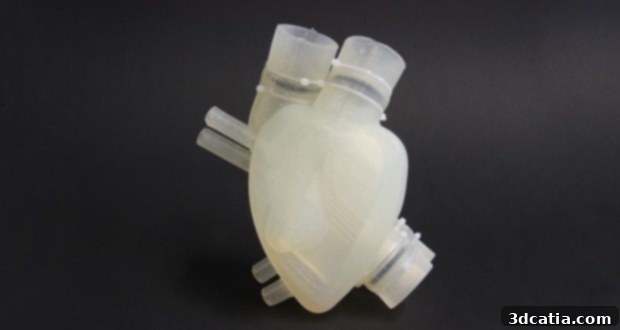
Pioneering 3D Printed Silicon Heart: Zurich University’s Breakthrough in Cardiac Technology
The Zurich University of Applied Sciences (ZHAW) has long been recognized as a hotbed of innovation within the additive manufacturing landscape. Their significant contributions include affiliations with trailblazing companies like Cytosurge, a leader in nano-3D printing technology, and nurturing brilliant minds responsible for groundbreaking creations such as the advanced 6-axis 3D printer. Continuing their legacy of pushing technological boundaries, ZHAW researchers have once again captivated the scientific community, this time with a monumental achievement in the medical field: the successful 3D printing of a functional human heart crafted entirely from silicon. This remarkable feat represents a significant leap forward in addressing critical challenges in cardiac medicine and offers a beacon of hope for countless patients worldwide.
This monumental success can be attributed to the tireless efforts of a dedicated team of Swiss researchers, whose work was expertly spearheaded by doctoral student Nicholas Cohrs. Through their intensive and focused research, they meticulously developed an artificial heart engineered to precisely mimic the form, function, and even the tactile properties of a natural human heart. This accomplishment is nothing short of revolutionary, marking a colossal stride for the future of medical implants and setting a new precedent for what is achievable through the synergistic application of advanced materials and additive manufacturing techniques. The implications of this development resonate deeply within the medical community, promising new avenues for treatment and intervention.
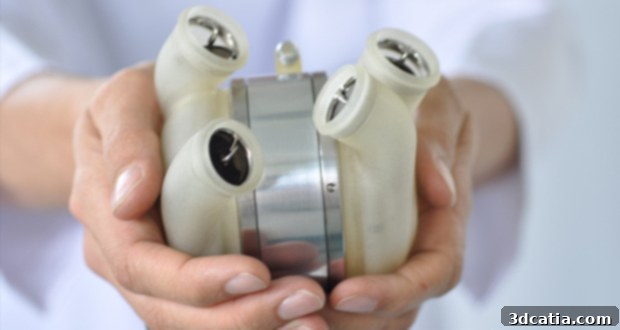
Photo // RWTH Aachen
As articulated by Nicholas Cohrs, the fundamental objective guiding the development of this pioneering artificial heart was to create a device that not only matched a patient’s exact anatomical dimensions but also replicated the intricate biomechanical dynamics of a natural human heart. This meant achieving precise fidelity in both its external morphology and, crucially, its internal pumping mechanisms. The urgency for such innovations is underscored by staggering global statistics: an estimated 26 million individuals worldwide grapple with debilitating cardiac-related conditions, often facing the dire prospect of heart failure. For many, the only viable long-term solution remains a heart transplant, a procedure severely constrained by a critical shortage of compatible organ donors. In this context, the ZHAW team’s groundbreaking work has garnered immense attention, presenting a tangible, albeit temporary, solution for patients enduring the agonizing wait for a life-saving organ. Such an innovation could serve as a vital bridge-to-transplant, sustaining patients and improving their quality of life while awaiting a donor organ, thereby dramatically impacting patient outcomes and offering precious time.
The creation of the heart’s profoundly intricate internal architecture presented one of the most significant engineering challenges. To successfully replicate the complex network of chambers, valves, and musculature characteristic of a biological heart, the researchers indispensable utilized advanced 3D printing technology. Conventional manufacturing methods simply lack the precision and adaptability required to fabricate such nuanced, organic-like geometries. Additive manufacturing, however, provided the unparalleled capability to construct these elaborate structures layer by layer, accurately translating their digital designs into physical reality with remarkable fidelity. Furthermore, a crucial design criterion was the need for the artificial heart to possess both exceptional softness and flexibility. Previous generations of artificial heart models were often rigid, bulky, and conspicuously dissimilar to the natural organ, limiting their functional biomimicry and patient compatibility. To overcome these limitations, the ZHAW team made the strategic decision to employ silicon as their primary material. Silicon, known for its superb elasticity, biocompatibility, and durability, afforded them the precise combination of mechanical properties essential for developing a truly lifelike and responsive cardiac implant. This material choice was instrumental in enabling the creation of an artificial heart that could genuinely emulate the dynamic contractions and relaxations of a living organ, moving beyond mere structural replication to functional biomimicry.
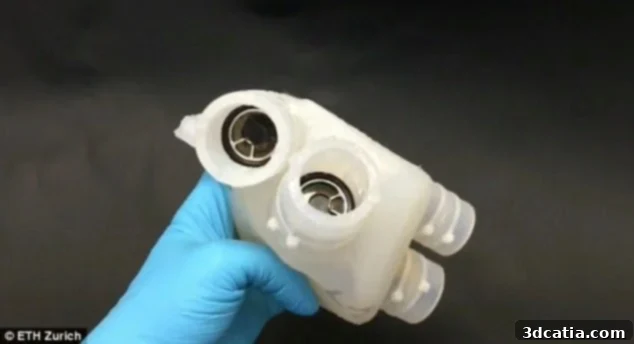
Photo // ETH Zurich
Upon the completion of the meticulous 3D printing process, the research team was presented with an astonishingly lifelike artificial heart. This marvel of bioengineering incorporated all the essential components found within our own hearts, including the crucial right and left ventricles, each designed to perform its vital function. However, the ingenious design introduced a subtle yet revolutionary modification. Rather than retaining the traditional muscular wall that typically separates the right and left ventricles in a biological heart, the team opted for an innovative approach. They strategically replaced this septum with an additional, integrated chamber. This novel chamber is engineered to be cyclically inflated and deflated using precisely controlled pressurized air. This dynamic expansion and contraction mechanism effectively replicates the rhythmic human pulse, serving to efficiently pump blood throughout the circulatory system. This innovative design bypasses the complexities of replicating natural muscle contraction, instead leveraging pneumatic actuation to achieve highly controlled and reliable blood propulsion, marking a truly clever adaptation of bio-inspired engineering principles.
The successful culmination of this development phase led to rigorous testing, overseen by graduate student Anastasios Petrou. Reflecting on his experience, Petrou shared his profound astonishment: “As a mechanical engineer, I would never have thought that I would ever hold a soft heart in my hands.” His initial surprise quickly evolved into an intense fascination, as he continued, “I’m now so fascinated by this research that I would very much like to continue working on the development of artificial hearts.” Petrou’s enthusiastic commitment underscores the transformative potential of this research and highlights the inspiring convergence of engineering and medicine. His words not only express personal excitement but also signal a growing recognition within the scientific community of the profound impact such innovations can have on shaping the future of healthcare and biomedical device development. This sentiment resonates deeply, motivating further investigation and dedication to refining these life-altering technologies.
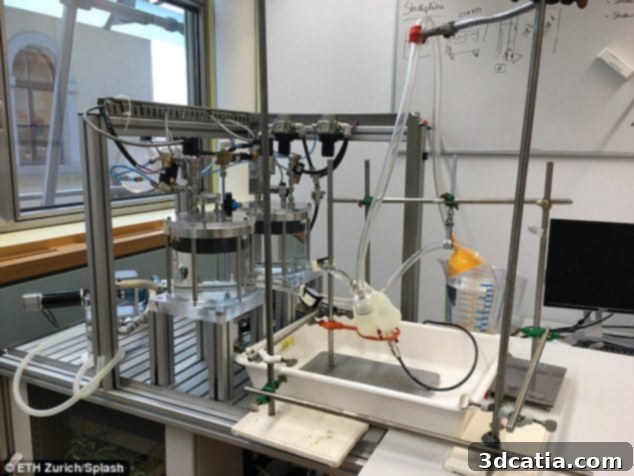
Currently, their heart can only last between 30 to 45 minutes or 3,000 beats
While the initial results are undeniably promising and represent a monumental scientific achievement, the 3D printed silicon heart is, at present, still in its conceptual and experimental stages. It is not yet ready for clinical implantation in human patients. The primary limitation, as current testing reveals, lies in the material’s longevity. The pioneering silicon heart is capable of sustaining approximately 3,000 beats before material fatigue begins to set in. This operational lifespan translates to roughly 30 to 45 minutes of continuous function, sufficient to demonstrate the feasibility of the concept but inadequate for long-term physiological support. This critical hurdle emphasizes that the immediate imperative for the research team is to identify, or more likely, to develop entirely new and advanced biomaterials. These next-generation materials must possess significantly enhanced durability, biocompatibility, and fatigue resistance, capable of withstanding the relentless demands of an organ that beats billions of times over a human lifetime. The ongoing challenge involves material science at its cutting edge, seeking polymers or composites that can endure the mechanical stresses and biochemical environment of the human body for extended periods, transforming this groundbreaking prototype into a truly clinically viable solution for cardiac support.
The future trajectory of this research is poised to unfold in several exciting directions. Beyond merely extending the lifespan of the silicon heart, future developments will likely focus on miniaturization, enhanced integration with the body’s physiological systems, and refining the control mechanisms for pneumatic actuation. Researchers will explore ways to make the device more compact and less invasive, potentially paving the way for fully implantable temporary cardiac assist devices. The challenge of biocompatibility – ensuring the material doesn’t provoke adverse immune responses – will also be paramount. Furthermore, the principles learned from this silicon heart could inspire entirely new approaches to organ replacement and repair, moving beyond mechanical pumps to potentially bio-integrated systems. The ZHAW team’s work opens doors to a future where personalized 3D printed organs could alleviate the global organ donor shortage, providing bespoke solutions tailored to individual patient needs. This vision underscores the profound societal impact of such biomedical engineering breakthroughs, promising to revolutionize cardiac care and offer new hope where traditional medicine faces its most severe limitations.
This pioneering research by Zurich University of Applied Sciences not only reaffirms their position at the forefront of additive manufacturing innovation but also ignites profound conversations about the future of medicine. The successful 3D printing of a functional silicon heart, despite its current limitations, represents a critical proof-of-concept and a monumental step towards addressing the severe shortage of organ donors and improving cardiac care globally. As scientists continue to push the boundaries of material science and biomedical engineering, we can anticipate a future where such artificial organs could become a vital component of medical treatment, offering hope and extending lives for millions suffering from heart disease. We invite you to share your thoughts on what future developments you envision stemming from this incredible 3D printed heart breakthrough. Let us know your insights in the comments section below, or engage with us on our Facebook and Twitter pages! Don’t miss out on the latest advancements in 3D printing; sign up for our free weekly Newsletter to receive all the cutting-edge news directly in your inbox.