
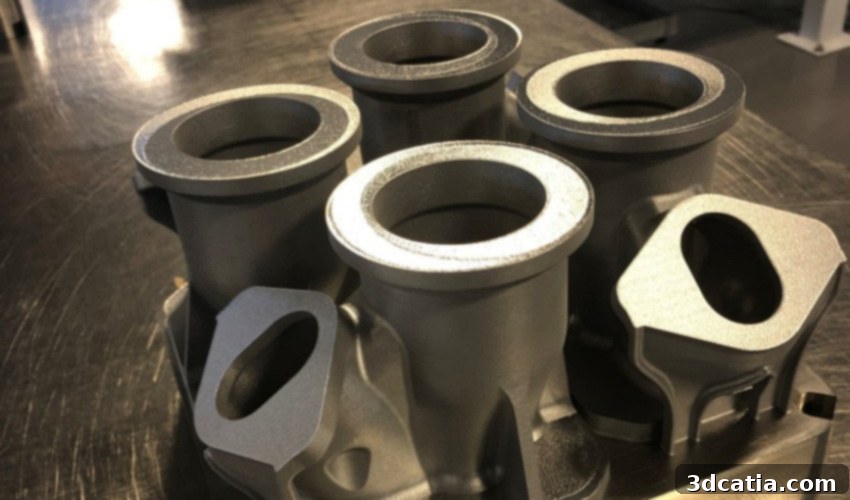
GE Aviation’s Strategic Shift: How Metal Additive Manufacturing Is Revolutionizing Aerospace Part Production
The aerospace industry, renowned for its stringent demands on precision, performance, and safety, has historically relied on established manufacturing techniques like casting. However, a significant paradigm shift is underway, championed by industry leaders like GE Aviation. In a landmark move, GE Aviation, in collaboration with GE Additive, is actively transitioning from traditional investment casting to advanced metal additive manufacturing (AM) for critical components within its land/marine turbines. This strategic pivot, initially focused on four specific bleed air parts for the LM90000 turbine, is driven by compelling advantages, most notably substantial cost savings – projected to slice 35% off GE’s production expenses for these parts – and a remarkably faster time to market. This bold decision signals a new era for aerospace manufacturing, challenging long-held conventions and paving the way for more efficient, agile, and resilient supply chains.
Traditional casting, a centuries-old manufacturing process, involves pouring liquid material, typically molten metal, into a pre-designed mold to achieve the desired shape. It has been a cornerstone of the aerospace sector for decades, particularly for complex, large-volume parts requiring specific material properties. Despite its widespread use, casting presents several inherent challenges that are becoming increasingly problematic in today’s fast-evolving industrial landscape. Manufacturers must invest heavily in creating bespoke molds, which are often costly and can only produce a single, specific design. Any design modification necessitates the creation of an entirely new mold, leading to significant delays and additional expenses. Furthermore, the reliance on fixed molds creates a critical vulnerability: once a mold or the specific raw material for a cast is no longer produced, the corresponding parts become impossible to replace. This issue of obsolescence can render older aircraft or equipment unserviceable, leading to premature retirement or costly redesigns, highlighting a major drawback that metal additive manufacturing directly addresses.

GE Aviation frequently integrates AM, exemplified by the SkyGuardian Remotely Piloted Aircraft (RPA) featuring a 3D printed component. (Photo Credits: GE Aviation)
The Power of Additive Manufacturing: Why GE Made the Switch
Additive Manufacturing, commonly known as 3D printing, has been gaining immense traction across various industries, with its impact particularly transformative in the aviation sector over the past decade. Unlike subtractive manufacturing processes that remove material from a larger block, AM builds parts layer by layer, directly from a digital design. This fundamental difference unlocks unprecedented design freedom, enabling the creation of intricate geometries and optimized structures previously impossible with traditional methods. GE Aviation has been a pioneer in leveraging AM’s potential, demonstrating its capabilities in multiple high-profile projects. For instance, a 3D printed fuel nozzle tip for GE Aviation’s LEAP engine ingeniously consolidated 20 separate parts into a single, unified structure, drastically reducing assembly time and improving performance. Similarly, the company’s new turboprop engine successfully integrated 855 individual components into a mere 10 3D-printed parts, yielding significant savings in both manufacturing time and associated costs.
The latest initiative saw GE Aviation apply metal AM to four specific parts for the LM90000, a robust land/marine turbine. The objective was clear: to rigorously test whether metal additive manufacturing could genuinely compete, and even surpass, industrial casting in terms of efficiency, cost-effectiveness, and speed for critical aerospace components. The results were conclusive and overwhelmingly positive, affirming AM’s superiority for these applications. The ability of AM to produce complex parts with high precision and repeatability, without the need for dedicated tooling, proved to be a decisive factor in its success.
Unlocking Unprecedented Cost Savings
One of the most compelling advantages driving GE’s strategic shift to metal AM for these parts was the significant reduction in manufacturing costs. Eric Galin, GE Aviation’s additive manufacturing leader, underscored the monumental impact of this transition, stating, “This is a game-changer. This is the first time we’ve done a part-for-part replacement, and it was cheaper doing it with additive than casting. To make sure we demonstrated cost competitiveness, we had four outside vendors quote the parts, and we still came in lower with additive manufacturing.” This statement is profound because it marks a pivotal moment where GE Aviation shifted production from investment casting to AM purely on the basis of superior cost-efficiency, even outperforming external traditional casting suppliers. The traditional model requires substantial investment in molds and fixtures, which are often single-use or limited to specific designs, incurring significant upfront costs. Metal AM, by contrast, eliminates the need for expensive tooling, allowing for direct digital-to-part production. This not only reduces initial capital expenditure but also minimizes material waste through optimized design and precise deposition, further contributing to overall cost reduction.
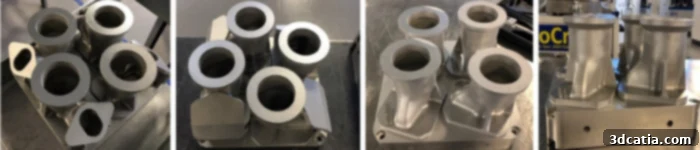
The four 3D printed parts for the LM90000 turbine: vent cap, drain cap, air cap, and accelerometer cap. (Photo Credits: GE)
Accelerated Development and Market Entry
Beyond the impressive cost savings, GE also highlighted that the adoption of metal AM dramatically enhanced productivity and slashed development timelines, leading to a much faster time to market. The entire conversion process for these four critical parts, from initial identification of target components to the production of final 3D printed prototypes, was completed in a mere 10 months. This represents a significant improvement compared to the typical 12 to 18 months usually required for the production of similar land/marine turbine parts using conventional casting processes. The agility of additive manufacturing allows for rapid design iterations, quick prototyping, and efficient validation cycles. Engineers can move swiftly from CAD models to physical parts, testing and refining designs in a fraction of the time, thereby accelerating product development and ensuring that innovations reach the market much quicker. This capability is invaluable in dynamic industries like aviation, where technological advancements and market demands necessitate continuous innovation.
Mitigating Obsolescence and Strengthening Supply Chains
A major strategic imperative behind this project was GE’s proactive approach to addressing the challenge of part obsolescence. In the aerospace sector, where aircraft have operational lifespans spanning decades, the availability of replacement parts is paramount. Joseph Moore, a senior project manager and project lead from GE Aviation, articulated this critical concern: “Our goal was always to look at ways to disrupt production. There are only a few suppliers that make investment castings for the aviation industry, so we need to have options to ensure we’re not impacted by obsolescence and reliant on the cost models of specific suppliers. If we can make an additive part for less, we can save money now and avoid any increase in the future.” This highlights a fundamental weakness of the traditional supply chain model, where reliance on a limited number of specialized casting suppliers can create significant vulnerabilities. If a supplier ceases production or alters its cost structure, it can have severe repercussions on maintenance schedules and operational continuity.
Metal AM offers a robust solution to this challenge. By enabling on-demand production directly from digital files, manufacturers gain unparalleled flexibility. Instead of maintaining vast inventories of physical parts or investing in costly, single-purpose molds, parts can be printed as needed, reducing storage costs and eliminating the risk of obsolescence due to discontinued production lines. This inherent versatility of metal AM allows for the production of a wide variety of parts, even in low volumes, making it ideal for sustaining older fleets or customizing components without incurring prohibitive costs. This strategic capability not only ensures the longevity of existing assets but also significantly enhances supply chain resilience, safeguarding against future disruptions and supplier dependencies.
A Glimpse into the Future of Aerospace Manufacturing
The successful implementation of metal AM for these four turbine components is just the beginning of a much larger transformation at GE Aviation. The company has already identified a staggering 180 cast parts that it believes could be produced more efficiently and cost-effectively using 3D printing technology. This ambitious vision underscores the profound potential of additive manufacturing to reshape the aerospace supply chain, moving beyond niche applications to become a mainstream production method for a wide array of critical components. The ability to innovate rapidly, optimize designs for performance and weight reduction, and create stronger, more durable parts further solidifies AM’s position as a cornerstone of future aerospace development. As the technology matures and becomes even more accessible, we can expect to see a continuous expansion of its applications, leading to lighter, more fuel-efficient aircraft and more sustainable manufacturing practices across the industry. This is not merely an incremental improvement; it is a fundamental shift in how aerospace components are designed, produced, and maintained.
For more detailed insights into GE’s groundbreaking decision and its implications, the official press release provides a comprehensive overview. You can find more about the decision in the official press release HERE.
What are your thoughts on GE Aviation’s strategic pivot towards metal additive manufacturing? Do you foresee this becoming the new standard in aerospace production? Share your insights and join the conversation by leaving a comment below or engaging with us on our Linkedin, Facebook, and Twitter pages! Don’t miss out on the latest advancements in 3D printing; sign up for our free weekly Newsletter here to get the freshest news delivered straight to your inbox. You can also explore our extensive library of videos on our YouTube channel for more in-depth content.
*Thumbnail Photo Credits: GE