
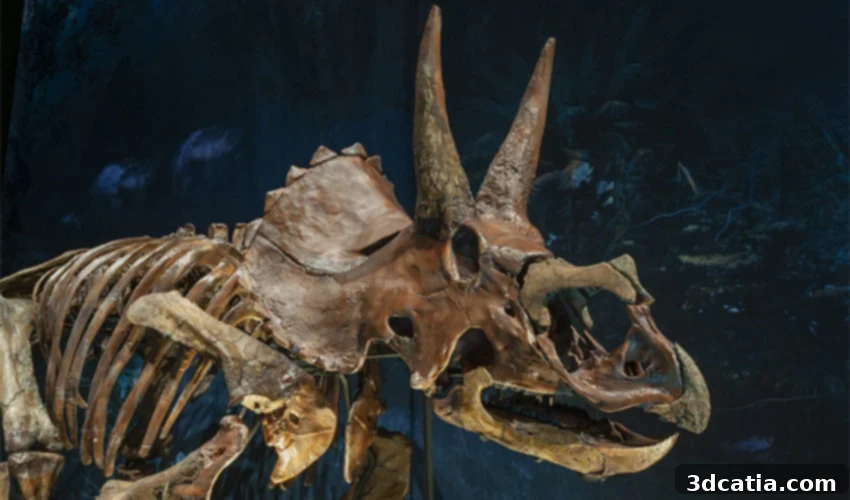
Bringing Ancient Giants Back to Life: The Revolutionary Role of 3D Printing in Reconstructing Triceratops Dirk
In a groundbreaking endeavor that bridges millions of years of history with cutting-edge technology, the Naturalis Biodiversity Centre in the Netherlands has successfully resurrected a creature thought lost to time: the magnificent triceratops. Through a meticulous process involving advanced 3D scanning and sophisticated additive manufacturing techniques, Naturalis has managed to reconstruct the entire skeleton of this iconic dinosaur, offering an unparalleled glimpse into the prehistoric world. This ambitious project involved digitizing existing fossil bones and, crucially, fabricating the missing elements using state-of-the-art 3D printers. The result is a remarkably realistic and awe-inspiring exhibit that allows visitors to truly grasp the colossal dimensions and intricate anatomy of a triceratops, bringing ancient paleontology to life for a modern audience.
The application of 3D technologies extends far beyond mere novelty; it has consistently proven instrumental in illuminating our past. Whether it’s the meticulous restoration of ancient artworks, the digital preservation of historic sites ravaged by conflict, or the scientific reconstruction of long-extinct animal species, additive manufacturing offers a transformative toolkit. This capability was famously demonstrated with the colossal triceratops replica displayed at Austerlitz station in Paris, which was expertly designed and produced on a large-format Massivit 3D printer. Such projects underscore the immense potential of 3D printing to enhance our understanding of bygone eras, diverse cultures, complex architectural marvels, or simply to give tangible form to concepts that were once purely abstract. Its role in scientific research, particularly in fields like paleontology, is continually expanding, allowing for discoveries and reconstructions that were previously unimaginable.
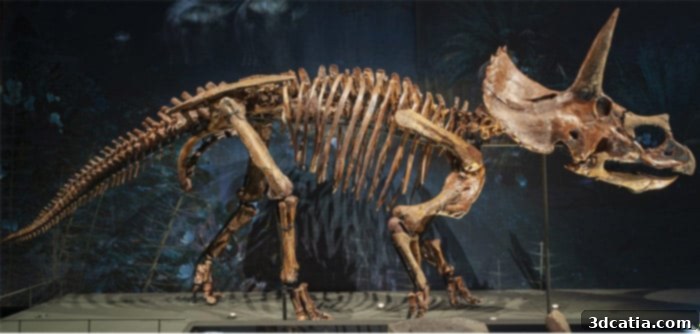
Credits: Naturalis
Dirk the Triceratops: Unearthing a 67-Million-Year-Old Giant
The star of this remarkable reconstruction project is a triceratops named Dirk, whose fossilized remains were unearthed near Newcastle. Dated at approximately 67 million years old, Dirk represents a significant paleontological find. However, like many fossil discoveries, Dirk’s skeleton was not complete. Paleontologists at Naturalis identified numerous missing bones crucial for a full exhibit, including several ribs, one of the distinctive horns, and a substantial portion of the skull. The ambition to display Dirk’s entire skeleton, a truly monumental undertaking, led the team to explore innovative methods for filling these gaps. This challenge became the catalyst for integrating advanced 3D technologies into their scientific practice.
For two years, the dedicated team embarked on the arduous task of digitally reconstructing Dirk. The core of their solution lay in utilizing Fused Deposition Modeling (FDM) 3D printing, a robust and versatile additive manufacturing technique. To handle the immense scale of the project – some of Dirk’s bones measure between 50 and 130 cm in length – they turned to the industrial capabilities of the Builder Extreme 1500 PRO printer. This choice was pivotal, as smaller, conventional 3D printers would have been inadequate for producing parts of such significant size and structural integrity. The Builder Extreme 1500 PRO provided the necessary build volume and reliability to tackle the reconstruction of a dinosaur skeleton piece by piece.
The Digital Backbone: 3D Scanning and Modeling for Paleontology
Every successful 3D print begins with a precise 3D file, which is typically acquired either through detailed 3D scanning of existing objects or meticulous 3D modeling from scratch. For the Triceratops Dirk project, the scientists at Naturalis employed a combination of ingenious techniques. When a bone from one side of the skeleton was missing but its counterpart on the opposite side was present – for instance, a missing right rib when a left rib was available – they utilized an elegant solution: “If we have, for example, a left bone and the right-side counterpart is missing, we can easily make a scan and a mirrored 3D print.” This mirroring technique provided accurate anatomical reconstructions for paired bones, significantly streamlining the process.
However, not all missing bones had a perfect mirrored counterpart. In such cases, the team went a step further, collaborating with other institutions to scan bones from other triceratops skeletons housed in different museums. This inter-institutional cooperation highlights the collaborative spirit within the scientific community and the power of shared data in advancing research. By leveraging scans from multiple sources, Naturalis ensured the anatomical accuracy and integrity of Dirk’s reconstructed skeleton. It’s also important to note that the team made a conscious decision not to expose all of Dirk’s original bones. Certain highly fragile elements, such as delicate veins within some bones, were carefully preserved away from the main display, emphasizing the museum’s commitment to both exhibition and long-term conservation of its precious fossil collection.
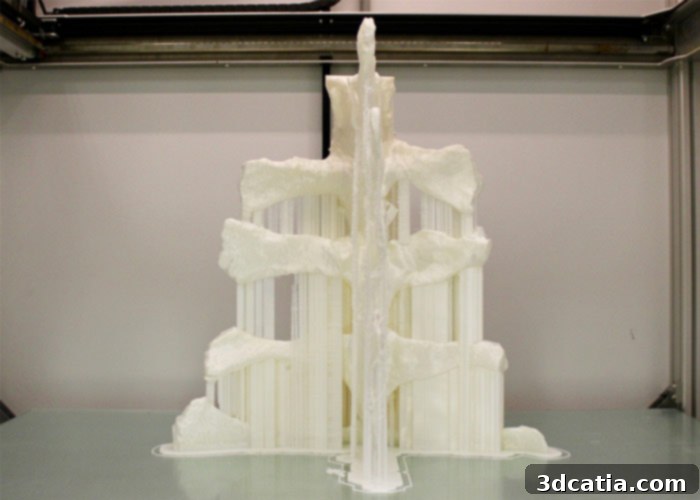
One of the 3D printed bones of Dirk’s spine | Photo Credits: Naturalis
Precision Printing and Meticulous Finishing: The Final Touches
Over a period of two intensive months, the Builder Extreme 1500 PRO 3D printer operated tirelessly, bringing to life more than 100 individual bones with astonishing precision. The use of FDM technology allowed for the creation of robust and anatomically correct replicas that could withstand the rigors of exhibition while accurately representing the original fossil structures. Once printed, each piece underwent a crucial post-processing stage: hand painting. This meticulous step was not merely about aesthetics but also served an educational purpose. The reconstructed bones were painted a shade intentionally lighter than the real, fossilized bones. This subtle yet effective differentiation allows visitors to easily distinguish between the authentic, millennia-old fossil elements and the expertly crafted, 3D printed additions, offering a transparent and engaging educational experience.
The commitment to education at Naturalis extends even further, as the Builder Extreme 1500 PRO printer itself is proudly displayed as part of the LiveScience gallery. This interactive element allows visitors to witness firsthand the cutting-edge technology that enables paleontologists to perform their remarkable work. It serves as a live demonstration, demystifying the process of fossil reconstruction and highlighting the interdisciplinary nature of modern scientific discovery. Peter H. Schalk, Director of Public Sectors and Markets at Naturalis, eloquently summarizes the essence of this initiative: “Modern day palaeontologists use 3D imaging and printing techniques as an instrument to reconstruct fossil remains that are discovered in scientific excavations. An industrial Builder Extreme 3D printer is deployed in the LiveScience gallery of the new Naturalis museum as an ongoing demonstration to the public how missing parts are printed and fitted in dinosaur skeletons.” This statement underscores the paradigm shift in paleontology, where digital tools have become as vital as excavation instruments.
The exhibit has been a resounding success since its opening in the LiveScience gallery last month. Visitors, from young children to seasoned enthusiasts, have been captivated by the sheer scale and detailed reconstruction of Dirk the triceratops. This immersive display not only offers a powerful visual representation of a prehistoric giant but also serves as an accessible gateway for many curious individuals to discover the incredible capabilities and scientific applications of 3D printing. It perfectly illustrates how technology can enhance our appreciation and understanding of the natural world, bridging the gap between ancient history and contemporary innovation. For those interested in delving deeper into the specifics of this remarkable project and the technology behind it, more information can be found HERE.
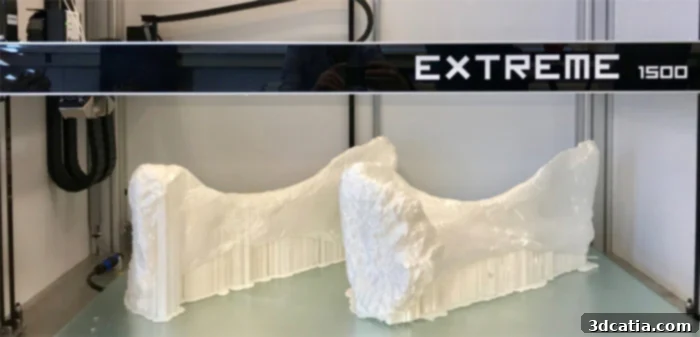
3D printing of tibial bones | Photo Credits: Naturalis
The Future of Paleontology: Beyond Reconstruction
The success of the Triceratops Dirk project at Naturalis is more than just an exhibition; it’s a testament to the transformative power of additive manufacturing in scientific research and public education. This project demonstrates how 3D printing can overcome limitations inherent in fossil discovery, enabling museums and research institutions to present complete, anatomically accurate representations of ancient life forms, even when original specimens are incomplete. The ability to scan, mirror, model, and print missing skeletal components not only makes magnificent displays possible but also facilitates critical research, allowing paleontologists to study biomechanics, growth patterns, and evolutionary relationships with greater precision.
Looking ahead, the integration of 3D technologies promises even more exciting advancements in paleontology. Researchers can now create lightweight, durable replicas for hands-on study without risking damage to priceless original fossils. Educational outreach can be expanded through portable 3D printed models, making scientific discovery accessible to classrooms and communities worldwide. Furthermore, the capacity to digitally archive and share 3D models of fossils means that researchers across the globe can collaborate more effectively, transcending geographical barriers. The reconstruction of Dirk the triceratops stands as a shining example of how innovative technology can breathe new life into ancient discoveries, inspiring future generations of scientists, educators, and museum-goers alike.
What are your thoughts on this remarkable reconstruction of Dirk using advanced 3D printing techniques? We invite you to share your insights and comments below, or engage with us on our Facebook and Twitter pages! Don’t miss out on the latest advancements and news in the world of 3D printing; sign up for our free weekly Newsletter to have all the updates delivered straight to your inbox!