
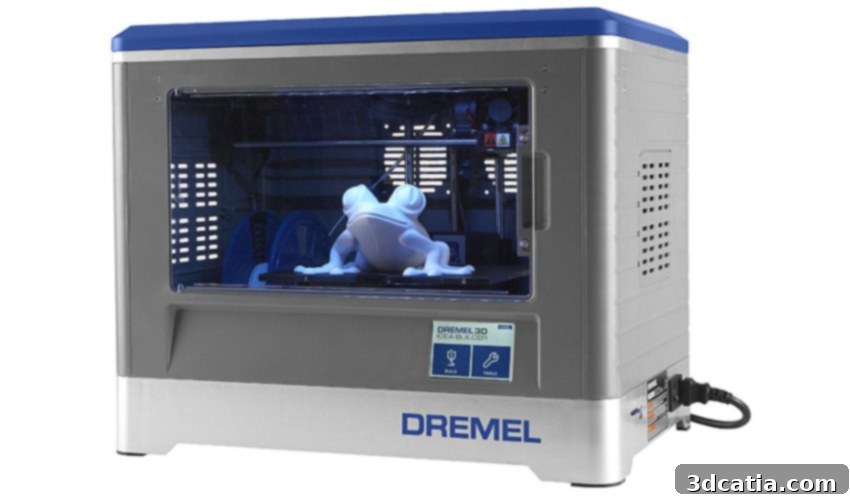
Dremel Idea Builder Review: Unlocking Creativity with an Accessible 3D Printer
Dremel, a name synonymous with DIY projects and precision rotary tools for generations, made a significant strategic move by announcing its entry into the rapidly expanding 3D printing market. This venture culminated in the release of the Dremel Idea Builder, a Fused Deposition Modeling (FDM) 3D printer designed with a distinct “Plug & Play” philosophy. Given Dremel’s long-standing reputation for user-friendly, reliable tools, the Idea Builder instantly garnered considerable anticipation within both the DIY community and the broader additive manufacturing landscape. Our team at the 3Dnatives Lab was eager to put this machine through its paces, rigorously testing its capabilities to determine if it truly lives up to the substantial hype surrounding its launch and whether it could carve out a niche in a competitive market.
Upon its initial reveal, astute observers within the 3D printing community couldn’t help but notice a striking resemblance between the Dremel Idea Builder and the FlashForge Dreamer. This observation wasn’t coincidental; Dremel chose to enter the market through a strategic partnership with FlashForge, a prominent Chinese 3D printer manufacturer known for its robust and reliable machines. This collaboration resulted in a customized version of the Dreamer platform, rebranded and refined under the Dremel umbrella. While some might question Dremel’s decision not to develop an entirely original machine from the ground up, this partnership should be viewed as a shrewd strategic maneuver rather than a lack of creativity. By leveraging FlashForge’s established manufacturing expertise and proven FDM technology, Dremel could accelerate its market entry, ensuring a reliable product from day one. This allowed Dremel to focus on user experience, software integration, and brand alignment, capitalizing on FlashForge’s deep ties and extensive experience within the 3D printing industry. The synergy aimed to combine Dremel’s reputation for accessibility and quality with FlashForge’s technical prowess, ultimately benefiting the end-user with a well-engineered and approachable 3D printing solution.
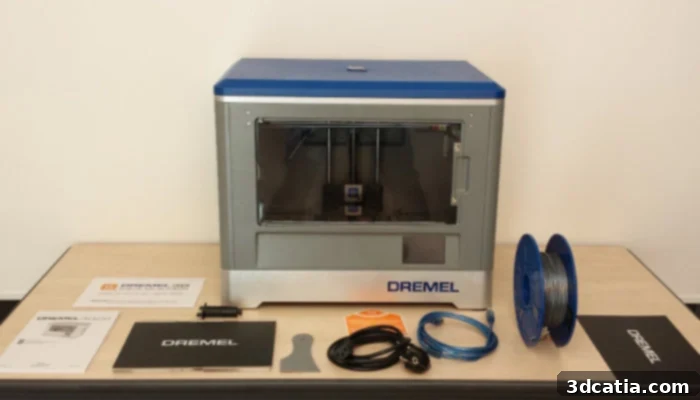
The Dremel Idea Builder with all its accessories and tools included.
Unboxing and First Impressions: The Dremel Idea Builder’s Thoughtful Design
The unboxing experience of the Dremel Idea Builder immediately conveys a sense of quality and user-centric design. The printer itself boasts a substantial footprint, measuring 400 x 485 x 335 mm, a size comparable to popular desktop models like the Makerbot Replicator 2. This generous exterior volume suggests a sturdy build, though it does require a dedicated space on a workbench or desk. The packaging thoughtfully includes a comprehensive array of accessories, ensuring users have nearly everything they need to begin their 3D printing journey right away. Alongside a detailed user manual – a crucial component for beginners – you’ll find a spool of Dremel’s proprietary PLA filament, a specialized tool for safely removing finished prints from the build plate, and a leveling tool to ensure precise bed calibration. An additional adhesive support is provided for future use, demonstrating Dremel’s commitment to sustained printing success. Connectivity is covered with both power and USB cables, and a spacious 32GB SD card is included, preloaded with sample models, allowing for immediate printing without the need for additional downloads. However, a minor oversight was the absence of a spatula or pliers, which are often invaluable tools for post-processing and support removal, particularly during the initial learning curve of 3D printing.
Beyond its size, the Dremel Idea Builder’s physical design incorporates several thoughtful features aimed at enhancing usability and safety. It features a robust front door that helps enclose the print chamber, maintaining a stable temperature for better print quality and reducing noise during operation. Additionally, the top panel of the printer is conveniently removable, providing easy access to the interior for maintenance, filament loading, or simply a clearer view of the printing process. Despite its substantial external dimensions, the FDM 3D printer offers a practical maximum print volume of 230 x 150 x 140 mm, which is ample for a wide range of common household and hobbyist projects. The machine’s user interface is managed via a vibrant full-color IPS touchscreen located prominently on the front. This intuitive screen is designed to simplify navigation through settings, print selection, and monitoring, making the entire process approachable even for novice users. The inclusion of two ventilation vents, one on each side of the machine, suggests an effective internal cooling system, essential for maintaining optimal operating temperatures and ensuring consistent performance over extended print jobs.
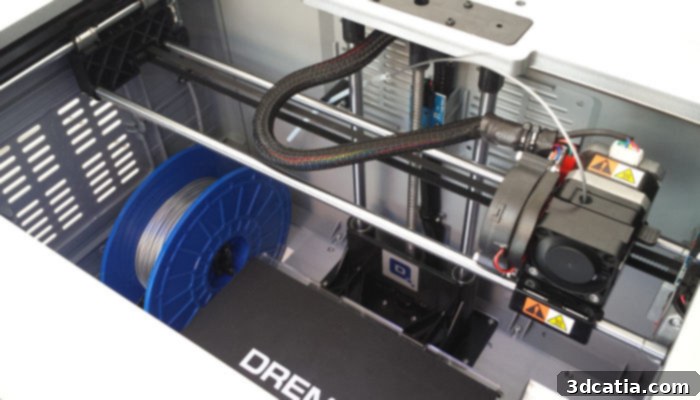
The filament spool is positioned inside the Dremel Idea Builder.
Effortless Setup and Seamless Installation: Getting Started with the Idea Builder
One of the Dremel Idea Builder’s strongest selling points, and indeed a core promise of its “Plug & Play” designation, is its remarkably straightforward installation process. Setting up the printer proved to be entirely problem-free, a refreshing experience compared to some more complex 3D printing systems. The initial steps involve simply connecting the mains power plug and the USB cable to a computer, establishing the necessary power and communication links. Following this, the filament spool is installed internally; this is achieved by unlocking a dedicated support mechanism designed to securely hold the filament roll within the enclosed chamber, protecting it from dust and environmental fluctuations. The print plate itself is engineered for ease of use, featuring fasteners that allow it to be effortlessly clipped into place. Should a user encounter any difficulty, the removable top panel offers convenient access to the interior, simplifying the process of guiding the filament or ensuring the print plate is correctly seated. This level of accessibility underscores Dremel’s commitment to a hassle-free user experience.
Once the physical components are in place, the operational setup is equally intuitive. The next step is to power on the printer and prepare the extruder for filament loading. This crucial process is guided entirely through the vibrant full-color touchscreen interface. Users are prompted to heat the extruder to the appropriate temperature for the chosen filament, after which the machine guides them through loading the filament into the print head. This automated and guided process removes much of the guesswork typically associated with preparing a 3D printer, making it genuinely accessible for first-time users. Furthermore, the Dremel Idea Builder comes equipped with an internal memory of 4GB. This generous storage capacity allows users to store multiple 3D CAD files directly on the printer, enabling standalone operation without constant connection to a computer once a file has been transferred. This feature significantly enhances convenience, allowing for quick access to frequently printed models or enabling printing directly from the SD card.
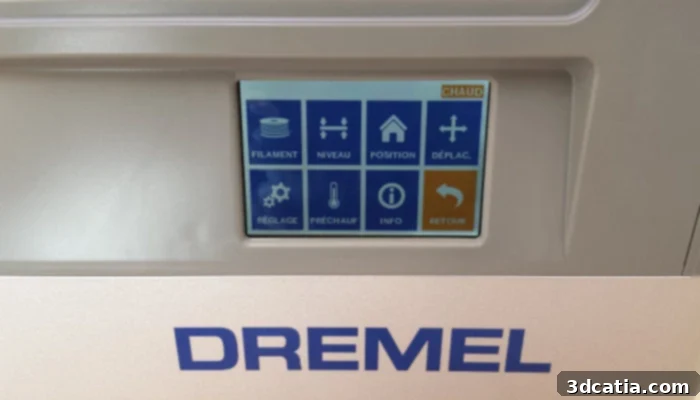
The Dremel Idea Builder has an easy to use touch-screen which we enjoyed.
Mastering Your Prints: An Overview of the Dremel 3D Software
The third critical component in the Dremel Idea Builder ecosystem is its dedicated slicing software, an essential interface for translating 3D models into printable instructions for the machine. The Dremel 3D printer software is readily available for download, with convenient access provided via Dremel’s official support page, which can be found here. Compatibility is broad, supporting Windows Vista and later versions, as well as Mac OS X 10.8 and above, ensuring that a wide range of users can seamlessly integrate the software into their existing computing environment. The installation process itself is straightforward, reflecting the overall user-friendly design philosophy of the Dremel Idea Builder.
Once installed, the Dremel 3D software presents a user interface that is both comprehensive and remarkably intuitive, especially for those new to 3D printing. The initial view offers a suite of fairly standard but highly effective options for preparing your 3D models. Users can effortlessly view an object from any angle (360° rotation), precisely move it within the virtual print area to optimize placement, and rotate or scale it to fit specific project requirements. These basic manipulation tools are crucial for ensuring a model is correctly oriented for optimal printing, minimizing the need for supports, and maximizing the use of the build volume. Beyond these fundamental controls, the software truly shines with its “advanced settings.” Here, users gain greater control over critical printing parameters such as print temperature, which can be adjusted for different filament types or desired surface finishes. The fill density, determining the internal structure of the print, can be varied to balance strength against material consumption and print time. Layer height is another vital setting, directly impacting the level of detail and overall print resolution; finer layers yield smoother, more detailed results but extend print time. Finally, print speed can be adjusted to either accelerate the process or enhance quality for intricate designs. This balance of easy-to-use basic functions with accessible advanced controls makes the Dremel 3D software an excellent tool for both beginners seeking simplicity and intermediate users looking for more granular control over their prints, ultimately contributing to a more refined and successful 3D printing experience.
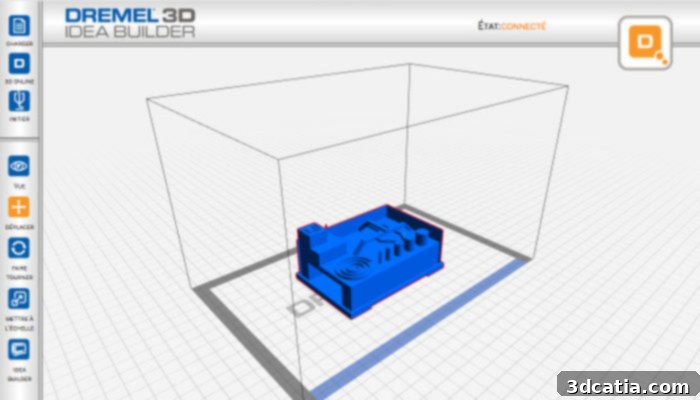
A snapshot of Dremel’s 3D software which we had loaded the torture test into.
Exceptional Performance: Printing with the Dremel Idea Builder
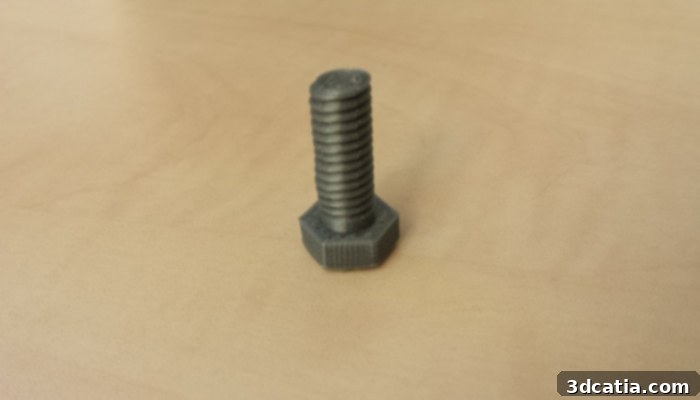
The culmination of our testing involved putting the Dremel Idea Builder to the ultimate test: actual 3D printing. Throughout numerous print jobs, we encountered remarkably few issues, affirming the “Plug & Play” promise and Dremel’s commitment to reliability. The printing process was consistently smooth and hassle-free, with the machine operating quietly and efficiently. For users looking for immediate inspiration or projects, Dremel’s website hosts a variety of readily available 3D models, providing a convenient starting point for new users and showcasing the printer’s capabilities. In terms of print quality, the results were consistently impressive, characterized by a notable cleanliness and precision. This superior quality is visually evident in the accompanying photographs, which highlight the smooth surface finishes, accurate dimensions, and crisp details achieved by the Idea Builder.
A significant benchmark for any 3D printer is its ability to successfully complete a “torture test” print. These specialized models are designed to push the limits of a printer’s precision, cooling, bridging, overhang capabilities, and overall reliability. The Dremel Idea Builder not only handled our rigorous torture test with flying colors but also delivered an output that exceeded our expectations. The fine details were rendered accurately, overhangs were managed effectively without significant sagging, and intricate features were reproduced with commendable fidelity. This demonstrates the printer’s robust calibration and excellent control over filament extrusion and cooling. The layer adhesion was strong, and there was minimal to no stringing or blobbing, indicating well-tuned retraction settings. The overall structural integrity of the torture test print was superb, a testament to the Idea Builder’s consistent performance across various challenging geometries. The resulting print speaks volumes about Dremel’s commitment to delivering a high-quality user experience, particularly for those who prioritize ease of use without compromising on output quality. For DIY enthusiasts, educators, and hobbyists, this consistent performance means fewer failed prints and more successful creations, enhancing the overall value proposition of the Dremel Idea Builder.
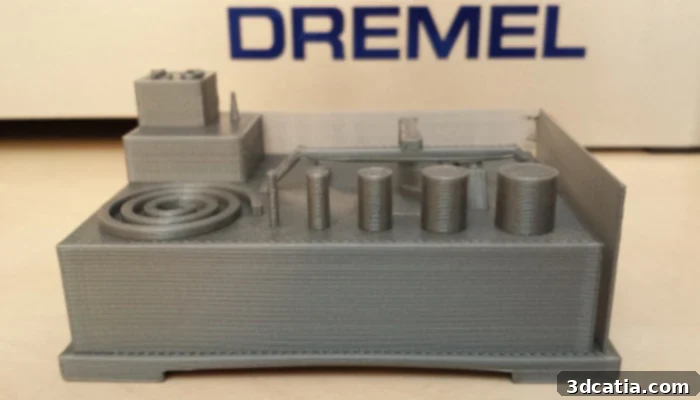
The finished torture test printed out by the Dremel Idea Builder. We were quite impressed with the quality.
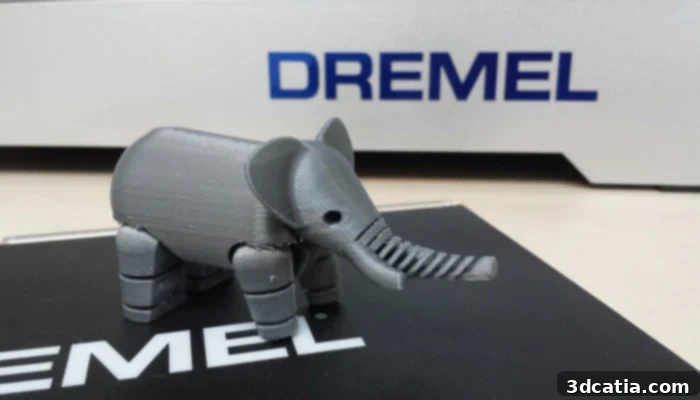
Another model 3D printed by the Dremel Idea Builder.
Conclusion: Is the Dremel Idea Builder Right for You?
After comprehensive testing, the Dremel Idea Builder unequivocally proves itself as a formidable entrant into the 3D printing market, especially for its target audience. Its “Plug & Play” promise is largely delivered, making the barrier to entry significantly lower for newcomers. The strategic partnership with FlashForge has clearly paid dividends, providing Dremel with a robust, reliable, and refined hardware platform from the outset. The thoughtfully designed physical features, including the enclosed print chamber, removable top, and intuitive full-color IPS touchscreen, all contribute to a smooth and enjoyable user experience. Installation is genuinely simple, and the guided filament loading process, coupled with the convenient internal memory, enhances operational ease.
The Dremel 3D software is another highlight, balancing simplicity for beginners with enough advanced settings to satisfy more experienced users seeking to fine-tune their prints. The ability to manipulate models, adjust critical print parameters like temperature, infill, layer height, and speed, all within a comprehensive and intuitive interface, is a significant advantage. Most importantly, the print performance is where the Idea Builder truly shines. Consistently clean, detailed, and accurate results, evidenced by its successful navigation of our challenging torture test, confirm its capabilities as a reliable 3D printer. While the absence of a spatula or pliers in the accessory kit is a minor point, it doesn’t detract from the overall excellent package.
The Dremel Idea Builder is particularly well-suited for beginners, educational institutions, and DIY enthusiasts who value ease of use, reliability, and consistent quality over highly specialized features or an open-source, tinkering-heavy experience. It offers a hassle-free introduction to the world of additive manufacturing, empowering users to bring their creative visions to life with minimal fuss. For those looking to confidently step into 3D printing with a trustworthy brand, the Dremel Idea Builder represents a compelling and well-executed solution.
What are your thoughts on the Dremel Idea Builder? Have you had a chance to try it out? We’d love to hear your experiences and opinions in the comments section below! You can also join the conversation and connect with us on our Facebook and Twitter pages. And don’t forget to sign up for our free weekly Newsletter to stay informed with all the latest news, reviews, and innovations in the exciting world of 3D printing, delivered directly to your inbox!