
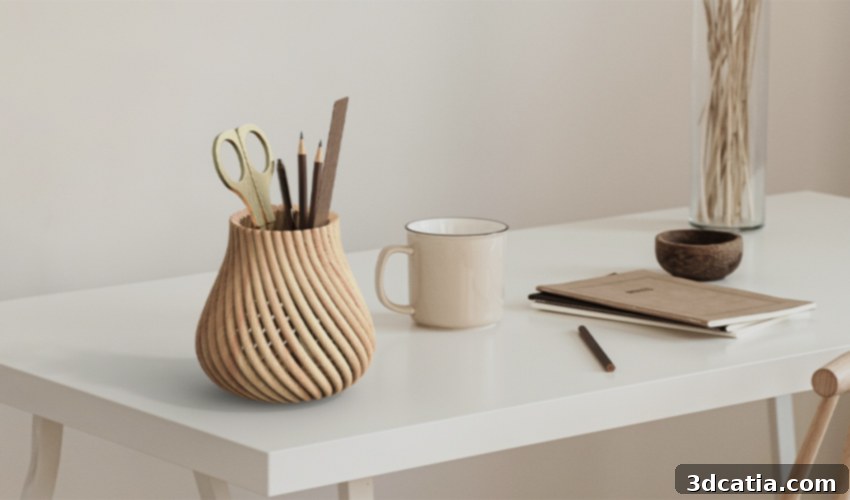
Revolutionizing Wood Manufacturing: Desktop Metal and Forust Pioneer Sustainable 3D Printed Wood
Desktop Metal, a leader in the additive manufacturing space, has consistently demonstrated a forward-thinking approach to expanding its market presence and technological capabilities. Following its significant acquisition of EnvisionTEC, a historical frontrunner in resin 3D printing, Desktop Metal signaled its clear intention to aggressively penetrate and innovate within the resin additive manufacturing sector. However, the American giant’s ambitions extend far beyond conventional materials. A pivotal announcement recently unveiled a groundbreaking partnership with Forust Corporation, a pioneering company dedicated to additive manufacturing utilizing wood-based materials. This strategic collaboration, simply named Forust, empowers Desktop Metal to strategically position itself at the forefront of 3D printing functional, aesthetically pleasing, and remarkably sustainable wooden parts.
The innovative manufacturing process at the heart of the Forust project leverages Desktop Metal’s well-established binder jet technology. Crucially, this method doesn’t rely on virgin timber, but instead harnesses industrial wood waste, specifically sawdust and lignin. By transforming these abundant by-products of the timber industry into a viable feedstock for 3D printing, Forust is not just creating new products; it’s redefining the very concept of material utilization and waste reduction within manufacturing. This initiative represents a significant stride towards a more circular economy, offering an unprecedented method for creating complex wood structures that are both economically efficient and environmentally responsible.
Through the Forust collaboration, Desktop Metal is introducing an entirely new paradigm for architects, manufacturers, and designers worldwide. This method promises not only a more durable and efficient production process but also an inherently more aesthetic outcome. The claim from the manufacturer is compelling: parts created using the Forust process are virtually indistinguishable from those produced via conventional woodworking techniques. This opens up vast possibilities for applications where the natural look and feel of wood are paramount, without the ecological footprint often associated with traditional wood sourcing. Leading voices in sustainable design are recognizing the profound implications of this technology. Architect William McDonough, renowned for his efforts to revolutionize waste utilization in design and manufacturing, passionately articulates the transformative potential:
“The Forust technology allows us to take something that was previously wood waste and re-materialize it into exquisitely beautiful and useful things. We are honoring the cellulose and lignin of the trees by rearticulating them into assets for present and future generations.”
McDonough further emphasizes the environmental stewardship enabled by Forust, concluding:
“By allowing millions of trees to remain in place in their forests, Forust is launching a highly evolved technology for the circular technosphere that supports and celebrates stewardship of the natural, regenerative, and diverse biosphere, making it not only smart, but wise.”
This perspective underscores the profound shift Forust represents—moving beyond mere efficiency to embody a deeply ethical and sustainable approach to material consumption and product creation. It highlights the opportunity to conserve natural resources on an unprecedented scale, fostering a manufacturing ecosystem that works in harmony with the environment.
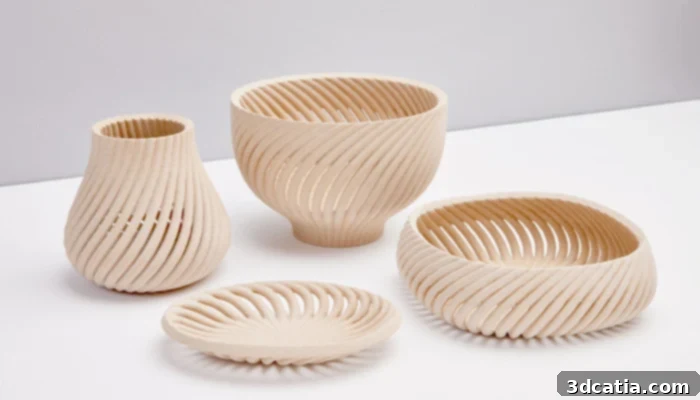
Renowned designer Yves Béhar has pioneered a collection of stunning 3D printed wooden products, showcasing the immense potential of Forust technology (Photo credits: Forust).
Recycling Materials and Driving a Circular Economy Through Advanced Additive Manufacturing
One of the most compelling aspects of the Forust technology is its inherent ability to foster a truly circular economy, transforming what was once industrial waste into valuable resources. From intricately designed home furnishings and sophisticated architectural applications to custom-fitted car interiors, Forust unlocks almost limitless design flexibility, challenging traditional manufacturing constraints. The ability to create complex geometries and customized components that were previously impossible or prohibitively expensive with conventional woodworking methods is a game-changer. This level of design freedom, coupled with the sustainable material source, positions Forust as a trailblazer in modern manufacturing.
The versatility of Forust’s production capabilities is also noteworthy. Depending on the specific size and intricacy of the wooden parts being produced, Forust can utilize a range of Desktop Metal’s advanced binder jetting systems. These include the highly efficient Shop System™ machine, ideal for mid-volume production, and the impressive RAM 336™, a larger-scale system. The RAM 336™, Desktop Metal’s cutting-edge new machine, boasts an expansive print volume of 1800 x 900 x 300 mm and is equipped with a sophisticated robotic arm, allowing for the creation of exceptionally large and complex wooden structures. This suite of machines ensures that Forust can cater to a diverse range of project scales and industrial demands, from bespoke artisanal pieces to large-scale industrial components.
Recognizing that such advanced 3D printers represent a significant capital investment, the American company is committed to making this innovative technology accessible to a wider audience. To this end, Desktop Metal also offers a comprehensive online printing service. This platform allows designers, engineers, and businesses to easily order samples or submit their custom creations for production, effectively democratizing access to sustainable 3D printed wood. This service lowers the barrier to entry, enabling more professionals to experiment with and integrate Forust’s capabilities into their design and manufacturing workflows, fostering broader adoption and innovation within the industry.
With the Forust project, Desktop Metal is not merely introducing a new product line; it is making a powerful statement about the pivotal role 3D printing can play in the evolution of the circular economy. By transforming industrial wood waste like sawdust and lignin into high-value, functional wooden parts through additive manufacturing, the technology empowers users to produce components with intricate geometries that are not only durable but also inherently reusable and biodegradable. This innovative approach significantly reduces reliance on virgin resources, minimizes landfill waste, and offers a compelling model for sustainable production. Andrew Jeffery, CEO of Forust Corporation, encapsulates this ambitious vision for a truly closed-loop system:
“We want to make it easy for designers to explore complex new geometries for a wide variety of products and applications using an age-old material. At the end of the wood product’s life, we would like to see customers have two choices – dispose of it and it will biodegrade over time as any wood product would, or shred it and repurpose the material into future parts through Forust. Our vision is a true circular manufacturing process.”
This long-term perspective highlights the commitment to not just creating sustainable products, but also to establishing an infrastructure for their end-of-life management that aligns with ecological principles. The ability to biodegrade naturally or be shredded and repurposed closes the loop, offering an unparalleled level of sustainability that few manufacturing processes can match. This commitment to a true circular economy positions Forust at the forefront of environmentally responsible manufacturing, setting a new benchmark for the industry. It’s a testament to how innovative technology, combined with a clear environmental vision, can redefine our relationship with materials and production cycles.
Join the Conversation on Sustainable Wood 3D Printing
What are your thoughts on the revolutionary Forust project and its potential to reshape sustainable manufacturing? We’d love to hear from you! Let us know in a comment below or engage with us on our social media channels: Facebook, Twitter, andLinkedIn. Stay ahead of the curve with the latest innovations in additive manufacturing by signing up for our free weeklyNewsletter here, delivering the most important 3D printing news directly to your inbox!
Cover photo credits: Forust – Showcasing the beauty and versatility of 3D printed wooden products.