
Revolutionizing the Future: Top 3D Printing Innovations from Dubai to Deep Space
The world of additive manufacturing continues its relentless pace of innovation, pushing boundaries across diverse sectors, from extraterrestrial habitation to personal desktop fabrication. This week, we delve into some of the most exciting advancements shaping the future of technology and human endeavor. From Dubai’s ambitious Mars Science City, simulating life on the Red Planet using advanced 3D printing, to Relativity Space’s audacious goal of launching fully 3D-printed rockets into orbit, the scope of what’s possible with additive manufacturing is expanding exponentially. We also explore consumer-friendly innovations like Anycubic’s new Vyper 3D printer, making high-quality printing more accessible, alongside critical industrial applications such as optimized jigs and fixtures, and breakthrough materials that enhance durability and performance in demanding environments. Join us as we uncover these groundbreaking projects and understand how 3D printing is not just a technology, but a catalyst for unprecedented progress across industries.
Dubai’s Vision for Mars: The Science City Project
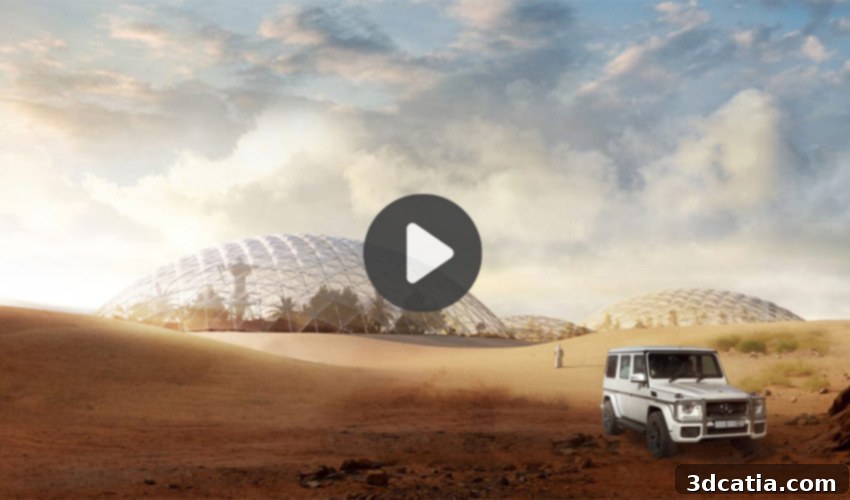
The United Arab Emirates (UAE) has set an audacious long-term goal: to establish a human colony on Mars by the year 2117. This ambitious vision, known as the “Mars 2117 plan,” is a testament to the nation’s commitment to pushing the frontiers of space exploration and scientific innovation. As a critical step towards this monumental objective, the architectural firm BIG (Bjarke Ingels Group) has unveiled an extraordinary project: the Mars Science City. Located in the vast desert landscape just outside Dubai, this sprawling complex is designed to be a fully immersive, 177,000-square-meter city that meticulously simulates the challenging living conditions on Mars.
The Mars Science City is not merely a conceptual blueprint; it is an active research and development hub aiming to address the multifaceted challenges of long-duration space missions and extraterrestrial habitation. Its design incorporates cutting-edge technology and innovative features crucial for sustaining life in a hostile environment. A cornerstone of its construction methodology is the extensive use of 3D printing technology, particularly for fabricating the city’s modular homes. Architects and engineers have ingeniously leveraged readily available desert sand as the primary building material, transforming it into robust structures through advanced additive manufacturing processes. This approach is not only cost-effective but also offers invaluable insights into utilizing in-situ resources—a concept critical for future Martian colonies where transporting building materials from Earth would be prohibitively expensive and logistically complex. The construction process is further enhanced by sophisticated robotic arms, streamlining assembly and demonstrating the potential for automated construction in extreme environments. This project serves as a vital testbed for developing the technologies and strategies necessary for long-term human survival and scientific research on Mars, bringing the UAE’s 2117 vision closer to reality.
Relativity Space Challenges SpaceX with Larger 3D-Printed Rockets
In the burgeoning private space industry, a formidable new challenger has emerged, poised to compete directly with established giants like Elon Musk’s SpaceX. Relativity Space, a company built on the revolutionary premise of 3D printing entire rockets, has recently announced significant milestones, securing over $600 million in funding to accelerate the development and manufacturing of its innovative launch vehicles. Their latest offering, the Terran R, is generating considerable buzz as it aims to match the impressive capabilities of SpaceX’s workhorse, the Falcon 9, in terms of both size and speed, while boasting a fundamentally different and potentially more efficient production paradigm.
The core innovation at Relativity Space lies in its unparalleled use of metal 3D printing, specifically large-scale robotic additive manufacturing. This technology allows them to print complex rocket components, and indeed, entire rocket bodies, with significantly fewer parts than traditionally manufactured rockets. This reduction in component count not only simplifies the supply chain but also drastically cuts down assembly time, promising a faster production cycle. The video highlights how the Terran R achieves its ambitious goals through this advanced manufacturing process. By leveraging metal 3D printing, Relativity Space can achieve intricate designs and optimized geometries that are impossible or too costly with conventional methods. This inherent flexibility in design, coupled with automated manufacturing, also paves the way for a more cost-effective production process compared to competitors. The ability to iterate designs rapidly and produce rockets on demand could disrupt the space launch market, offering greater agility and potentially lower launch costs for satellites and other payloads. As the space race intensifies, Relativity Space’s 3D-printed rockets represent a significant leap forward, demonstrating the transformative power of additive manufacturing in achieving ambitious aerospace feats.
Introducing the Anycubic Vyper: Accessible 3D Printing for All
Anycubic, a highly regarded and popular manufacturer in the desktop 3D printing market, continues to democratize access to additive manufacturing with the launch of its latest FDM (Fused Deposition Modeling) machine, the Anycubic Vyper. Designed to cater to a broad spectrum of users, from complete novices to seasoned professionals, the Vyper brings together an impressive suite of features that enhance usability, performance, and overall value, making high-quality 3D printing more attainable than ever before.
One of the standout attributes of the Vyper, consistent with Anycubic’s philosophy, is its approach to pricing. While some assembly is required, this design choice contributes significantly to keeping the printer’s cost competitive, making it an excellent option for individuals and small businesses operating on a budget. This cost-effectiveness doesn’t come at the expense of functionality, however. The Vyper is packed with incredible features that greatly simplify the printing process. Foremost among these is its advanced auto-leveling system. Manual bed leveling has long been a source of frustration for many 3D printer users, often leading to failed prints and wasted material. The Vyper’s intelligent auto-leveling effectively eliminates this hurdle, ensuring perfect first layers consistently, which is a massive boon for beginners and a time-saver for experienced users. Furthermore, the inclusion of a vibrant 4.3-inch touchscreen interface provides an intuitive and user-friendly experience, allowing for easy navigation through settings and print files. The company also emphasizes the Vyper’s quick installation process, enabling users to get up and running with their first print in minimal time.
Beyond user convenience, the Anycubic Vyper also boasts significant performance improvements. Anycubic claims that the Vyper offers a printing speed up to 30% faster than its previous Mega series printers. This speed enhancement means faster print completion times, increasing efficiency for both hobbyists working on personal projects and professionals producing prototypes or small-batch parts. The combination of ease of use, robust features, and improved speed positions the Anycubic Vyper as a highly versatile and compelling choice for anyone looking to enter or upgrade their experience in the world of 3D printing, solidifying Anycubic’s reputation for delivering accessible innovation.
Optimizing Manufacturing: The Power of 3D Printed Jigs & Fixtures
In the realm of manufacturing, jigs and fixtures are indispensable tools that ensure precision, consistency, and efficiency in production processes. Jigs guide a cutting tool or other devices to perform a specific operation, while fixtures hold a workpiece firmly in a specific position during machining or assembly. Traditionally, these essential tools have been produced using conventional manufacturing methods such as CNC milling or injection molding. However, the advent of 3D printing has introduced a revolutionary alternative, offering distinct advantages that can significantly optimize their creation and application.
The video explores the specific scenarios where 3D printing proves to be an ideal solution for manufacturing jigs and fixtures. It highlights the critical differences between additive manufacturing and traditional production methods, emphasizing how these distinctions translate into tangible benefits in terms of design flexibility, material selection, production time, and overall cost. For instance, 3D printing excels at producing highly complex geometries and custom designs that would be difficult, time-consuming, or prohibitively expensive to achieve with subtractive or mold-based methods. This design freedom allows engineers to create lighter, more ergonomic tools that perfectly conform to unique workpieces or assembly requirements.
When comparing methods, the differences are stark:
- **Design:** 3D printing enables intricate, organic, and custom shapes optimized for specific tasks, often impossible with traditional methods. CNC milling is limited by tool access, and injection molding requires extensive tooling.
- **Material Selection:** While traditional methods offer a wide range, 3D printing, especially industrial additive manufacturing, provides access to advanced polymers and composites with specific properties like high strength, abrasion resistance, or ESD (Electrostatic Discharge) safety, tailored precisely for the jig or fixture’s function.
- **Production Time:** 3D printing offers rapid prototyping and on-demand manufacturing. A custom jig can be designed and printed within hours or days, significantly reducing lead times compared to weeks or months for CNC machining or injection molding tooling.
- **Costs:** For low-volume production or unique custom tools, 3D printing can be far more cost-effective. It eliminates expensive tooling costs associated with injection molding and reduces material waste compared to subtractive manufacturing.
- **Batch Size:** 3D printing is exceptionally well-suited for producing one-off custom jigs or small batches, whereas traditional methods like injection molding only become economical at high volumes.
The number of parts required for a specific jig or fixture is a significant factor in deciding the optimal manufacturing method. For unique, complex, or rapidly needed tools, 3D printing is often the superior choice. The video features expert advice from leading 3D printing manufacturers like Essentium, who provide valuable insights into selecting the right technology and materials to maximize the benefits of additive manufacturing for jigs and fixtures, ultimately boosting efficiency and reducing overhead in manufacturing operations.
Enhancing Durability: Igus iglidur® I3 Material for 3D Printing
Wear and tear are perennial challenges in mechanical systems, particularly in components subjected to constant friction and movement. Traditional materials often fall short in applications requiring high wear resistance, leading to frequent replacements and increased maintenance costs. Addressing this critical issue, the renowned German company igus, a specialist in motion plastics and tribo-polymers, has introduced an innovative material specifically designed for 3D printing: iglidur® I3. This advanced polymer offers significantly enhanced durability and performance compared to conventional 3D printing materials like ABS, especially for parts that experience abrasive forces, such as screw nuts.
The featured video graphically demonstrates the striking difference in wear rates between screw nuts produced with conventional ABS material and those fabricated using igus’s iglidur I3. The iglidur range of materials is specifically engineered to be self-lubricating and highly resistant to wear, making them ideal for bearings, gears, and other moving components. The I3 variant, optimized for FDM 3D printing, brings these benefits directly to the desktop and industrial additive manufacturing space. When used for screw nuts, the iglidur I3 material exhibits a much lower friction coefficient and superior resistance to abrasion, resulting in a substantially longer lifespan for the printed parts. This translates into greater reliability, reduced downtime, and ultimately, significant cost savings over time.
The versatility of iglidur I3 makes it suitable for a wide array of applications, from intricate prototypes and functional components in industrial machinery to durable spare parts and custom solutions for private 3D printing at home. Its ease of printability on standard FDM machines further broadens its appeal. Beyond the capability for users to print these wear-resistant parts themselves, igus also offers the option for customers to have these specialized components manufactured by their in-house experts. This dual approach ensures that both hobbyists and industrial clients can access the benefits of iglidur materials, whether through DIY printing or professionally produced parts. The visual evidence in the video powerfully underscores just how much more resistant and durable the iglidur materials are, highlighting their potential to revolutionize the performance and longevity of 3D printed mechanical components, particularly where friction and wear are primary concerns.
From the ambitious extraterrestrial aspirations of Dubai’s Mars Science City, leveraging 3D printing for future human habitats, to Relativity Space’s bold vision of entirely 3D-printed rockets challenging the very foundations of aerospace manufacturing, the scope of additive manufacturing is continually expanding. These groundbreaking projects, alongside the accessibility offered by desktop printers like the Anycubic Vyper, and the industrial efficiencies gained through 3D printed jigs and specialized materials like iglidur I3, collectively demonstrate the profound and transformative impact of 3D printing across all sectors. This technology is not just enabling new ways of making things; it’s catalyzing unprecedented innovation, driving down costs, accelerating development cycles, and opening up entirely new possibilities for design, engineering, and exploration. The journey from conception to creation is being redefined, making complex ideas tangible and pushing the boundaries of what humanity can achieve.
What are your thoughts on Dubai’s Mars Science City, Relativity Space’s Terran R, the Anycubic Vyper, or the other incredible 3D printing innovations showcased this week? We invite you to share your insights and engage with our community. Let us know in a comment below or join the conversation on our Facebook, Twitter, and LinkedIn pages! Don’t miss out on the latest advancements and news in the additive manufacturing world; sign up for our free weekly Newsletter here, and get the most up-to-date 3D printing news delivered straight to your inbox!