
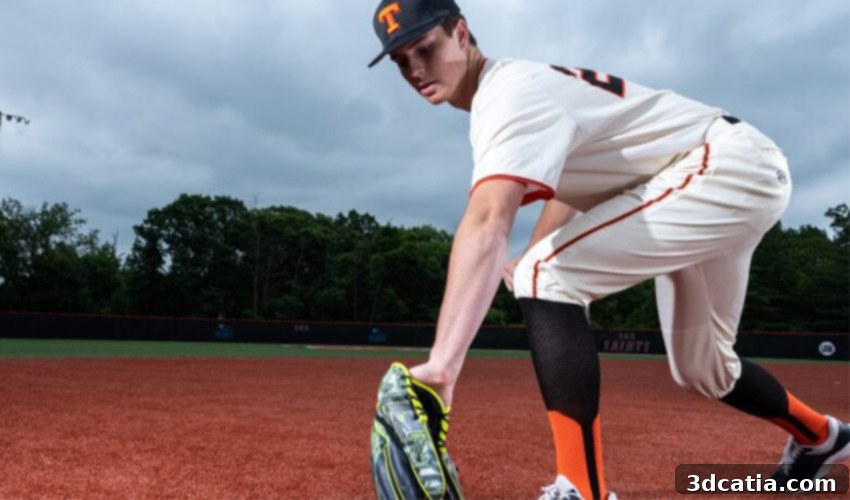
Revolutionizing the Diamond: Carbon’s 3D Printed REV1X Catcher’s Mitt Reshapes Baseball Equipment
The world of sports has long been a fertile ground for technological innovation, constantly seeking advantages that can enhance athlete performance, safety, and equipment durability. Among the pioneers in bringing cutting-edge manufacturing to the athletic arena, Carbon has consistently demonstrated the transformative power of additive manufacturing. Their journey in sports began with remarkable collaborations, notably partnering with Adidas to produce over 100,000 pairs of FutureCraft 4D sneakers. These iconic athletic shoes, featuring intricate lattice midsoles, were brought to life using Carbon’s proprietary Digital Light Synthesis (DLS) technology, showcasing the mass production capabilities of 3D printing in consumer goods. Further solidifying their reputation, Carbon unveiled the first 3D printed hockey helmet liner in 2020, significantly advancing head protection in one of the most physically demanding sports. Now, Carbon is taking its innovative spirit to America’s favorite pastime: baseball. In a groundbreaking collaboration with digital manufacturing experts Fast Radius and venerable baseball equipment specialist Rawlings, Carbon has engineered the REV1X, a revolutionary 3D printed catcher’s mitt designed to redefine performance and protection behind home plate.
This ambitious project, culminating in the REV1X glove, was the result of several years of dedicated research, development, and engineering expertise. The design and prototyping phase heavily leveraged Carbon’s advanced Digital Light Synthesis (DLS™) process, a cornerstone technology that allows for the creation of incredibly complex geometries and durable, functional parts directly from a digital design. Philip DeSimone, Co-Founder and Head of Product and Business Development at Carbon, emphasized the strategic importance of this development. “The REV1X glove,” DeSimone states, “proves that our DLS process speeds time to market by producing working prototypes ready for mass production. The mesh insert is a major step in the design of the glove and brings the latest in additive manufacturing to baseball.” He further conveyed the enthusiasm surrounding this partnership, concluding, “We are delighted to be part of the process with Fast Radius and Rawlings.” This collaboration highlights not only Carbon’s technological prowess but also the synergistic power of combining specialized additive manufacturing expertise with deep industry knowledge in sports equipment and agile digital manufacturing capabilities.
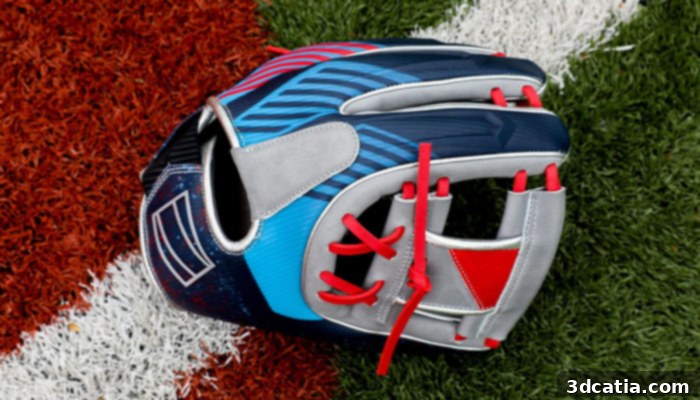
The REV1X glove designed by Rawlings, Fast Radius, and Carbon represents a new era in sports equipment. (Photo Credit: Rawlings)
Understanding Digital Light Synthesis (DLS): The Core of REV1X Innovation
To truly appreciate the advancements embodied in the REV1X glove, it’s essential to understand the technology that underpins its most innovative features: Digital Light Synthesis (DLS). Unlike traditional 3D printing methods, DLS is a photochemical process that uses digital light projection, oxygen permeable optics, and engineering-grade resins to produce exceptionally high-resolution, complex, and durable polymeric parts. This unique process builds parts continuously from a pool of resin, resulting in isotropic mechanical properties that are consistent throughout the printed object. For applications like a baseball glove, where performance and reliability are paramount, DLS offers several critical advantages.
Firstly, DLS enables the creation of intricate lattice structures with remarkable precision. These cellular designs are not possible with conventional manufacturing techniques and are key to the REV1X’s enhanced functionality. Secondly, the speed of the DLS process, coupled with its ability to produce end-use parts directly, significantly accelerates product development cycles. This “idea to market” efficiency was crucial for bringing the sophisticated REV1X from concept to reality in a timeframe that would be challenging with traditional tooling and molding. Thirdly, DLS allows for the use of a wide range of engineering resins, each tailored for specific mechanical properties such as elasticity, rigidity, and impact absorption. This material versatility empowers designers to fine-tune the performance characteristics of different parts within the same product, providing unparalleled customization and optimization.
Revolutionary Features of the 3D Printed REV1X Glove
The integration of Digital Light Synthesis technology was pivotal in allowing engineers to design a truly unique internal finger support system for the REV1X. This innovative system features a bespoke 3D printed lattice structure, specifically engineered to provide targeted support and flexibility where it’s needed most for a catcher. By leveraging additive manufacturing, the design team could move beyond the limitations of traditional materials and methods, which typically involve bulky foams or rigid plastic inserts, to create a solution that is both highly protective and remarkably agile.
Unparalleled Lightweight Design and Optimized Rigidity
One of the most significant advantages of the REV1X is its dramatically reduced weight. Traditional catcher’s mitts, built for maximum protection against high-speed pitches, often come with considerable bulk. The DLS process allows for the creation of hollow lattice structures that use significantly less material without sacrificing structural integrity. This results in an ultra-lightweight glove that reduces fatigue for catchers during long games, allowing them to maintain peak performance throughout. Moreover, the lattice structure’s design can be precisely controlled, enabling varying degrees of rigidity adapted to each individual finger. This means certain areas can be stiffer for enhanced protection and support, while others remain more flexible to allow for natural hand movement and improved ball control, a critical factor for quick transfers and secure catches. This level of customized rigidity is a game-changer, offering a tactile feel and responsiveness that was previously unattainable.
Enhanced Protection, Durability, and a Thinner Profile
Despite its lighter weight and thinner profile, the REV1X does not compromise on protection or durability. The advanced engineering-grade resins used in the DLS process, combined with the optimized lattice design, provide superior impact absorption capabilities. This ensures that the catcher’s hand is well-protected from even the fastest pitches, mitigating the risk of injury. Furthermore, the material properties of the 3D printed components are designed for exceptional longevity, resisting wear and tear from constant use and exposure to the elements, thereby maintaining the high level of durability expected from professional-grade equipment. The ability to create a thinner glove than other gear on the market, while simultaneously incorporating more robust padding, is another testament to the ingenuity of 3D printing. A thinner glove offers catchers a better feel for the ball, crucial for framing pitches and quickly transferring the ball for throws. This enhanced sensitivity, coupled with superior padding, provides an optimal balance of protection and performance that can significantly impact a catcher’s game.
In essence, Carbon encapsulates the core benefits of the REV1X by stating that their glove is “ultra-light, well-fitting and ready to play which provides athletes with consistent playability.” This perfectly summarizes how the tailored fit, minimal weight, and robust construction work in harmony to give catchers a consistent, reliable tool that feels like a natural extension of their hand from the moment they step onto the field.
Beyond the Print: Complementary Design Elements
While the 3D printed components form the innovative heart of the REV1X, other critical features ensure its overall functionality and user experience. Elements such as the slip-on band, the adaptive fit system, and the premium leather palm padding were not 3D printed. Instead, these traditional, yet highly refined, components were integrated seamlessly with the advanced DLS parts. The slip-on band provides a secure and comfortable fit around the wrist, crucial for maintaining stability during intense play. The adaptive fit system allows for personalization to the individual catcher’s hand, ensuring maximum comfort and control. And the high-quality leather palm padding offers the traditional feel, grip, and durability that baseball players expect, acting as a familiar interface between the ball and the revolutionary internal structure. This hybrid approach, combining the best of traditional craftsmanship with cutting-edge additive manufacturing, creates a glove that is truly greater than the sum of its parts, offering a holistic solution for high-performance catchers.
Athlete Endorsement and Real-World Validation
To underscore the quality and performance of the REV1X, Rawlings, Fast Radius, and Carbon enlisted the endorsement of a prominent figure in professional baseball: Francisco Lindor. The New York Mets superstar shortstop, renowned for his exceptional fielding prowess, became the face of the REV1X glove. Lindor’s involvement is not merely symbolic; it represents a crucial real-world validation of the glove’s design and functionality at the highest level of the sport. Professional athletes demand equipment that offers uncompromising performance, durability, and comfort. An endorsement from a player of Lindor’s caliber provides undeniable proof that the 3D printed REV1X meets and exceeds these rigorous standards. His feedback throughout the development process likely played a significant role in refining the glove’s features, ensuring it performs flawlessly under game-day pressure. This collaboration with a top-tier athlete demonstrates that 3D printing is not just a novelty, but a viable and superior manufacturing method for high-stakes sports equipment, capable of delivering tangible benefits to elite performers.
The Broader Impact of 3D Printing in Sports
The success of the REV1X baseball glove is another powerful testament to the ever-expanding role of 3D printing in the world of sports. Once again, additive manufacturing has proven its immense potential to greatly benefit athletes and equipment manufacturers alike. The primary driver behind this benefit is the unparalleled design freedom that 3D printing offers. Traditional manufacturing methods often impose constraints on geometric complexity, leading to compromises in performance or protection. However, technologies like Carbon’s DLS enable engineers to create internal structures, customize fit, and optimize material distribution in ways that were previously impossible.
This freedom translates directly into equipment that is not only lighter and stronger but also precisely tailored to an athlete’s body and specific performance needs. From custom-fit insoles and protective gear to performance-enhancing components in bicycles and running shoes, 3D printing facilitates a new era of personalization and optimization. Beyond individual products, additive manufacturing also streamlines the prototyping process, allowing for faster iterations and quicker time-to-market for innovative designs. This rapid development cycle means athletes can benefit from the latest advancements much sooner, keeping them at the forefront of performance and safety.
Looking Ahead: The Future of Sports Equipment
The REV1X catcher’s mitt represents a significant milestone, but it is merely a glimpse into the future of sports equipment. As additive manufacturing technologies continue to evolve, we can anticipate even more sophisticated and integrated designs. Imagine shoes with dynamically adaptive midsoles that respond to changing terrain, protective pads that conform perfectly to an athlete’s unique contours, or even lightweight components for competitive equipment that push the boundaries of speed and efficiency. The ability to use multi-material printing, embed sensors directly into printed structures, and scale production efficiently suggests a future where every piece of sports equipment is not only high-performing but also highly personalized. Carbon, in collaboration with industry leaders, is at the forefront of this revolution, continually pushing the boundaries of what is possible, ensuring that athletes everywhere have access to the best tools for their success.
What are your thoughts on Carbon’s 3D printed baseball glove and the future of additive manufacturing in sports? Share your insights by leaving a comment below or join the conversation on our Facebook and Twitter pages. Don’t miss out on the latest innovations in 3D printing; sign up for our free weekly newsletter, delivered straight to your inbox!
Photo Credit: Rawlings