
Unlocking the Full Potential of Additive Manufacturing: The Power of Digital Product Passports and Traceability in Binder Jetting
In an era of increasingly complex global supply chains and stringent regulatory demands, the ability to trace parts throughout their entire lifetime has become a paramount concern for manufacturers. Digital manufacturing offers a transformative advantage in this regard, yet many users still struggle to harness its full potential to create truly secure and verifiable records of a part’s journey. This is where the concept of digital product passports (DPPs) emerges as a game-changer. These innovative tools promise to revolutionize quality control, streamline regulatory compliance, and usher in an unprecedented level of supply chain transparency.
To delve deeper into this exciting development, we recently had the opportunity to speak with two leading experts in the field: Henrik Peiss from Desktop Metal and Dr. Ulrich Jahnke from Additive Marking. Our conversation focused on how digital product passports can be seamlessly integrated into Desktop Metal’s advanced additive manufacturing technology, binder jetting, to provide real-time tracking data and unparalleled insights. Throughout this discussion, we explored how this sophisticated approach not only enhances product authenticity and simplifies complex certification processes but also paves the way for widespread industry adoption, transforming the landscape of modern manufacturing.
3DN: Could you tell us about yourself?
HP: My name is Henrik Peiss, and I’ve been a part of the Desktop Metal team since 2021, based out of Germany. In my current role, I lead the EMEA Application Team and also serve as the Sales & Technical Manager for the DACH & Eastern Europe region. My professional background is rooted in mechanical engineering, and I bring over 13 years of extensive experience within the additive manufacturing industry, having worked across various roles and geographies worldwide. This diverse experience has given me a comprehensive understanding of the challenges and opportunities within this rapidly evolving sector.

Dr. Ulrich Jahnke (left) and Henrik Peiss (right)
UJ: I’m Dr. Ulrich Jahnke, and I have accumulated over 15 years of dedicated experience in the realms of 3D printing and the entire additive manufacturing process chain. This extensive background has allowed me to cultivate a deep and specialized expertise in this incredibly dynamic and innovative field. My academic journey commenced with a degree in engineering informatics, which provided a strong foundation for my subsequent research activities at Paderborn University, specifically within the highly regarded Direct Manufacturing Research Center (DMRC).
In 2018, I co-founded Additive Marking alongside two partners, driven by a clear and ambitious vision: to implement robust traceability solutions directly into 3D-printed components. This initiative was born from the desire to actualize the principles of Industry 4.0 at the most fundamental level – the shop floor. Our innovative technology serves as a crucial bridge, connecting the digital and physical realms by assigning unique digital identities not only to tangible assets produced through additive manufacturing but also to those created conventionally.
Since 2020, I have been passionately committed to realizing the comprehensive vision of Additive Marking, striving for end-to-end traceability that extends far beyond just additive manufacturing, encompassing the broader industrial landscape. Today, our service and product portfolio has expanded significantly. It now includes advanced automation of laser marking, dot peening, and labeling processes, as well as the sophisticated management of digital product passports through our proprietary Additive Marking Suite. Naturally, we don’t merely supply hardware and software for marking and scanning; we provide holistic solutions, which means that a methodical mixture of specialized training and expert consulting is an essential and mandatory part of our offering.
3DN: What is the importance of product traceability in additive manufacturing?
HP: Product traceability is absolutely vital in additive manufacturing (AM) for several critical reasons. Fundamentally, AM is a batch-based process. This means that for a single build job in technologies like binder jetting, we are dealing with a specific lot of powder and binder liquid, coupled with unique surrounding environmental conditions and the current wear status of the machine. To ensure rigorous quality control and maintain accountability, it’s imperative to be able to trace a part not only back to a specific build job but even down to its precise location within that build. This granular level of detail allows for accurate defect analysis and process optimization.
This level of traceability becomes especially critical when manufacturing parts for highly regulated industries such as aerospace, defense, and medical technology. The exacting quality standards in these sectors necessitate comprehensive quality checks and meticulous documentation for each individual part produced. Additive manufacturing, by its very nature as a digital manufacturing technology, offers unparalleled opportunities for automatic, unique part marking directly during the digital print preparation process. This inherent capability allows for the integration of traceability features from the earliest stages of production, setting it apart from traditional manufacturing methods.
UJ: I completely agree with Henrik. Product traceability in additive manufacturing (AM) is not merely a beneficial feature; it plays a truly vital role in ensuring stringent quality control, maximizing operational efficiency, and guaranteeing regulatory compliance across the board. One of the most significant advantages of robust traceability is its ability to empower manufacturers to track each individual part through its entire production chain and, indeed, its whole lifecycle. This comprehensive tracking spans from initial data preparation, through production, subsequent post-processing, and rigorous quality assurance, all the way to logistics, the actual usage phase, and ultimately, recycling.
This comprehensive overview is particularly crucial in AM, where the final material properties and precise dimensional accuracy of a component are intricately determined during the manufacturing process itself. Even seemingly less relevant parameters, such as build orientation and exact positioning within the build volume, can significantly influence these critical properties. This underscores why achieving traceability from the very first moment of a part’s production is absolutely essential. And this is precisely where the strength and unique advantage of Additive Marking lie: it enables direct part identification to be embedded during production, eliminating the need for separate, often error-prone, additional labeling processes.
Unlike conventional manufacturing, where external labeling methods can introduce risks of mix-ups or errors, the machine-readable identification generated by the Additive Marking Suite can be directly embedded into the part during both the digital design and the physical build process. This intrinsic integration dramatically reduces the potential for mistakes, ensuring that every component is traceable with maximum efficiency and reliability from its inception.
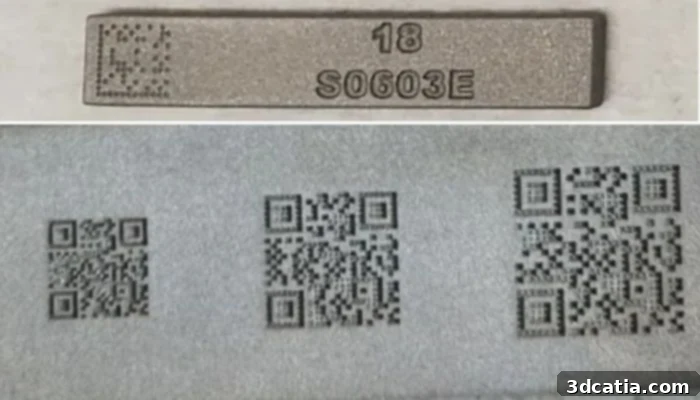
Surface test coupon integrating an Additive Marking dot matrix code which links to the digital pass-x product passport of the part (top). Different sized Additive Marking generated QR-codes on another MBJ part (bottom)
Furthermore, traceability is especially critical in industries where safety and strict regulatory compliance are non-negotiable, such as medical devices or critical aerospace components. It empowers manufacturers to rapidly identify and effectively address any defects, deviations, or quality issues, thereby enabling swift and efficient recalls or replacements when necessary, minimizing risks and ensuring public safety. Beyond immediate crisis management, robust traceability significantly strengthens the integrity of the entire supply chain, offering unparalleled visibility. It actively supports the efficient management of digital inventories, allowing for real-time tracking of components and materials, and greatly facilitates the precise tracking of spare parts.
By simply scanning an embedded code on a part—for instance, using our DPM Scan Pro Scan Engine, which is available for iOS, Android, and can also be integrated into stationary industrial camera equipment—manufacturers can instantly access all associated files stored in a digital warehouse. This capability dramatically streamlines part identification, reduces costly downtime, and optimizes maintenance operations, making the entire product lifecycle far more manageable and transparent.
3DN: Could you tell us about digital passports and how they work?
UJ: Digital passports represent a truly revolutionary concept in the realm of product traceability, particularly impactful within additive manufacturing and beyond. At its core, a digital passport functions as a comprehensive, living digital record for each individual component. It meticulously encapsulates all essential information, ranging from precise material specifications and detailed manufacturing processes to specific processing parameters, critical quality control data, and even the unique maintenance history of that specific part. This wealth of information is securely stored in a digital format and can be accessed throughout the product’s entire lifecycle simply by scanning the unique code embedded directly into the component, product, or machine.
By consolidating all relevant product data onto a single, easily accessible platform, such as pass-x.eu, digital product passports empower manufacturers to significantly enhance product quality, elevate customer satisfaction, and boost overall operational efficiency. A key advantage of pass-x.eu is its inherent interoperability with parallel hosted platforms, ensured through adherence to common industry standards, fostering a connected ecosystem. Some of the most notable benefits that digital product passports bring include:
- Ensuring robust compliance and seamless adherence to increasingly complex regulatory frameworks, such as the Ecodesign for Sustainable Products Regulation, the General Product Safety Regulation, and the Battery Regulation, minimizing legal risks.
- Offering complete and unwavering traceability and transparency across the entire product lifecycle, from design to disposal, and crucially, leveraging use lifecycle information to inform and optimize next-generation product development and innovation.
- Actively supporting sustainability initiatives and fostering a thriving circular economy by providing crucial data that aids in the efficient recycling, responsible reuse, and effective refurbishment of components and materials, reducing waste and environmental impact.
- Building profound customer confidence and loyalty through unparalleled transparency regarding product origins, manufacturing details, and quality metrics, while also creating valuable cross-selling opportunities by providing access to related products or services.
- Optimizing spare parts management by making identification and re-ordering effortless, and enhancing overall lifecycle tracking, allowing for predictive maintenance and extended product longevity.
HP: In essence, the digital part passport can be conceptualized as a practical implementation of the “digital twin” concept. It serves as the central point for data storage and linking, consolidating all digital information pertaining to a unique, specific part. From a user’s perspective, a digital part passport, as expertly implemented by Additive Marking, represents the logical and crucial second step following the initial establishment of part traceability through unique serial markings directly on the components. While unique markings provide an identifier, the passport breathes life into that identifier by linking it to a wealth of contextual information.
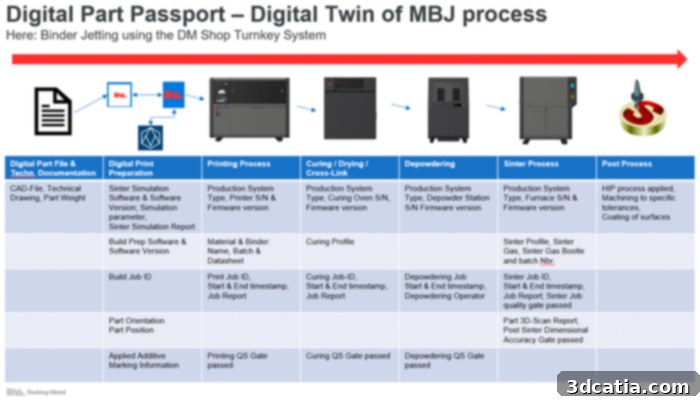
MBJ Process-Chart plus corresponding process step data which have been incorporated into a part’s digital part passport
This passport provides easy access to and secure storage of unique information relating to that specific part. This information is digitally accessible to authorized parties simply by scanning the machine-readable marking embedded on the part itself. A key advantage is the flexibility to configure specific sections of the passport: some sections can be designated for manufacturer-only visibility, containing proprietary process data or internal quality reports, while others can be made accessible to all users, providing essential product information. For instance, by accessing the digital passport, a user can effortlessly retrieve detailed quality reports, comprehensive production data, relevant material data sheets, user manuals, or even intricate part maintenance schedules. Moreover, if a Web-Shop link is seamlessly integrated into the digital passport, a user gains the convenience of being able to re-order the exact part or necessary corresponding supplies directly, simplifying the entire re-procurement process and enhancing customer service.
3DN: What benefits does it bring specifically when we are speaking about binder jetting?
HP: Binder jetting, as an advanced additive manufacturing 2.0 technology, is intrinsically focused on the high-volume serial production of hundreds, or even thousands, of parts. In such a high-throughput environment, the importance of tracking down individual parts with precision escalates dramatically, especially when supplying components to the highly regulated industries we discussed earlier. Beyond these critical applications, the granular traceability provided by digital part passports significantly streamlines the daily operations of running a modern digital additive manufacturing production center. It allows for effortless verification and documentation of passed production steps and internal quality assurance (QA) check-gates, simply by scanning the machine-readable codes on the parts.
A particular and general advantage of combining binder jetting with digital part marking lies in the unique characteristic of part shrinkage during the sintering process. With binder jetting, the printing of a part, along with its integrated digital marking, occurs in an approximately 20% upscaled state. During the subsequent sintering phase, the part shrinks down by this 20%, and critically, the embedded marking shrinks proportionally. This phenomenon becomes immensely important when marking very small, intricate parts—a capability that other additive technologies, such as Laser Powder Bed Fusion (LBPF), often struggle to achieve with the required precision and legibility. This allows for discreet yet fully traceable markings even on the smallest components, expanding the possibilities for binder jetting in diverse applications.
UJ: Traceability in binder jetting offers several profoundly significant benefits, particularly given the inherent complexity of its process chain, which stretches from the initial data preparation all the way to the finished part. Since binder jetting involves multiple intricate stages—including precise data preparation, careful material selection, meticulous layer deposition, controlled curing, and subsequent sintering—robust traceability allows for continuous quality tracking across all these stages. This enables manufacturers to optimize future print jobs, ensuring consistent quality and performance across multiple production runs, especially crucial for parts with complex geometries or those utilizing high-performance materials where deviations can have significant consequences.
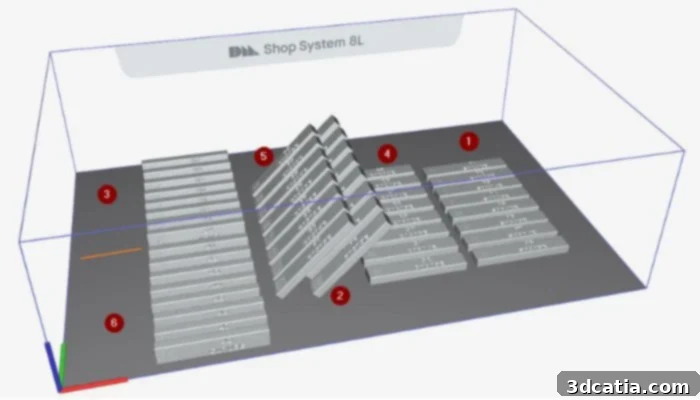
Desktop Metal Shop System Build Volume filled with dot matrix code marked surface test samples. Parts are arranged in different orientations
Thanks to the exceptionally high resolution achievable in binder jetting processes, machine-readable codes can be reliably realized even on the smallest surface areas. This capability is critical for meeting stringent requirements, such as those stipulated by GS1 specifications, thereby ensuring compliance with influential common regulatory bodies like the Medical Device Regulation (MDR). Furthermore, meticulous version control and the management of design iterations in binder jetting are just as important as in any other agile manufacturing technique. Directly embedding unique print marks and identifiers into the digital product data prior to the commencement of production represents the most straightforward and effective method to achieve unparalleled transparency and accountability throughout the entire manufacturing workflow, safeguarding against errors and ensuring accurate part provenance.
3DN: Could you talk us through a practical example touching on a part’s lifecycle?
HP: Let’s consider a compelling practical application: a highly customized part, meticulously serialized with a unique marking that directly links to its comprehensive digital passport. The journey of this part would begin with an [internet] user interacting with a [web-based] customizer software, perhaps within an online web shop, where they define the desired parameters—such as form, texture, material, and coating—for a parametric design. As soon as the user finalizes and saves their bespoke design for production, a unique serial identifier is automatically generated, which immediately initiates the creation of a unique digital passport specifically for that part.
This newly created passport would then receive the user-defined customization parameters as its very first data entries, establishing the part’s initial identity. As the digital part progresses into the production preparation phase, crucial data—including the software versions utilized, the specific settings applied by the print preparation software, and the parameters and results from any part production simulation software—would all be meticulously added to the passport. Since additive manufacturing via binder jetting is a multi-step process, subsequent data from each stage is vital. Binder jetting production status reports, such as detailed print logs and time-lapse records, the specific curing oven profile and its corresponding log, results from depowder inspection quality assurance checks, and the sintering profile and log, including the precise furnace position, would all be seamlessly linked into the digital part passport. Furthermore, information from post-processing steps—like the applied Hot Isostatic Pressing (HIP) process cycle and its logs, the specific coating applied (e.g., by RAL number), and even comprehensive 3D-scan based measurement reports—would also be added, creating a complete and immutable record.
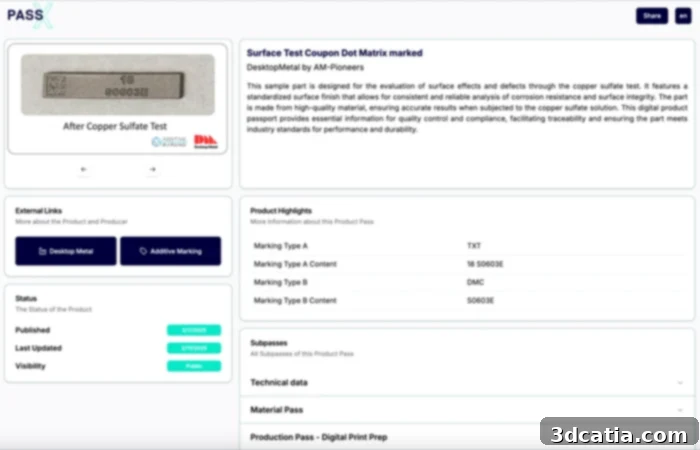
Additive Markings pass-x product passport website in internal setup-View. Shown is the setup-mode of the MBJ production data of a Surface Test Coupon
This comprehensive collection of information effectively constitutes the part’s detailed production documentation, which would typically be accessible only by the producer for internal quality and process management. After production, the part would be integrated into a larger assembly, and the final product subsequently sold to a customer. At this stage, crucial assembly information, the serial number of the final product, and even the part’s calculated carbon footprint could be added to its digital part passport, enhancing transparency and supporting environmental, social, and governance (ESG) reporting. During the usage phase, an end-user could effortlessly scan the part-marking, prompting the linked web-based digital part passport to open in their internet browser. The user-visible content of the digital part passport would then display essential information such as the product manual, detailed part or assembly maintenance schemes, and a convenient link to a web shop for ordering required consumables or even re-ordering the exact customized part. At the end of the specific part’s life, the digital product passport would contain all the necessary information on how to responsibly dispose of or recycle the component, closing the loop for circular economy initiatives.
At Desktop Metal, we’ve successfully leveraged Additive Marking technology in the past to precisely trace parts during an extensive internal material test campaign. This campaign focused on Stainless Steel 316L material processed on our DM Shop System Printer. The images below visually demonstrate an Additive Marking dot matrix label through various stages: in digital part preparation, in its green state (pre-sintering), in its as-sintered state, and finally, after undergoing a successful surface corrosion test, showcasing its resilience. The corresponding x-pass digital part passport for this specific test component can be accessed and explored further HERE.
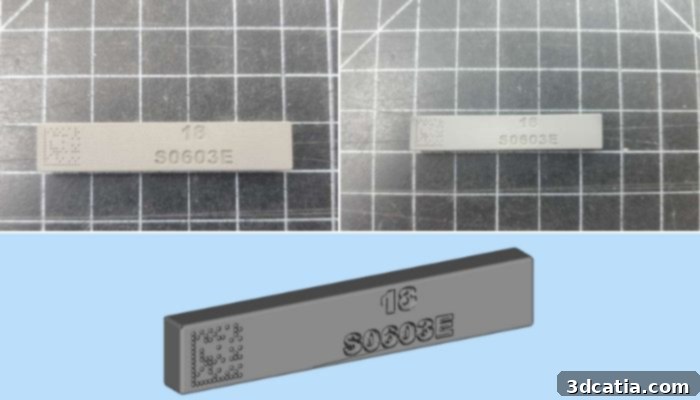
Dot Matrix Code marked Surface Test Coupon during MBJ production. Already in Green state (left) the codes on the parts are machine readable and can be scanned to “check in” parts after passing production step quality gates. The right picture shows the part after Sintering – part & code shrunk to ~20% to its final dimensions. On the bottom, the part is shown in the Digital Part Production Phase, available in the link above
UJ: One of the most compelling and practical examples, both in my daily private and business life, revolves around spare parts for virtually any application, regardless of whether it’s a high-value component or a simple, everyday item. Let’s imagine a critical spare part for a 24/7 processing plant – a component whose failure could lead to significant downtime and cost. This part would embark on a series of meticulously tracked stages, beginning from its initial design, progressing through manufacturing, post-processing, rigorous testing, and culminating in final validation, with a digital product passport diligently tracking its entire lifecycle.
The design of this crucial part is first created using sophisticated CAD software. Crucially, the digital product passport (DPP) is initialized even before physical production begins, typically when the design is ordered and specific requirements are defined. As a foundational data input, the CAD file (including its version), the chosen material, precise geometric specifications, and the desired manufacturing technique are all fully documented within the DPP. When one or more individual instances of that part are produced, each embedded with its own unique serial number (both human and/or machine readable), this process again generates valuable data input for the DPP: material batch numbers, supplier names and certifications, specific material properties of that batch, as well as all relevant data recorded by the AM system during the build.
The next vital step involves linking all post-processing information to the DPP, encompassing timestamps for each station, specific processing parameters applied, details of personnel qualifications involved, and later, the comprehensive reports from quality assurance checks. All this data, inextricably linked to the physical component and easily accessible by simply scanning its individual marking, significantly eases the component’s journey through its further lifecycle. Some powerful examples of how this facilitates various aspects include:
- Certification and Compliance: A third party, such as a regulatory body, can now effortlessly access and link compliance documentation directly to the part, vastly simplifying audits and ensuring adherence to standards like those for medical or aerospace components.
- User Assistance: For the end-user who needs to integrate the component into a larger assembly, vital assistance information for mounting, installation, or troubleshooting is now just one scan and a click away, dramatically reducing errors and speeding up processes.
- On-Demand Ordering and Redesign Feedback: Ordering a replacement has never been easier. Scan the code, be seamlessly forwarded to pass-x.eu, and order a new spare part while simultaneously reporting that the old one is broken. This immediate feedback loop provides the manufacturer with invaluable real-world lifespan information about the broken part, which is crucial for informing and optimizing future redesigns and product improvements.
- Circularity and Waste Management: Traditionally, waste management and achieving circularity are challenging, particularly in identifying materials. With a DPP, it becomes possible to definitively identify the material composition of a component. Again, just one scan, and components can be recycled efficiently and responsibly, as their material properties are precisely known and linked within the material pass section of the digital product passport, supporting truly sustainable practices.
3DN: Any last words?
HP: Thank you for inviting me for this insightful interview. It was a pleasure to discuss such a vital topic. For those interested in exploring further, you can learn more about Desktop Metal, our innovative binder jetting technology, and how we integrate robust traceability solutions by visiting our resources HERE.
UJ: Thank you very much for this engaging and kind interview! I am incredibly enthusiastic about the future of traceability and genuinely look forward to assisting more users in fully harnessing the power of digital product passports to transform their operations. To discover more about Additive Marking and our comprehensive solutions, please visit us HERE.
What are your thoughts on the critical role of product traceability in additive manufacturing and the potential of digital product passports? We encourage you to share your insights and opinions in a comment below or join the conversation on our LinkedIn, Facebook, and Twitter pages! Don’t forget to sign up for our free weekly Newsletter here to receive the latest 3D printing news straight to your inbox! You can also find all our compelling videos on our YouTube channel for more in-depth content.
*All Photo Credits: Desktop Metal/Additive Marking