

Revolutionizing Hiking Comfort: OECHSLER’s 3D Printed Backpack with Advanced Shock-Absorbing Mesh
German manufacturing leader OECHSLER is once again pushing the boundaries of what’s possible with additive manufacturing, setting new benchmarks for innovation within the sector. Their latest breakthrough involves the development of a groundbreaking hiking backpack that, for the first time, integrates an advanced 3D-printed, shock-absorbing mesh material directly into its design. This pioneering creation represents a significant leap forward in ergonomic outdoor gear, promising unprecedented levels of comfort for hikers. The ingenuity of OECHSLER’s proposal did not go unnoticed, earning it the prestigious Red Dot Design Concept Award. This annual accolade celebrates the most outstanding product designs that demonstrate forward-thinking concepts and exceptional execution. With this innovative backpack, OECHSLER’s core mission is to transform the experience of carrying heavy loads over long distances, making hiking journeys significantly more comfortable and enjoyable.
The integration of 3D printing into consumer products, particularly within the sporting goods industry, has repeatedly proven to be a game-changer, offering a multitude of compelling benefits for businesses and end-users alike. Additive manufacturing techniques are increasingly being utilized to produce a vast array of everyday items, showcasing their versatility and potential. Notable examples include the meticulously designed soles of the Adidas 4DFWD sneakers, engineered for optimal performance; the ergonomically crafted Squishy Mouse computer mouse, tailored for enhanced user interaction; and the sophisticated VAEN bicycle saddle, renowned for maximizing rider comfort. What connects all these innovative projects, including OECHSLER’s revolutionary backpack, is a shared reliance on 3D printing to unlock geometric complexities previously unattainable through traditional manufacturing methods. This unparalleled design freedom allows for the creation of intricate lattice structures that are not only exceptionally lightweight but also possess remarkable shock-absorbing properties, ultimately delivering superior comfort and performance for the user.
The Power of Additive Manufacturing for Enhanced Comfort and Performance
The ability of 3D printing to create intricate lattice structures is central to its transformative impact on product design. Unlike solid materials, these open, repeating patterns can be precisely engineered to exhibit specific mechanical properties, such as compression, elasticity, and energy absorption. For applications like a hiking backpack, this means the cushioning can be optimized in different zones to provide support where needed and flexibility elsewhere, adapting dynamically to the wearer’s movements and the load being carried. This level of customization and performance tuning is simply not feasible with conventional foam padding or molded plastics, which often rely on bulky, heavy materials to achieve a similar, though less effective, cushioning effect. Furthermore, the inherent breathability of lattice structures significantly enhances air circulation, a crucial factor for comfort during strenuous outdoor activities. By allowing air to flow freely between the backpack and the wearer’s back, it helps to dissipate heat and moisture, preventing discomfort and chafing, a common issue with traditional backpack designs.
The transition from theoretical design to a tangible, high-performance product like OECHSLER’s backpack highlights the maturity of additive manufacturing technologies. Businesses are increasingly leveraging 3D printing not just for prototyping, but for end-use parts that demand superior functionality, durability, and aesthetics. This paradigm shift is driven by advancements in materials science, leading to high-performance polymers specifically developed for additive manufacturing, and by the evolution of 3D printing hardware that can produce complex geometries with exceptional precision and consistency. The result is a new generation of products that are not only innovative in concept but also robust and reliable in real-world applications, delivering tangible benefits that set them apart in competitive markets.
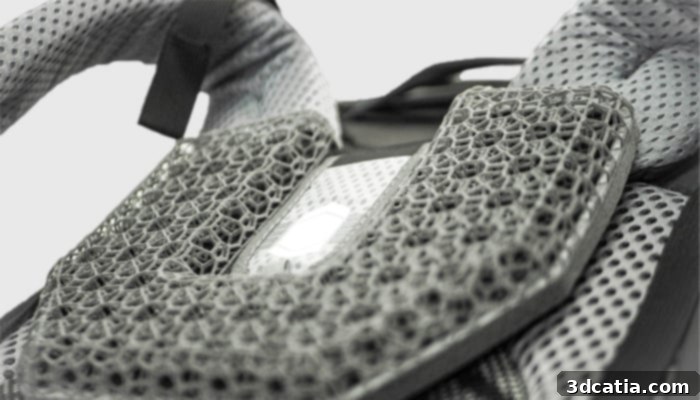
The lattice structure of the shock-absorbing mesh (photo credits: OECHSLER)
Engineering Comfort: The OECHSLER Backpack’s 3D Printed Mesh
The extraordinary damping effect achieved by OECHSLER’s backpack is largely attributable to its ingeniously designed grid structure. At the heart of this innovation is HP’s Multi Jet Fusion (MJF) technology, renowned for its ability to produce functional, high-quality parts with complex geometries at speed. The material of choice for this demanding application was BASF Forward AM’s Ultrasint® TPU01. This thermoplastic polyurethane (TPU) is specifically engineered for additive manufacturing, offering an ideal balance of strength, flexibility, and durability, crucial properties for outdoor gear subjected to rigorous use. The material’s inherent elasticity allows the lattice to absorb impact forces effectively, while its excellent tear resistance ensures the longevity of the backpack’s critical components.
The strategic implementation of a honeycomb design within the backpack’s structure is key to its superior performance. This intricate pattern, carefully integrated into the back panel and hip fins, creates a sophisticated cushioning system. It acts as an intelligent interface between the backpack’s main compartment and the wearer’s back, distributing weight evenly and mitigating pressure points. This design not only provides an exceptional level of comfort by conforming to the body’s contours but also significantly enhances breathability. The open nature of the honeycomb lattice allows for continuous airflow, effectively reducing heat buildup and moisture accumulation, which are common causes of discomfort during long hikes. The selection of Ultrasint® TPU01 further ensures that these printed parts maintain their mechanical integrity and excellent surface quality even under challenging environmental conditions, guaranteeing a reliable and comfortable experience for the hiker.
Advanced Ergonomics, Lightweight Design, and Sustainable Manufacturing
The design philosophy behind OECHSLER’s hiking backpack extends beyond just comfort, encompassing advanced ergonomics, material efficiency, and a strong commitment to sustainability. The entire backpack is meticulously engineered to be more ergonomic than traditional designs, adapting fluidly to the wearer’s body. This bespoke fit not only enhances comfort but also improves load distribution, making heavy packs feel lighter and reducing strain on the hiker’s back and shoulders. Furthermore, the 3D-printed lattice structures are inherently lightweight, allowing the backpack to shed considerable weight compared to designs that rely on bulkier, traditional cushioning materials. The initial spark for this innovation came from a very personal experience: one of OECHSLER’s own AM Program Managers, after a summer vacation filled with hiking, sought a practical solution to the persistent dampness on his shirt where his backpack rested. This real-world problem highlighted the critical need for improved ventilation and comfort, directly inspiring the breathable mesh design.
A cornerstone of this project’s success lies in the unparalleled design flexibility offered by additive manufacturing. This capability allowed OECHSLER to produce complex components such as the back pads and hip fins as a single, unified piece. This monolithic construction dramatically simplifies the manufacturing process by eliminating multiple assembly steps, significantly reducing both assembly time and overall production costs. As OECHSLER emphasized, “Significantly, no gluing or sewing is needed anymore.” This not only streamlines production but also enhances the structural integrity and durability of the backpack by removing common failure points associated with assembled components. Beyond manufacturing efficiency, the project also champions environmental responsibility. Unprocessed powder material from the MJF printing process is fully reused in subsequent print jobs, minimizing waste. Additionally, the printed parts themselves are designed to be 100% recyclable at the end of their lifecycle, aligning with a circular economy model. This holistic approach underscores OECHSLER’s dedication to both pioneering performance and ecological stewardship. You can delve deeper into the specifics of this remarkable project by visiting OECHSLER’s official website HERE.
The Future of Outdoor Gear and Beyond
OECHSLER’s 3D-printed hiking backpack is more than just a product; it’s a testament to the transformative power of additive manufacturing in shaping the future of consumer goods. This innovation serves as a powerful case study demonstrating how complex geometries, advanced materials, and precise engineering can converge to solve real-world problems and significantly enhance user experience. The principles applied here – lightweight design, superior shock absorption, enhanced breathability, and integrated ergonomics – have far-reaching implications. We can anticipate similar lattice structures and 3D printing techniques being adopted across a myriad of other applications, from protective sports equipment and orthopedic supports to customizable seating in automotive and aerospace industries. The ability to create tailor-made, performance-optimized products on demand signals a new era of personalized manufacturing, where consumer needs drive highly efficient and sustainable production methods. OECHSLER’s achievement thus points towards a future where discomfort and design limitations become relics of the past, paving the way for smarter, more adaptable, and environmentally conscious products in every aspect of our lives.
What are your thoughts on OECHSLER’s revolutionary 3D printed backpack? We invite you to share your feedback in a comment below or join the conversation on our LinkedIn,Facebook, andTwitter pages! Don’t miss out on the latest advancements in additive manufacturing; sign up for our free weeklyNewsletter here, delivering the freshest 3D printing news directly to your inbox! For more visual content and in-depth discussions, you can also explore all our videos on ourYouTube channel.
*Cover Photo Credits: OECHSLER