

Revolutionizing the Track: How Chevrolet and 3D Printing Are Driving Motorsports Forward
In a testament to the transformative power of modern manufacturing, Chevrolet, a venerable division of General Motors (GM) since 1918, has announced a significant milestone: its high-performance race cars have collectively covered an astonishing 80,000 miles (approximately 130,000 km) this season, all while utilizing critical 3D printed components. This achievement underscores General Motors’ strategic commitment to placing additive manufacturing at the core of its developmental processes, spanning everything from rapid prototyping to the production of essential end-use parts. A prime example of this innovative approach was seen in January 2020, when two new Corvette C8.Rs made their debut on the racetrack, each incorporating an impressive 75 3D printed parts. These components ranged from crucial functional elements like the oil tank and fuel tank inlet and cap to driver-focused systems such as the cooling box and an integrated hydration system, showcasing the versatility and reliability of additive manufacturing in high-stakes environments.
The adoption of 3D printing in the automotive industry is rapidly expanding, revealing the immense potential of this technology across various applications. Automotive manufacturers are increasingly leveraging additive manufacturing to design and produce a diverse array of components, from high-performance pistons and robust brake pedals to intricate custom parts that enhance vehicle interiors. In today’s competitive landscape, it has become increasingly rare to find a major automotive player that isn’t actively exploring or investing in 3D printing solutions. General Motors stands out as a pioneering force in this regard, having strategically invested in additive manufacturing for several years. Back in 2018, the company publicly revealed that it had realized savings exceeding $300,000 within just two years through the integration of 3D printing. This success fueled an ambitious plan to standardize this advanced manufacturing process, with the goal of designing and producing thousands of finished parts using additive techniques. Given this strong foundational commitment, it is hardly surprising that GM’s iconic Chevrolet subsidiary is enthusiastically integrating additive manufacturing into its production and motorsports activities, pushing the boundaries of what’s possible on and off the track.
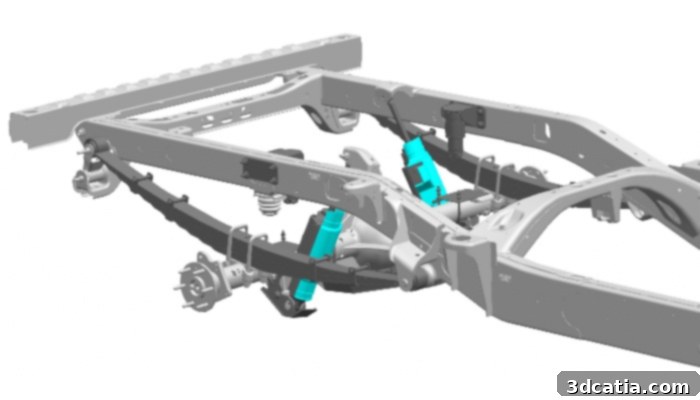
The 3D printed parts were made by GM, including the rear damper shields. (Image credits: General Motors)
The synergy between motorsports and production vehicle development is a cornerstone of innovation at General Motors. Jim Campbell, US Vice President of Performance and Motorsports at General Motors, eloquently articulates this philosophy: “Chevrolet has a long history of technology transfer between our motorsports and production teams, and this is a perfect example of our approach. GM’s 3D printing capability speeds up our learning cycles and, in turn, these racetrack experiences help our additive manufacturing team move one step closer to using 3D printed parts in production vehicles.” This statement highlights a crucial aspect of GM’s strategy: motorsports serve as an accelerated, high-stress testing ground for new technologies. The extreme conditions and relentless pursuit of performance on the track provide invaluable data and insights that directly inform the development and refinement of additive manufacturing processes, ultimately paving the way for their broader application in consumer-grade vehicles. This continuous feedback loop ensures that the innovations proven in competitive racing environments can be efficiently transferred to enhance the quality, performance, and efficiency of future production models.
Unleashing Performance: Chevrolet Race Cars with 3D Printed Parts
Chevrolet’s commitment to leveraging additive manufacturing is evident across its formidable racing divisions, including the iconic Corvette, the high-speed INDYCAR, and the powerful NASCAR Camaro and Silverado teams. These racing teams have been actively fielding vehicles equipped with numerous 3D printed components, demonstrating their robustness and unwavering durability over extensive periods. The impressive 80,000 miles covered since the beginning of the year stand as irrefutable proof of the reliability and performance advantages offered by these advanced parts. A prime example is the new Corvette C8.Rs, which have logged nearly 9,000 miles across just seven grueling races. Each of these cutting-edge vehicles incorporates a remarkable 75 3D printed parts, with 50 of them ingeniously designed and produced in-house by General Motors’ expert teams. These components are not merely aesthetic; they are critical to the vehicle’s performance, contributing to optimized weight distribution, enhanced aerodynamics, and improved system integration. For instance, the customized oil tanks and fuel system components allow for precise fluid management under extreme g-forces, while driver-specific elements like cooling boxes and hydration systems ensure peak human performance throughout demanding races.
The application of additive manufacturing extends strategically to the INDYCAR series, where the exhaust system of the high-octane Indy V6 race car has been partially fabricated using 3D printing. This innovative method was specifically chosen to address and eliminate previously observed structural failures, significantly reduce manufacturing costs, and enable the creation of highly complex designs that would be virtually impossible to achieve with traditional manufacturing techniques. By embracing 3D printing for the exhaust system, engineers were able to consolidate multiple parts into a single, intricately designed component, leading to a substantial reduction in the overall number of parts required. This not only streamlined the assembly process but also reduced the likelihood of connection failures, thereby enhancing the system’s reliability and performance. Furthermore, the freedom of design offered by additive manufacturing allowed for optimized internal geometries, improving exhaust flow and, consequently, engine efficiency and power output—a critical advantage in the highly competitive world of INDYCAR racing.
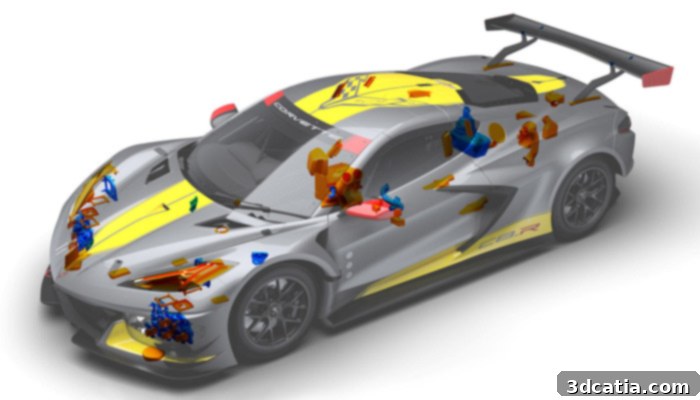
The mid-engine Corvette C8.Rs is equipped with 75 3D printed parts. (Images credits: Chevrolet)
In the challenging arena of NASCAR, additive manufacturing has proven equally indispensable. For the formidable ZL1 1LE vehicle body, more than 500 prototype parts were meticulously 3D printed and rigorously tested in state-of-the-art wind tunnels. This rapid prototyping capability significantly accelerated the aerodynamic development cycle, allowing engineers to quickly iterate on designs, evaluate their performance, and make crucial adjustments without the time and cost constraints associated with traditional manufacturing. This iterative process is vital in motorsports, where even marginal gains in aerodynamics can translate into significant competitive advantages. Beyond prototyping, the ZL1 1LE is also equipped with an advanced 3D printed cooling system, a critical component that has been deployed and proven effective in 27 races, covering well over 80,000 miles. The ability to create complex, optimized cooling channels through additive manufacturing ensures maximum thermal efficiency, preventing overheating and maintaining optimal engine performance throughout gruelling races. This dual application of 3D printing—for both rapid prototyping and robust end-use parts—showcases its profound impact on engineering and performance in professional racing.
Audley Brown, GM Director of Materials Engineering, Additive Design, and Manufacturing, provides a comprehensive overview of the multifaceted benefits derived from this strategic integration: “By utilizing 3D printed parts, Chevrolet Motorsports is demonstrating the many benefits of additive manufacturing, including manufacturing efficiencies, mass reduction, parts consolidation, creativity, and cost savings. 3D printed parts can offer equal strength and durability to cast or milled components, which is critical for product development and design.” This statement encapsulates the core advantages that make additive manufacturing a game-changer for the automotive industry. Manufacturing efficiencies are realized through faster production cycles and on-demand manufacturing, reducing lead times and supply chain complexities. Mass reduction is achieved by designing topologically optimized parts that are stronger for their weight, a crucial factor in motorsports where every gram counts. Parts consolidation simplifies assembly, reduces potential points of failure, and enhances overall structural integrity. The freedom of design inherent in additive manufacturing fosters unprecedented creativity, allowing engineers to develop innovative solutions that were previously impossible. Finally, the demonstrated ability of 3D printed parts to match the strength and durability of conventionally manufactured components, even in demanding racing conditions, solidifies their role not just for prototypes but as reliable end-use parts in future vehicle development and design.
The extensive use and proven success of 3D printed parts in Chevrolet race cars are not just an achievement for motorsports; they represent a significant step forward for the entire automotive industry. This technological transfer from the extreme conditions of the racetrack to future production vehicles promises lighter, more efficient, and more customizable automobiles for consumers. As General Motors continues to push the boundaries of additive manufacturing, we can expect to see an accelerating pace of innovation, leading to a new era of vehicle design and performance. The journey of 80,000 miles is just the beginning, paving the way for a future where 3D printing is a standard, indispensable tool in automotive engineering, driving both exhilarating performance and everyday practicality.
What do you think about Chevrolet race cars achieving such milestones with 3D printed parts? We’d love to hear your thoughts! Let us know in a comment down below or share your opinions on our Facebook and Twitter pages! Don’t forget to sign up for our free weekly Newsletter to receive all the latest news and advancements in 3D printing delivered straight to your inbox!