

The Transformative Power of 4D Printing: Shaping the Future of Manufacturing
In April 2013, a groundbreaking concept was unveiled that promised to revolutionize the world of additive manufacturing. Skylar Tibbits, the visionary founder of the MIT Self-Assembly Lab, hosted a TEDx conference where he introduced what he termed “4D printing.” This innovative technology took the established principles of 3D printing and added an entirely new dimension: time. Tibbits eloquently explained that 4D printing was not just about creating static objects, but imbuing materials with the inherent ability to transform their shape, properties, or functions over a specified period. This remarkable self-transformation occurs autonomously, without direct human intervention, triggered solely by external stimuli such as changes in light, heat, moisture, vibration, or magnetic fields. Essentially, a 4D printed object is a smart material programmed to adapt and evolve in response to its environment.
Since its inception, 4D printing has captured significant attention across a multitude of industries, all eager to explore its vast potential for creating customizable, adaptive devices and structures. The technology’s promise is evident in market reports; the 2019 Gartner Report, for instance, highlighted a surging interest in 4D printing. Projections indicated that by 2023, startups dedicated to advancing this field were expected to attract an impressive $300 million in venture capital. Such rapid growth naturally prompts critical questions about the future trajectory of 4D printing. Will it carve out a niche for itself, or could it potentially supersede traditional additive manufacturing for certain applications? What profound impact will this dimension-adding innovation have on the broader industrial landscape and our daily lives?
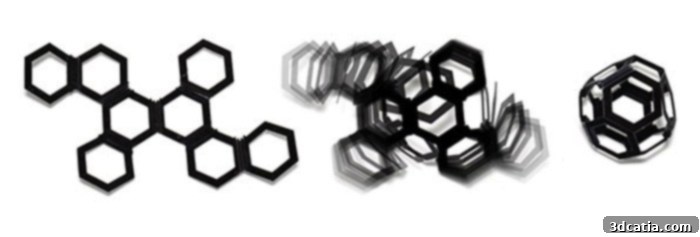
This 3D printed object gradually changes shape due to external factors. In other words it’s a 4D printed object | Credits: Self-Assembly Lab
Unraveling the Mechanics: How 4D Printing Works
At its core, 4D printing draws significant inspiration from the natural phenomenon of self-assembly, a concept far from new. Many are familiar with molecular self-assembly, where molecules spontaneously organize into complex, ordered structures without human intervention – a principle extensively applied in nanotechnology. 4D printing elevates this idea by applying it to macroscopic 3D printed objects. If tiny structures can assemble and reconfigure themselves on a microscopic scale, the logical next step is to enable larger, engineered objects to do the same.
While conventional 3D printing yields objects with a fixed and immutable shape, 4D printing endows these objects with dynamic capabilities. Not only can their shape change, but also their color, size, texture, and even their movement patterns. This is achieved through the use of specialized “intelligent” or “smart” materials. These materials are meticulously programmed during the printing process to exhibit predefined responses when exposed to specific external stimuli. Much like a computer executes code, these smart materials contain embedded “instructions” that dictate their transformation. The most common trigger is temperature, but others include light, pH levels, magnetic fields, or even water immersion. Bastien E. Rapp, President of the Process Technology Laboratory NeptunLab, aptly summarizes this by stating, “4D printing is the functional form of 3D printing. Instead of printing only physical structures, we can now print functions. It’s like embedding a piece of code in a material – once triggered, it does what you programmed it to do.” This functional capability is what truly sets 4D printing apart, allowing for the creation of active, responsive components rather than passive ones.
Key Materials and Technologies in 4D Printing
Given that 4D printing is a relatively nascent field, the range of compatible materials is not as extensive as that found in mature additive manufacturing. However, several distinct and promising material classes are currently at the forefront of research and development. One of the most prominent are shape-memory polymers (SMPs). These remarkable materials possess the ability to “remember” a complex original shape, be deformed into a temporary secondary shape, and then return to their original configuration when exposed to a specific stimulus, most commonly heat. Crucially, this transformation occurs without any permanent residual deformation, ensuring the object’s integrity. Beyond heat, SMPs can also be programmed to respond to other indirect stimuli like magnetic fields, electric currents, or even changes in humidity or immersion in water, offering versatile application potential.
Another significant class of 4D printing materials comprises liquid crystal elastomers (LCEs). As their name implies, LCEs incorporate liquid crystals that are highly sensitive to temperature fluctuations. By carefully controlling the orientation of these liquid crystals during the printing process, researchers can program the material to adopt precise desired shapes. When subjected to changes in temperature, the LCE material undergoes controlled expansion or contraction, transforming according to the embedded “code” or programmed orientation. The third notable material group is hydrogels. These are networks of polymer chains that are largely composed of water, giving them unique properties like high flexibility and biocompatibility. Hydrogels are particularly favored in photopolymerization processes, making them highly attractive for biomedical and soft robotics applications due to their ability to swell or shrink in response to changes in pH or temperature.
Many advanced 4D printing applications leverage multi-material approaches. This often involves combining smart polymers like SMPs or hydrogels with other composite elements, such as carbon fibers, wood fibers, or even different types of polymers. These composites can enhance mechanical strength, direct specific transformation pathways, or even introduce additional functionalities. The MIT Self-Assembly Lab, a pioneer in the field, initiated its foundational research into 4D printing using a Stratasys Connex machine. This system, based on the principle of material jetting, is inherently capable of multi-material printing, which proved crucial for their early experiments. While these are the primary materials, ongoing research is exploring other smart materials for 4D printing, including certain ceramics and advanced metal alloys, pushing the boundaries of what’s possible.
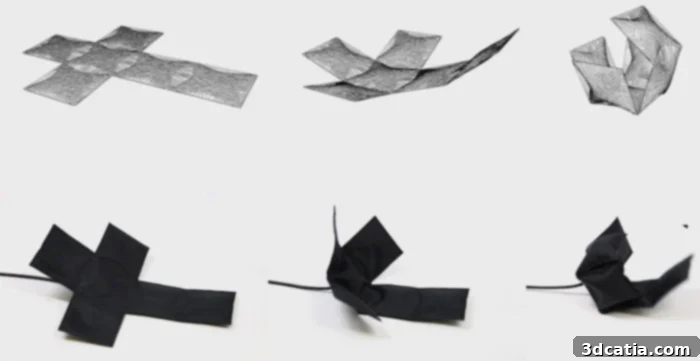
Credits: Self-Assembly Lab
Ultimately, the success of any 4D printing endeavor hinges on a deep understanding of the chosen material’s behavior. As Bastien E. Rapp emphasizes, “a very good knowledge of materials is required to facilitate 4D printing.” This foundational understanding allows engineers to predict and control how the material will react to specific stimuli, designing objects with precise transformative properties. Once this material science is mastered, existing 3D printing technologies can be adapted for 4D printing. These include stereolithography (SLA) for photopolymerizing hydrogels and LCEs, material jetting for its multi-material capabilities, and fused filament fabrication (FFF) for various polymers, especially SMPs. Often, the 3D printers used for 4D applications are enhanced versions of standard machines, specifically modified to accommodate the unique requirements of printing with smart materials and embedding the “4th dimension” programming. Bastien E. Rapp further elaborates on the adaptable nature of the process: “Depending on the complexity of your 4th dimension, it can be as easy as printing two materials in parallel. This may also involve heating or cooling the material during the manufacturing process. There are many methods, all of which require specific conditions.” This highlights the intricate engineering involved in controlling the material’s state during fabrication to ensure the desired future transformation.
Diverse and Impactful 4D Printing Applications
The ability to program an intelligent material to transform on demand opens up an incredibly expansive realm of applications for 4D printing. Imagine an object that can dynamically alter its form, functionality, or responsiveness based on environmental cues. This revolutionary technology has the potential to impact virtually every sector, from enabling the construction of structures that adapt to changing climatic conditions, to consumer goods that intuitively adjust to individual user needs, and critical advancements in the medical field.
One of Skylar Tibbits’ earliest and most practical visions for 4D printing involved the creation of intelligent pipes. These pipes would possess the remarkable ability to change their internal diameter in response to the volume of water flowing through them, optimizing fluid dynamics and preventing blockages. Furthermore, they could autonomously detect and react to subterranean phenomena, such as ground shifts or leaks, by altering their shape. This innovation would dramatically reduce the need for labor-intensive and costly excavation and replacement, offering a sustainable and efficient solution for infrastructure maintenance.
Without a doubt, one of the sectors poised to benefit most significantly from 4D printing is medicine. The technology holds immense promise for developing tailor-made, intelligent, and scalable biomedical devices. For instance, a 4D printed implant could be designed to adapt to a patient’s physiological changes over time, improving integration and long-term viability. This dynamic adaptability could also facilitate real-time monitoring of the implant’s condition, providing crucial data to clinicians. Similarly, in regenerative medicine, 4D printing could revolutionize the fabrication of cellular structures and tissues. By allowing cells to adapt and organize within a scaffold that responds to specific biological cues like body temperature or chemical gradients, it becomes possible to create constructs that more closely mimic natural living tissues. Chloé Devillard, a researcher at 3d.FAB, exemplifies this work, explaining, “We work with 4D printing for applications in tissue engineering and regenerative medicine in order to repair living organisms. In particular, I use it to reproduce a blood vessel that is as close as possible to reality in terms of physiology, function and mechanics. We can create constructions that are as similar as possible to living things.” This research underscores the potential to develop highly functional, biomimetic replacements for damaged organs and tissues.
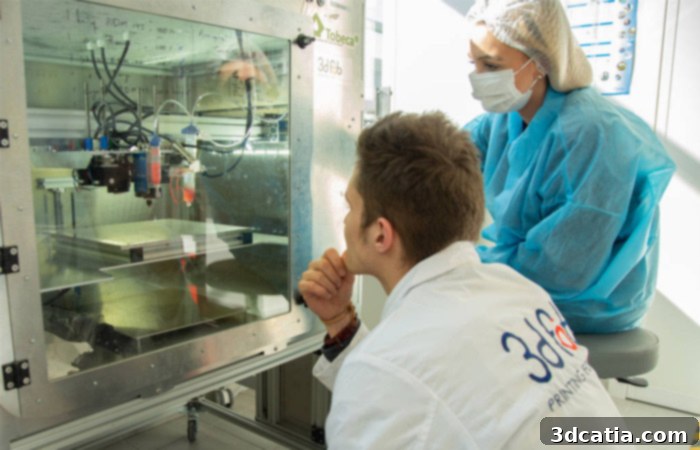
3d.Fab is currently working on 4D printing projects to create blood vessels | Credits: 3d.Fab
Expanding on medical applications, imagine a 4D printed pharmaceutical device capable of controlled drug release, activated precisely by a patient’s internal body temperature. This concept is a core focus of Dr. Fang’s research at MIT. He elaborates, “We want to use body temperature as a trigger. If we can design polymers correctly, we may be able to create a drug delivery device that will only release the drug if a fever develops.” Such smart drug delivery systems could drastically improve treatment efficacy, minimize side effects, and enable highly personalized therapeutic interventions.
The transportation sector, encompassing both automotive and aerospace industries, also holds a keen interest in the potential of 4D printing. In 2018, BMW and MIT collaboratively developed an innovative inflatable material that could change its shape and size when subjected to air pulses. This technology holds immense promise for future tire design, enabling tires that could self-repair punctures or actively adapt their tread patterns and rigidity to extreme weather conditions or varying terrains, thereby enhancing safety and performance. Beyond ground vehicles, the aerospace industry stands to gain significantly. A 4D printed aircraft component could autonomously react to fluctuating atmospheric pressures or temperature changes during flight, dynamically altering its form to optimize aerodynamics or structural integrity. Airbus, a leader in aerospace manufacturing, is actively exploring this. The company envisions these adaptive components replacing complex mechanical systems like hinges and hydraulic actuators, leading to substantial weight reductions – a critical factor for fuel efficiency and reduced emissions – and potentially enabling entirely new forms of active flight control surfaces.
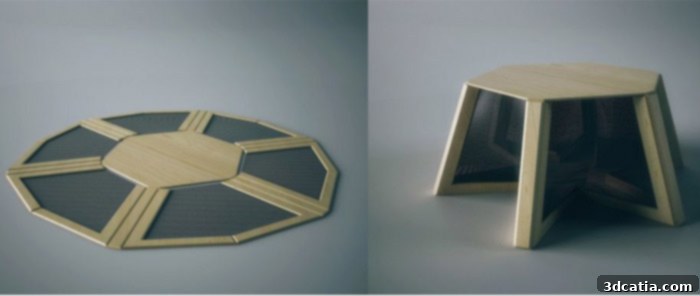
Imagine a stool that folds and unfolds by itself | Credits: Self-Assembly Lab
Ultimately, 4D printing excels in applications demanding a high degree of customization and adaptability. By programming materials to respond to individual needs or dynamic environments, the possibilities become endless. While currently a frontier concept, one can envision clothing that dynamically adjusts to the wearer’s body shape and temperature for optimal comfort, or furniture that folds and unfolds autonomously to maximize space utilization in smart living environments. This ability to create truly “responsive” products marks a fundamental shift in design and manufacturing paradigms.
The Road Ahead: The Future of 4D Printing
Despite its incredible promise, 4D printing, like any emerging technology, faces significant limitations and challenges that need to be addressed before widespread adoption. Key questions revolve around the long-term durability and reliability of these intelligent materials. How will their transformative capabilities hold up against repeated cycles of transformation? What is their real resistance to degradation over extended periods? Will they consistently perform their programmed duties without fatigue or failure in demanding environments? Currently, many companies are still in the experimental phases, meticulously testing these manufacturing processes, and comprehensive long-term results remain largely under wraps.
Another considerable hurdle lies in the highly specialized knowledge required to effectively implement 4D printing. Bastien E. Rapp highlights that the technology demands a profound understanding of material science, design engineering, and advanced manufacturing processes. This inherent complexity makes the democratization of 4D printing significantly more challenging compared to the increasing accessibility of conventional additive manufacturing. He notes, “As this is a rather complex subject, requiring very good material and manufacturing control, it may not become as widely available and accessible as 3D printing itself. But it will nevertheless have a significant impact on the industry.” This suggests that while 4D printing may not become a household technology in the near future, its impact on high-value, specialized industries and niche applications will be transformative, driving innovation in areas where adaptive and responsive materials are crucial.
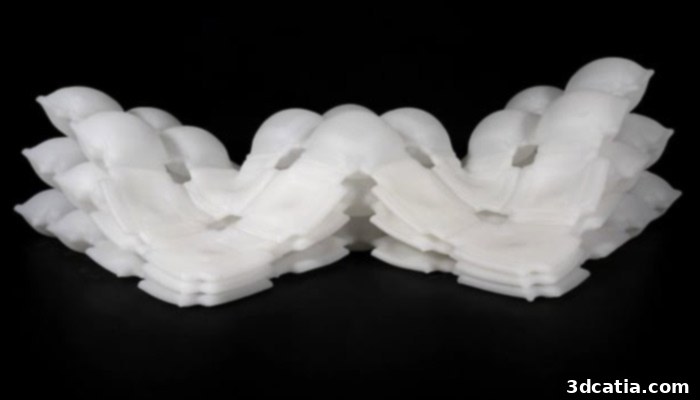
BMW has 4D printed a silicone material that can inflate itself: is this the future of pneumatics?
The journey for 4D printing is just beginning, yet its potential to reshape how we design, manufacture, and interact with objects is undeniable. As research progresses and material science evolves, we can anticipate a future where objects are no longer static entities but dynamic, responsive components that seamlessly integrate with their environment and adapt to our changing needs. This marks a profound paradigm shift from passive products to active, intelligent systems.
What are your thoughts on 4D printing? How do you foresee its impact on current manufacturing processes and the products we use every day? We invite you to share your insights in the comments below or engage with us on our Facebook and Twitter pages! Don’t forget to sign up for our free weekly Newsletter to stay updated on all the latest advancements in 3D printing technology, delivered straight to your inbox!