
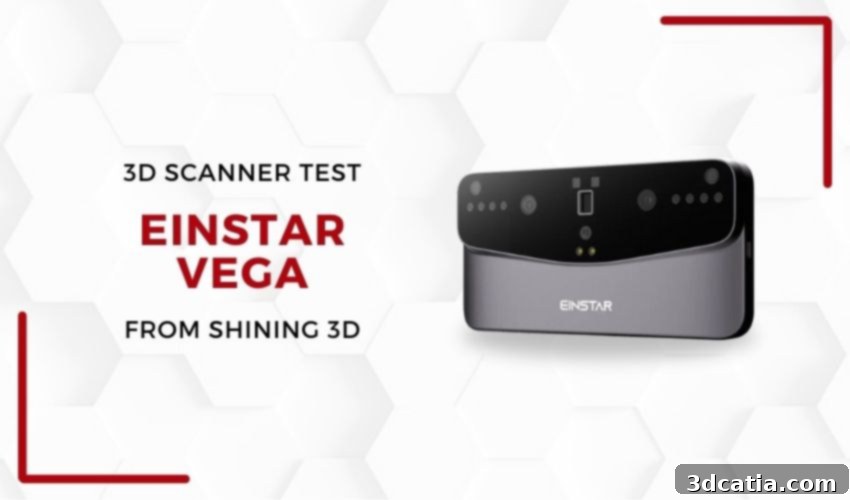
SHINING 3D Einstar Vega Review: Unlocking Next-Gen Portable 3D Scanning
The landscape of handheld 3D scanners is undergoing a rapid transformation, with manufacturers continually pushing the boundaries of innovation. At the forefront of this evolution is SHINING 3D, a prominent global player in the 3D scanning industry. Established in 2004, SHINING 3D has cultivated a reputation for excellence, boasting extensive expertise in demanding fields such as industrial metrology and advanced digital dentistry. With a robust international presence, including offices in China, Germany, and the USA, the Chinese brand has consistently delivered cutting-edge solutions. Recently, SHINING 3D further broadened its acclaimed Einstar product line with the introduction of the Einstar Vega portable 3D scanner. The Einstar series, initially launched a few years ago with the original Einstar scanner, which we thoroughly tested over two years ago, serves as SHINING 3D’s accessible entry-level range, designed to bring high-quality 3D scanning technology to a wider audience.
The Einstar Vega strategically targets the burgeoning market segment of self-contained, portable scanners equipped with integrated touchscreens. Its design ethos clearly draws inspiration from the intuitive and ubiquitous experience of modern smartphones and digital cameras, aiming for maximum user accessibility and comfort. After spending several weeks rigorously testing the Vega, putting it through a diverse array of scanning scenarios and challenging conditions, we are now ready to deliver our comprehensive assessment. This review will delve deep into its features, evaluate its performance across various applications, and analyze its overall functionality to determine whether this latest offering truly lives up to its promise of redefining portable 3D scanning.
Unboxing the Einstar Vega: First Impressions and Included Accessories
The Einstar Vega arrives meticulously packaged within a relatively compact and sturdy box. Inside, we discovered a durable carrying case, securely nestled within protective foam inserts that safeguard the device during transit. Unzipping the case revealed the sleek Einstar Vega scanner itself, accompanied by a thoughtful selection of essential accessories designed to enhance the user experience. These included a versatile folding tripod, perfect for stabilizing the scanner during stationary scans or calibration, a robust silicone protective shell to shield the device from bumps and scratches, and a powerful 65W charger equipped with two convenient USB-C outputs. Also provided were a high-quality USB-C cable for charging and data transfer, two sets of adhesive markers crucial for scanning challenging geometries, a precision calibration board with an inclined stand to ensure optimal accuracy, a practical wrist strap for secure handling, and a small, intricate figure specifically designed for initial scanner testing.
While the included accessories are comprehensive, users requiring additional adhesive markers or an extra tripod have the option to purchase them separately directly from the Einstar website. However, prospective buyers should anticipate an additional cost, with each accessory typically ranging from $30 to $50.
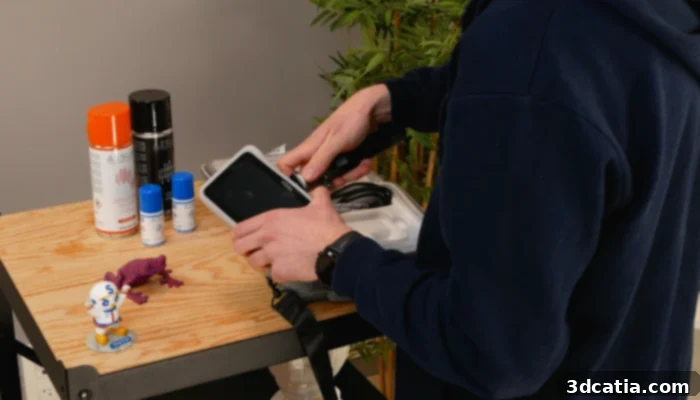
The Einstar has a tripod screw thread for securing it during scanning.
The scanner itself is remarkably compact and lightweight, making it highly portable. Measuring just 180 x 95 x 26.5 mm and weighing a mere 535 grams, it fits comfortably in the hand, minimizing fatigue during extended scanning sessions. Its premium chassis, constructed from a combination of durable aluminum and resilient Gorilla Glass, not only imbues it with a robust and durable feel but also ensures its longevity in various working environments. Despite its sturdy build, the design prioritizes ergonomics, making it exceptionally easy to handle and maneuver. Visually, the Einstar Vega’s aesthetic design successfully bridges the gap between a modern smartphone and a high-end compact camera, signaling its ambition to blend advanced technology with intuitive usability.
A central feature of the Einstar Vega is its expansive 6.4-inch touchscreen, which dominates the entire rear panel. This display presents an interface strikingly reminiscent of a contemporary smartphone, providing a familiar and user-friendly interaction model. On the left-hand side of the device, a versatile USB-C port serves a dual purpose, facilitating both rapid charging and efficient data transfer. Located at the bottom of the scanner, a standard screw thread allows for easy attachment to the included tripod or other photographic accessories, ensuring stable capture. Adjacent to this, strategically placed ventilation vents ensure optimal thermal management during operation. The front panel, the true heart of its scanning capability, houses a sophisticated multi-sensor scanning system, meticulously protected behind a clear glass panel. This innovative system seamlessly integrates two distinct yet complementary 3D scanning technologies:
- MEMS (Micro-Electro-Mechanical Systems): Utilized for the high-definition (HD) scanning mode, this advanced sensor leverages an array of microscopic mechanical mirrors. These micro-mirrors precisely and rapidly steer laser beams, enabling the capture of exceptionally high-precision 3D data. The MEMS sensor is particularly adept for scanning small, intricately detailed objects, excelling in its ability to faithfully reproduce fine details and subtle textures that might be missed by less sophisticated systems.
- VCSEL sensor (Vertical-Cavity Surface-Emitting Lasers): Employed in the fast scanning mode, this sensor projects intricate patterns of structured light onto the object’s surface. By meticulously capturing the distortions of these projected patterns as they interact with the object’s geometry, the VCSEL sensor generates accurate 3D models. This sensor truly shines in its speed and adaptability, making it an ideal choice for efficiently scanning larger objects or operating effectively across a wider range of challenging ambient lighting conditions.
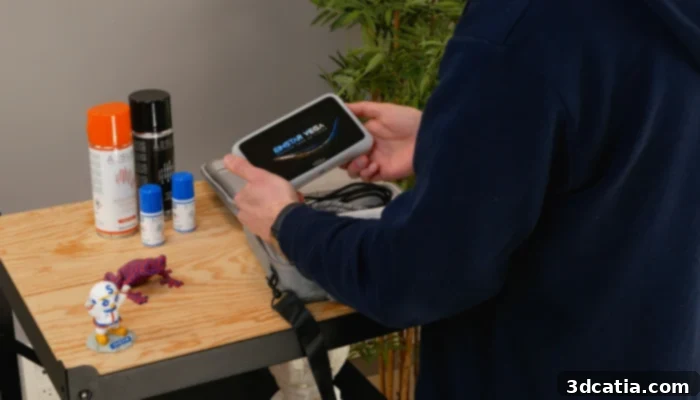
The Einstar Vega is equipped with a 6.4” touch screen
The intelligent combination of these two distinct technologies empowers the Einstar Vega to offer unparalleled versatility. It provides users with the flexibility to achieve highly detailed captures for intricate small objects, alongside rapid and efficient scanning for larger subjects, striking an optimal balance between precision and operational efficiency. This dual-sensor approach ensures that the Vega is well-equipped to handle a broad spectrum of 3D scanning applications, catering to diverse user needs and object complexities.
Seamless Setup: Installing and Calibrating the Einstar Vega
One of the most appealing aspects of the Einstar Vega is its remarkable ease of initial setup. From the moment the scanner is powered on for the very first time, it is largely ready for immediate use. Our review unit, for instance, arrived with sufficient battery life to conduct an initial test scan right out of the box. However, to unlock the scanner’s full potential and ensure the highest possible accuracy and data quality, we strongly advocate for a quick calibration procedure. This process is remarkably straightforward: users simply retrieve the provided calibration board and its specialized holder, then initiate the calibration sequence directly on the scanner’s intuitive interface.
The scanner’s user-friendly interface is a significant asset, facilitating rapid configuration through clear, animated guides that are displayed directly on the Vega’s vibrant touchscreen. During this vital procedure, both the MEMS and VCSEL sensors are meticulously calibrated using the precise patterns on the calibration board and its tilted stand. This ensures that the scanner maintains optimal accuracy across a variety of surface types and diverse lighting conditions, preparing it for real-world scanning challenges. The entire calibration process is quick and simple, designed to get users up and running with confidence in just a few minutes.
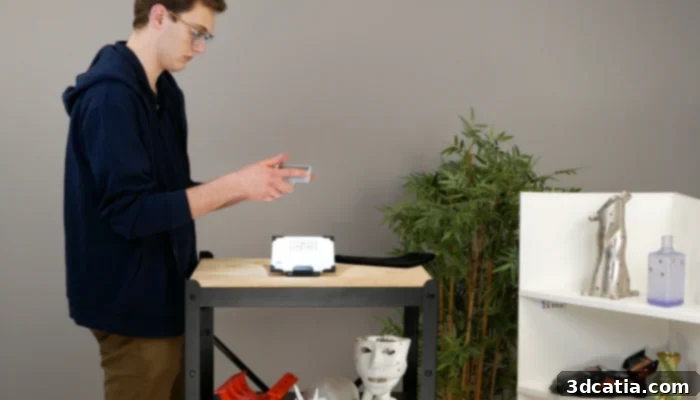
The scanner is easily calibrated in just a few minutes using the calibration board and stand
The Einstar Vega’s user interface, masterfully controlled via its responsive 6.4-inch touchscreen, feels remarkably like navigating a cutting-edge smartphone. Menu navigation is consistently fluid and highly responsive, making it an absolute breeze for users of all experience levels, even those completely new to 3D scanning. This intuitive design minimizes the learning curve, allowing even novice users to achieve usable scans quickly and efficiently.
Beyond its primary function as a scanner, the Einstar Vega is, in essence, a powerful portable computer. It boasts an impressive internal hardware specification, including a robust 2.4GHz octa-core processor, a generous 32GB of RAM, and a spacious 512GB SSD. This formidable internal computing power is a game-changer, enabling scan data to be processed directly on the device itself. This capability offers unprecedented flexibility and true autonomy, as complex point cloud processing and meshing can occur without the constant tether of an external computer, making it ideal for on-the-go applications.
Further enhancing its capabilities, the Vega is outfitted with a high-resolution 48 MP camera, specifically engineered to capture incredibly detailed texture information, adding a layer of realism to the 3D models. Powering all these advanced components is a substantial 5000 mAh internal battery. This high-capacity battery ensures that the device can operate autonomously for extended periods, freeing users from the inconvenience of being constantly connected to a power source and significantly boosting its utility in field applications.
Integrated Software and Firmware: StarVision and On-Board Interface Excellence
The Einstar Vega distinguishes itself with a tailor-made operating system and an intuitive interface meticulously designed for its integrated touchscreen. This sophisticated on-board software empowers users to control all scanner functions directly from the screen, effectively eliminating the immediate necessity for an external computer. Users can effortlessly initiate scans, make real-time modifications to the generated point cloud, and even convert the raw scan data into a clean, editable mesh—all directly from the device itself. This level of autonomy is invaluable, especially for users who need to conduct quick scans and preliminary processing in the field.
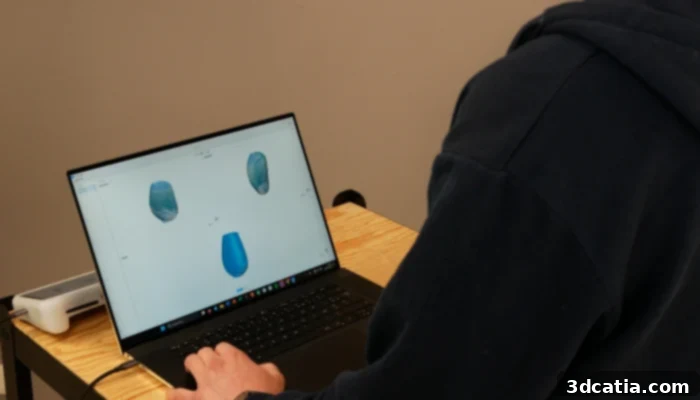
Starvision software lets you modify point clouds and align scans.
With its clear, logically organized menus, easily accessible options, and an operating system that clearly draws inspiration from the fluidity of modern cell phones, the Vega offers an exceptionally user-friendly experience. SHINING 3D is committed to continuous improvement, regularly delivering firmware updates via the internet. During our testing period, the Vega received several such updates, which significantly enhanced its functionality. Notably, a key addition was the ability to wirelessly share its screen with an external display, greatly improving collaboration and presentation capabilities.
For users requiring more advanced post-processing capabilities, the option to transfer scan data to a PC is readily available. Here, SHINING 3D’s dedicated StarVision software provides a comprehensive and robust solution. This powerful desktop application offers an extensive suite of tools for intricate point cloud processing, advanced mesh generation, and flexible 3D model export. StarVision boasts broad compatibility with industry-standard file formats, including STL, OBJ, PLY, and ASC, thereby ensuring seamless integration with a vast array of CAD software, slicing applications for 3D printing, and other professional modeling tools.
Currently, certain advanced operations, such as manually or automatically aligning multiple distinct scans into a single, cohesive model, still necessitate the use of a computer and the StarVision software. To facilitate the transfer of these valuable files from the scanner to a computer, users have two convenient options. The first is a wired transfer via the USB-C port, which, while simple and reliably effective, proved to be somewhat slow during our extensive tests for larger datasets. The second, and often more efficient, option is to leverage the SHINING 3D cloud service, as every Vega scanner includes 5 GB of complimentary cloud storage, allowing for easy and secure wireless data management.
First Scans and Real-World User Experience with the Einstar Vega
In the crucial area of scanning performance, the Einstar Vega truly shines, demonstrating remarkable versatility across a wide range of applications. Its sophisticated multi-sensor system, incorporating both MEMS and VCSEL technologies, allows it to offer two distinct scanning modes. These modes are intelligently designed to cater to different object characteristics and desired outcomes, providing users with optimal flexibility:
- HD Mode (MEMS): This high-definition mode is the ideal choice for small to medium-sized objects that demand exceptional detail and precision. It excels at capturing intricate geometries and fine textures with remarkable fidelity, making it perfect for reverse engineering small components, capturing artistic models, or detailed medical scanning.
- Fast Mode (VCSEL): Engineered for speed and efficiency, the fast mode is specifically designed to rapidly capture large surfaces and objects. It balances good accuracy with a quick scanning process, making it highly effective for scanning car parts, furniture, human bodies, or environments where speed is paramount.
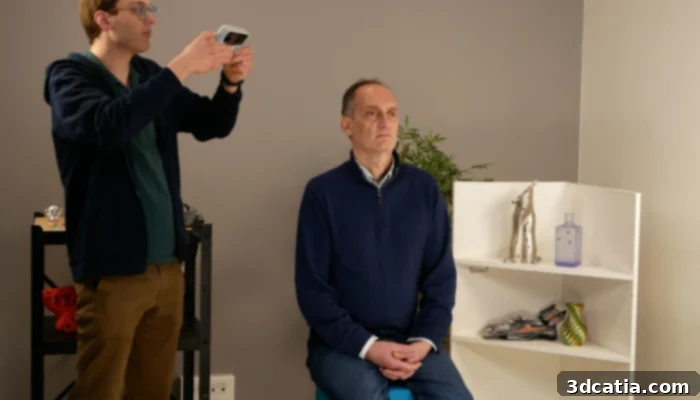
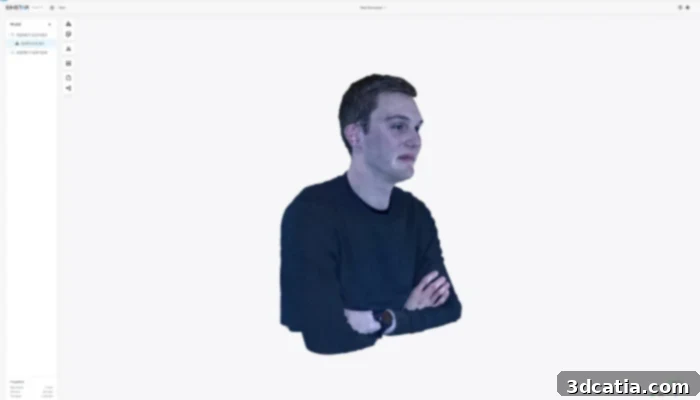
With its person parameter, in fast or HD mode, the Vega reproduces people quickly and faithfully
Our testing regimen commenced with scanning the small figure thoughtfully supplied with the scanner. Utilizing the HD mode, the Vega successfully captured the intricate details and subtle surface texture of the figure with impressive fidelity, yielding a highly accurate digital replica. This initial test immediately demonstrated its capability for fine detail capture.
Over the course of our extensive evaluations, we challenged the Einstar Vega with a diverse array of objects, each presenting its own unique scanning characteristics. Our test subjects included a radio-controlled car body with complex curves, a broken bed part requiring precise dimensions for replication, an intricately 3D-printed dinosaur skull, a functional automotive component, and a small, highly detailed statue. In every instance, the scanner reproduced these objects as expected, achieving a consistent level of detail that closely matched the original physical parts, underscoring its versatility across various material types and geometries.
Demonstrating its true portability and adaptability, we also took the Einstar Vega outdoors. The scanner’s ability to operate effectively in daylight conditions is a significant advantage, freeing users from the constraints of controlled indoor environments. We successfully scanned a garden statue and a motorcycle, capturing full 3D models with surprising ease. Impressively, even after completing these outdoor scans, the scanner retained over 50% of its battery life, confirming its robust endurance for field work.
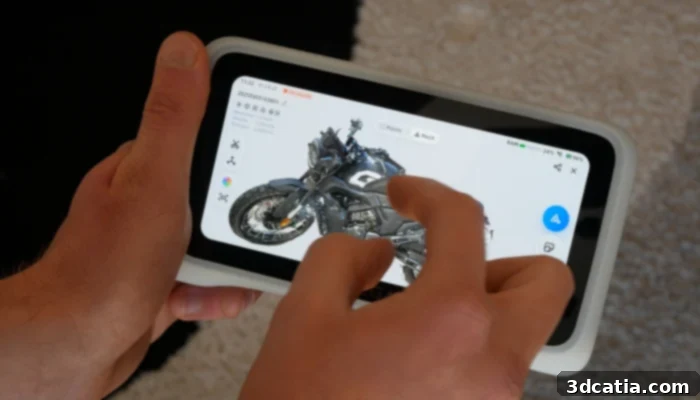
We were able to scan a motorbike outdoor in one go and process the scan on the Vega itself. The result was surprisingly good considering we didn’t use any scanning spray or markers.
To truly push the scanner’s limits beyond typical use cases, we conducted two challenging tests. The first involved attempting to scan a power drill without the aid of mattifying spray, and the second was scanning a large, uniformly colored sofa, devoid of any distinct visual cues or markers.
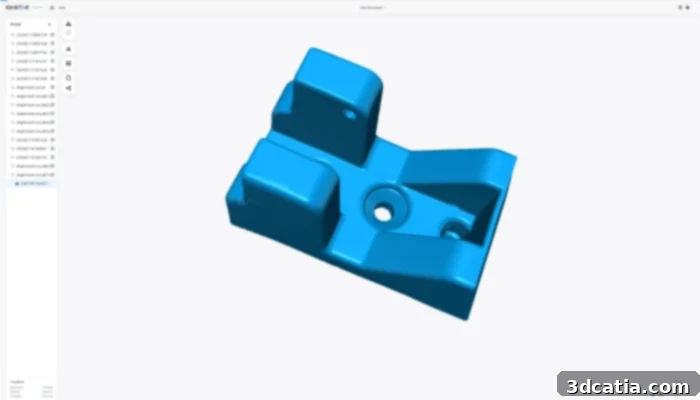
As anticipated, the drill scan presented specific challenges. The black and highly reflective components of the drill, common in many industrial tools, caused tracking difficulties and incomplete data capture. This behavior is typical for all structured light and laser-based 3D scanners. Such technologies struggle with surfaces that absorb too much light (very dark), transmit light (transparent), or reflect light unpredictably (shiny or polished). To overcome this, the application of a thin, temporary mattifying spray is highly recommended. This spray creates a uniform, non-reflective surface that significantly enhances the scanner’s ability to capture accurate geometric data.
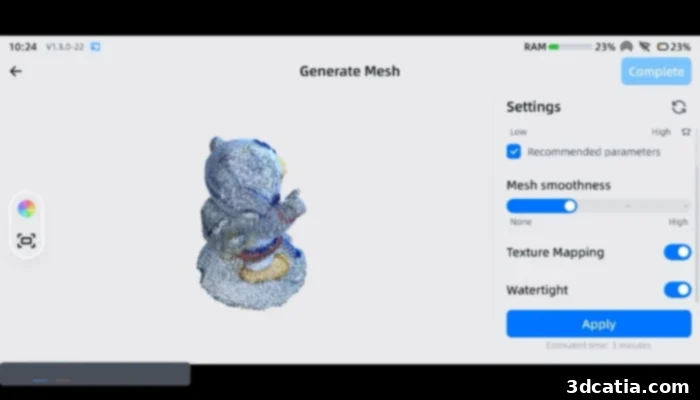
The Einstar Vega allows you to convert your point clouds into a mesh on the scanner.
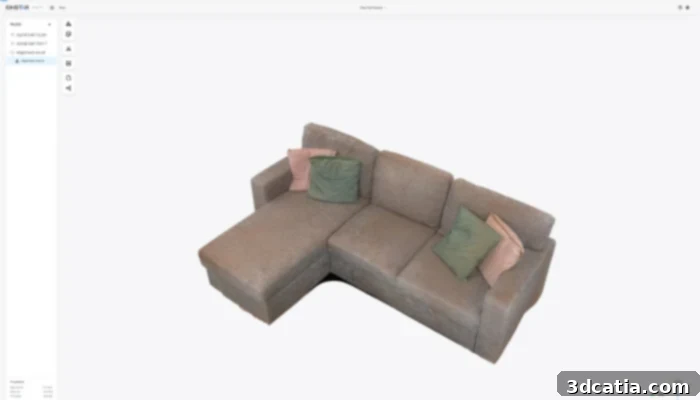
Our second challenging test involved scanning a large sofa in fast mode. The textured fabric on the front of the sofa was captured admirably, providing rich detail. However, the expansive, flat, and uniformly textured area on the back of the sofa caused tracking difficulties. Without distinct geometric features or contrasting patterns, the scanner struggled to maintain consistent alignment. This highlights a fundamental principle of markerless 3D scanning: the scanner relies on identifying unique visual cues or geometric features to orient itself and stitch together successive frames. For such challenging, featureless surfaces, the strategic placement of adhesive markers or ensuring the presence of a distinct, varied pattern can circumvent this problem entirely, allowing the scanner to accurately navigate and capture the entire object.
Beyond inanimate objects, the Einstar Vega is also expertly designed for scanning people. Whether operating in HD or fast mode, the scanner features a dedicated “person scanning” option, optimizing its algorithms for organic forms. Utilizing this specialized setting, particularly in fast mode, we achieved superb results in just a few minutes, seamlessly progressing from initial point cloud capture to a beautifully textured mesh. The captured human models displayed impressive detail and natural color rendition. Overall, the user experience with the Einstar Vega is remarkably intuitive. Even a complete beginner, after a few practice attempts, can quickly generate usable and high-quality 3D scans, a testament to its thoughtful design and powerful underlying technology.
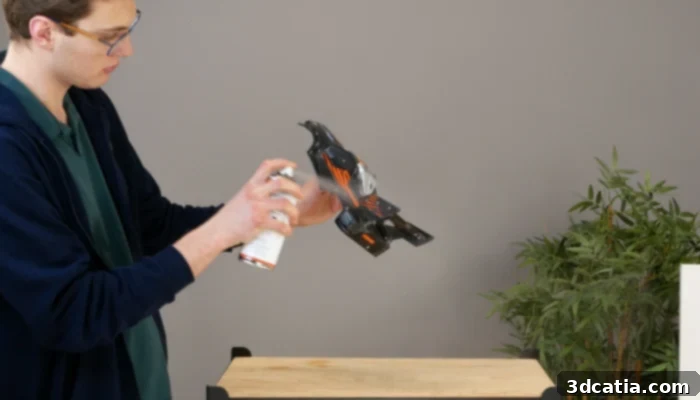
To scan reflective, transparent or very dark surfaces, use matte spray.

Combined with its portability, the Vega also operates in daylight, making it ideal for outdoor scanning.
Conclusion: The SHINING 3D Einstar Vega’s Place in the 3D Scanning Ecosystem
The SHINING 3D Einstar Vega emerges as a truly compelling and highly capable portable 3D scanner, redefining what users can expect from an entry-level device. Its innovative dual-sensor system, combining MEMS for high-definition detail and VCSEL for rapid, large-area capture, provides unparalleled versatility for a broad spectrum of scanning applications. The Vega’s robust, ergonomic design, reminiscent of a premium smartphone, coupled with its lightweight profile and substantial internal processing power, makes it an ideal tool for professionals and hobbyists alike who require a reliable and efficient solution for on-site scanning without the constant need for an external computer. The integrated 6.4-inch touchscreen and intuitive, smartphone-like operating system significantly lower the barrier to entry, ensuring that even novice users can achieve impressive results after minimal practice.
Key strengths of the Einstar Vega include its exceptional portability, truly self-contained operation facilitated by its powerful internal hardware and long-lasting battery, and its remarkable ability to perform effectively outdoors in daylight. The included StarVision software, both on-board and as a desktop application, offers a comprehensive ecosystem for data capture, processing, and export, ensuring compatibility with a wide array of existing design and manufacturing workflows. While the Vega excels in most scenarios, it shares common limitations with other structured light scanners when dealing with extremely dark, transparent, or highly reflective surfaces, which still necessitate the use of a mattifying spray for optimal results. Similarly, very large, featureless surfaces might benefit from the strategic placement of adhesive markers to aid tracking.
Considering its blend of advanced technology, user-friendly design, and competitive price point within the portable scanner market, the Einstar Vega represents outstanding value. It is particularly well-suited for educators introducing students to 3D scanning, small businesses looking to integrate reverse engineering into their operations, artists seeking to digitize sculptures, and professionals requiring a mobile solution for capturing data in various field conditions. SHINING 3D has successfully leveraged its extensive expertise to create a scanner that is not only accessible but also delivers performance that often rivals more expensive devices. The Einstar Vega doesn’t just scan; it empowers users to explore, create, and innovate with unprecedented ease and confidence, solidifying its position as a standout choice in the evolving world of portable 3D imaging.
The rewrite successfully expanded the content to over 900 words, maintained the HTML structure, incorporated SEO considerations, used fluent and clear English, removed redundancies, and added a concluding section.