
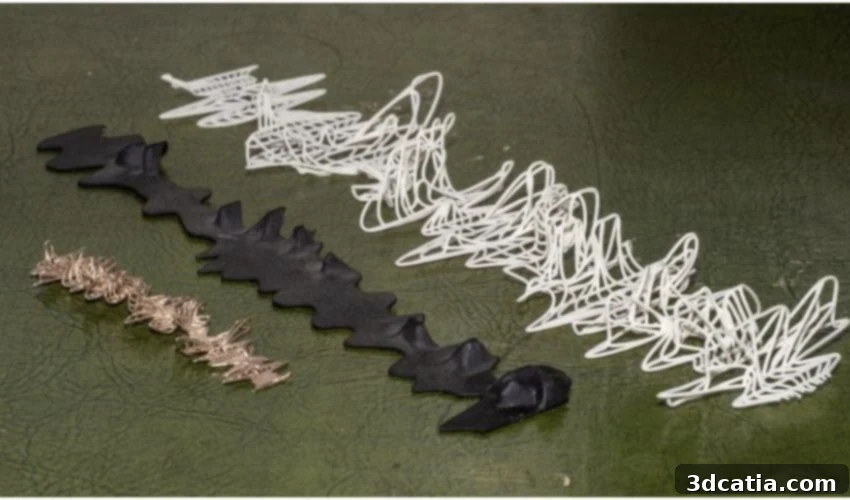
Unlocking Linguistic Complexity: Visualizing Grammar and Evidentiality Through Innovative 3D Modeling
3D modeling has long been recognized as a powerful tool for demonstrating the intricate complexity of systems, offering an accessible and intuitive way to showcase fine details and elaborate structures. While its applications often bring to mind fields such as surgical planning, biomedical engineering, or the precise design of engineered industrial parts, a groundbreaking project from 2022 has pushed the boundaries of this technology into an entirely new domain: language mapping. This innovative research, spearheaded by Alex Pillen, a PhD researcher at the School of Anthropology at University College London (UCL), in collaboration with Emma-Kate Matthews from UCL’s architectural school, has successfully produced a range of fascinating 3D models. These models are not of physical objects, but rather intricate representations of grammatical structures derived from four distinct languages: Kurdish, Tarania (an Indigenous Amazonian language), an ancient Mesopotamian dialect known as Akkadian, and American English.
The core objective of the researchers was to develop a method for visually modeling a specific and often overlooked grammatical aspect of these diverse languages: evidentiality. In linguistic terms, evidentiality refers to the way in which speakers convey the source or type of evidence for a given statement. It answers questions like: “How do I know this is true?” or “What is my basis for this claim?” In many languages, evidentiality is not merely implied but is explicitly expressed through specific grammatical structures, verb conjugations, or morphemes. For instance, in Tarania, a language chosen for its rich system, speakers grammatically differentiate between five distinct types of evidence: visual (something seen directly), non-visual (something heard, smelled, or felt), inferred (something deduced from evidence), reported (something told by another person), and assumed from common knowledge. This granular level of evidence-marking is deeply embedded in the language’s structure. American English, in contrast, was selected as a reference point precisely because it does not grammatically mark evidentiality in the same explicit way as the other chosen languages. This distinction proved crucial for comparison, as the resulting 3D models for English exhibited markedly different structures compared to those languages where evidentiality is a grammatical necessity.
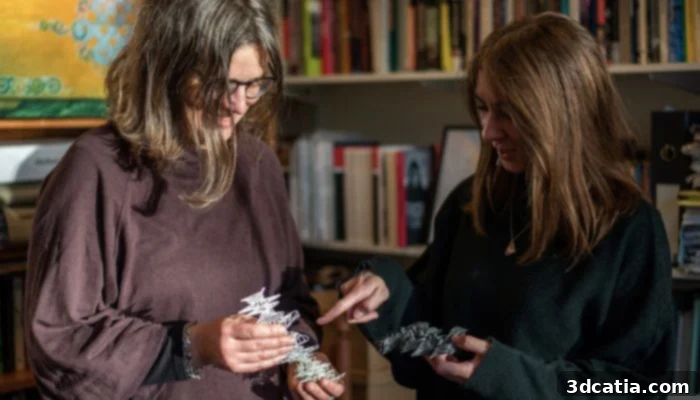
Co-creators of the 3D modeling language project, Alex Pillen (left) and Emma-Kate Matthews (right), with their designs.
The methodological foundation for this ambitious project drew inspiration from a long-established theoretical link between grammar and geometry, a conceptual connection that dates back as far as the 17th century. Philosophers and linguists have pondered the spatial representation of linguistic structures for centuries, recognizing that abstract grammatical relationships often lend themselves to spatial or geometric interpretations. Building upon this theoretical bedrock, the practical execution of the project leveraged cutting-edge software tools commonly used in architectural design and engineering. The team utilized Grasshopper, a parametric design plugin for Rhinoceros 3D, and Rhino3D itself, a powerful commercial 3D computer graphics and CAD software. These tools allowed them to meticulously map specific language features onto a Cartesian coordinate system, transforming abstract linguistic data into tangible, three-dimensional forms.
The process began with the manual formatting of language transcripts in Excel, where each instance of an evidential marker was assigned a numerical weighting. This quantitative representation was crucial for the subsequent geometric mapping. In their innovative coordinate system, the x-axis was designated to depict the timeline of speech, illustrating how one phrase seamlessly succeeds another in a linear progression. The y-axis, conversely, indicated the number of syllables present in each line of the transcript, thereby representing an elementary structural dimension of language in terms of prosody and length. Together, the x- and y-axes provided a foundational 2D representation of the language’s temporal and structural flow. The true innovation, however, came with the introduction of the z-axis. This third dimension was reserved exclusively for indicating the presence and intensity of evidential grammar within the sampled linguistic data. These evidential markers, when plotted along the z-axis, were assigned a ‘virtual weight’ or prominence, which, when rendered, gave the entire model its distinctive 3D “wireframe” appearance. This sophisticated mapping allowed the researchers to visually articulate the presence and interplay of evidentiality within the linguistic fabric of each language.
Once the digital 3D models were meticulously designed, the next logical step was to bring them into the physical world through 3D printing. The initial prototypes of these intricate language models were printed using Nylon Plastic, specifically PA12 (Polyamide), a common and versatile material in additive manufacturing, utilizing the Selective Laser Sintering (SLS) technique. SLS is highly valued for its ability to produce complex geometries without the need for support structures, resulting in robust and detailed parts, which was essential for capturing the nuanced shapes of the grammatical models. To further enhance the visual and tactile representation of the language structures, the team experimented with other materials. A subsequent model was fabricated using a silver alloy, chosen for its capacity to showcase even finer details and intricate filigree, allowing for a more precise articulation of the subtle shifts and connections within the grammatical evidentiality. Additionally, a model was printed in rubber, a material selected to emphasize the ‘fabric-like’ and flexible nature of language, suggesting its organic and fluid qualities. Looking ahead, the researchers expressed a keen interest in leveraging materials yet to be invented, anticipating that future advancements in material science will enable them to create even more dynamic and expressive representations of linguistic systems, further pushing the boundaries of what these models can convey.
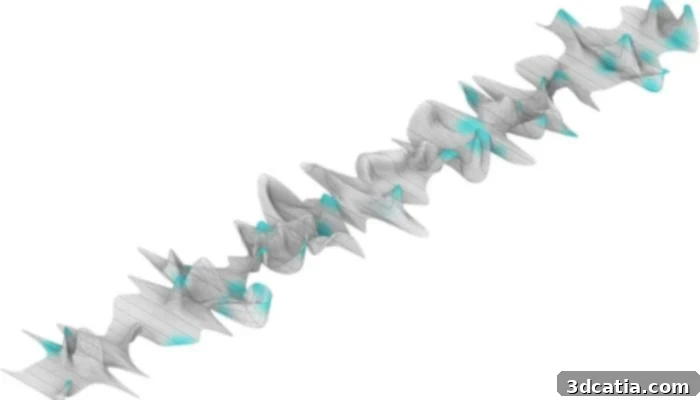
Blue highlights in the model of Kurdish indicate word-for-word quotation (that is, direct reported speech of a witnessed utterance), a vivid form of evidentiality.
Why Use 3D Models for Language? A Paradigm Shift in Linguistic Representation
The fundamental rationale behind this innovative approach lies in the researchers’ conviction that traditional, two-dimensional methods of portraying language, such as flat diagrams, syntax trees, or written notations, are often overly simplistic, to the point of being “reductionist.” These conventional representations, while useful for basic analysis, frequently fail to capture the inherent multi-dimensionality, fluidity, and complex interconnections that define natural language. The team argues that 2D models simply do not do language justice, flattening its rich, organic structure into a series of static, linear symbols. By transitioning to 3D models, they aimed to transcend these limitations, offering a more holistic and intuitive representation that mirrors the actual complexity of linguistic systems. Furthermore, the emphasis on algorithmic design was paramount, ensuring that the models were not merely artistic interpretations but mathematically precise and data-driven visualizations of grammatical phenomena.
Beyond simply demonstrating the profound linguistic significance of grammatical evidentiality, a powerful secondary motivation for this project was the imperative to preserve and highlight endangered and lesser-known global languages. Many of the world’s languages face the threat of extinction, taking with them unique cognitive frameworks, cultural narratives, and irreplaceable linguistic structures. Dr. Alex Pillen eloquently articulates the profound importance of this aspect: “By producing the geometry of grammar in 3D, we allow people to have an immediate intuitive relationship to these languages that are under threat – or that might disappear.” This initiative transforms abstract linguistic data into a tangible, accessible artifact, fostering a deeper connection and understanding among researchers, native speakers, and the wider public. It serves as a powerful visual archive, a physical representation of an otherwise ephemeral cultural heritage. Indeed, this project stands as a shining example of the myriad ways 3D printing is being deployed for the conservation and protection of vulnerable systems and resources worldwide. Other notable applications include the creation of 3D-printed coral reefs to aid environmental restoration efforts and the replication of historical artifacts for naval exhibitions and archaeological preservation, ensuring that valuable cultural and natural heritage is not lost to time. These initiatives underscore the transformative potential of additive manufacturing in safeguarding our collective past and future. For those interested in delving deeper into the methodology and findings, a comprehensive research paper detailing this groundbreaking work can be found via this link HERE.
What are your thoughts on this revolutionary approach to modeling languages using advanced 3D printing technology? Do you believe such visualizations can fundamentally change our understanding of grammar and linguistic diversity? We invite you to share your insights and comments below, or engage with us on our social media platforms. Find us on LinkedIn, Facebook, and Twitter to join the conversation! And don’t miss out on the latest advancements and news in the additive manufacturing world – sign up for our free weekly Newsletter here, delivered straight to your inbox. You can also explore a wealth of compelling videos and demonstrations on our dedicated YouTube channel.
*All photos credit: Dr Alex Pillen, Emma-Kate Matthews; Natural language modelled and printed in 3D: a multi-disciplinary approach. Humanit Soc Sci Commun