
Revolutionary 3D Printed Wearables: A New Era of DEET-Free Mosquito Repellent Technology
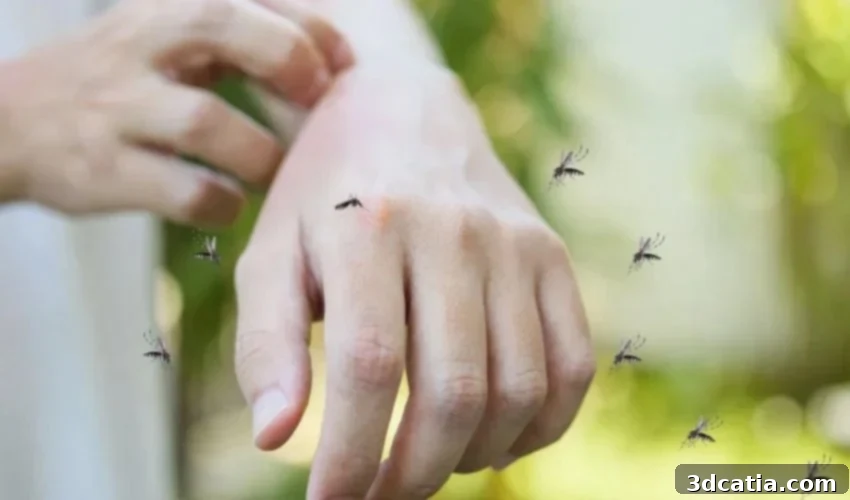
Mosquitoes, those tiny yet formidable insects, are responsible for far more than just annoying bites. They are notorious vectors for a multitude of severe diseases, including malaria, dengue fever, Zika virus, West Nile virus, and chikungunya. According to the World Health Organization (WHO), these mosquito-borne illnesses lead to an alarming estimate of one million deaths globally each year. Beyond the tragic loss of life, these diseases inflict immense suffering, cause long-term disabilities, and place a substantial burden on healthcare systems and national economies worldwide. The persistent, itchy bites themselves, while not deadly, significantly diminish quality of life and disrupt daily activities for billions of people.
For decades, the primary line of defense against mosquitoes has been chemical repellents, with DEET (N,N-diethyl-meta-toluamide) being the most prevalent active ingredient in commercial products. While DEET is highly effective in repelling insects, its widespread use has raised considerable concerns regarding both human health and environmental impact. Classified as a toxic substance, DEET can cause irritation upon contact with the eyes or mouth, and in higher concentrations or with prolonged exposure, it may lead to more serious adverse reactions, including skin rashes, neurological issues, convulsions, and in rare, extreme cases, even death. Furthermore, its strong, distinctive odor and oily texture are often unpleasant for users, requiring frequent reapplication and leaving a sticky residue. These drawbacks highlight an urgent and unmet need for innovative, safer, and more sustainable alternatives that can provide effective protection without compromising well-being or convenience.
Responding to this critical global challenge, a visionary team of researchers at Martin Luther University Halle-Wittenberg in Germany has engineered a groundbreaking solution: a 3D printed wearable mosquito repellent. This pioneering development leverages advanced additive manufacturing techniques to create a discreet and highly effective device designed to offer continuous protection. This breakthrough represents a significant leap forward in personal insect protection, moving beyond conventional, often problematic, methods to deliver a sustainable, skin-friendly, and long-lasting alternative that promises to redefine how we combat mosquito-borne threats.
Unveiling the Innovation: How 3D Printing Powers Continuous Protection
The ingenious concept behind this new wearable repellent lies in its ability to facilitate the controlled and sustained release of a specialized insect-repelling chemical. As articulated by Fanfan Du, the lead author of the study and a PhD candidate at MLU, “The basic idea is that the insect repellent is continuously evaporating and forming a barrier for insects.” This constant, low-level evaporation creates a localized protective zone around the wearer, effectively deterring mosquitoes from landing or even approaching. This mechanism offers a distinct advantage over traditional sprays, which provide only temporary coverage and often require frequent reapplication, or natural repellents that tend to dissipate very quickly.
The precision of 3D printing is crucial to the success of this system. The evaporation rate of the insect repellent is meticulously controlled by several key factors: the ambient temperature, the specific concentration of the active ingredient, and most importantly, the intricate internal structure and material properties of the biodegradable polymer used in the 3D printed device. By utilizing specialized 3D printing techniques, the researchers can accurately encapsulate the insect repellent within the polymer matrix. This encapsulation acts as a protective reservoir, ensuring the active chemical is released gradually and uniformly over an extended period. The ability of additive manufacturing to create complex, customized geometries allows for the precise engineering of porous structures and surface areas that optimize the repellent’s release profile, making it far more efficient and long-lasting than conventional methods.
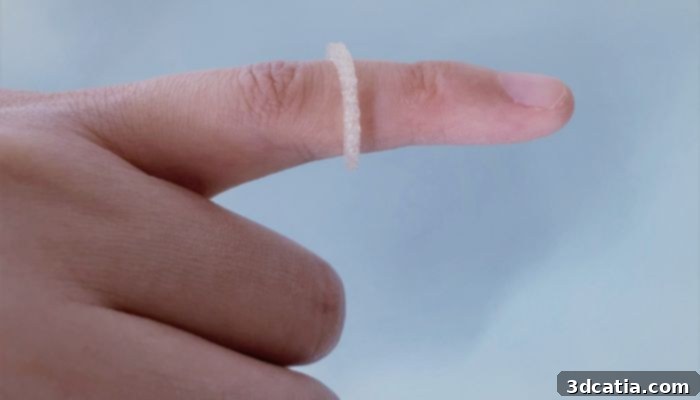
(Photo Credits: Uni Halle / Fanfan Du)
What Sets This 3D Printed Mosquito Repellent Apart?
This innovative repellent offers a compelling combination of safety, efficacy, and user convenience that sets it apart from existing solutions. The research team developed a specialized 3D printing method to precisely integrate the insect repellent into a biodegradable polymer, allowing for meticulous control over the release mechanism and the overall form of the product. The core active ingredient employed is IR3535, a well-established insect repellent developed by MERCK. Unlike DEET, IR3535 is known for its significantly lower toxicity profile, skin-friendliness, and favorable environmental impact, making it a much safer choice for continuous personal use.
The IR3535 is expertly encapsulated within a 3D printable, biodegradable raw material, specifically Polyactic Acid (PLA). PLA is a widely used thermoplastic derived from renewable resources such as corn starch or sugarcane, underscoring the product’s commitment to environmental sustainability. Its biodegradability ensures that the wearable will naturally break down under appropriate conditions, reducing plastic waste and ecological footprint. The inherent flexibility of 3D printing means that the repellent can be designed and manufactured in virtually any form a designer or user desires. This opens up vast possibilities for personalization and integration into everyday life.
Imagine wearing your mosquito protection as a stylish ring, a comfortable bracelet, a discreet clip on your clothing, or even seamlessly integrated into accessories. This personalized and hands-free approach eliminates the need for messy sprays, lotions, or constant reapplication, providing a comfortable and unobtrusive barrier against mosquitoes. This level of customization and ease of use represents a significant advantage, particularly for travelers, outdoor enthusiasts, or individuals living in mosquito-prone regions, offering constant, reliable protection without any conscious effort beyond putting on the wearable.
Performance, Future Prospects, and Global Health Impact
Initial investigations into the 3D printed repellent rings have demonstrated remarkable efficiency within controlled laboratory environments. These early results are highly encouraging, establishing a strong foundation for the technology’s future. The research team conducted rigorous tests to determine the longevity of the repellent, confirming that it can maintain its protective efficacy for more than a week, specifically over seven days, when exposed to a consistent temperature of 37 degrees Celsius, simulating human body temperature. This extended duration of protection is a crucial breakthrough, offering users sustained relief and significantly reducing the inconvenience of frequent reapplication or replacement associated with many traditional repellents.
While the prototypes, such as the rings and bracelets, have performed exceptionally well under controlled laboratory conditions, the next vital phase involves comprehensive testing in diverse real-world environments. Factors such as varying humidity levels, wind speed, intense physical activity, and fluctuating ambient temperatures can all influence the evaporation rate and, consequently, the overall effectiveness of the repellent. Extensive field studies will be essential to fully validate the real-world performance and durability of these innovative wearables. Furthermore, as highlighted by Androsch, a key member of the research team, there remains significant potential for further optimizing the encapsulation material itself. Continued advancements in polymer science and material engineering could lead to even longer-lasting protection, even more precise control over the release kinetics, and enhanced robustness of the wearable devices, pushing the boundaries of what’s possible.
The potential societal and public health impact of this 3D printed mosquito repellent is immense. It represents a significant step forward in addressing severe global health challenges, particularly in regions where mosquito-borne diseases are endemic and pose a constant threat to communities. By providing a safe, effective, and sustainable method of personal protection, this innovation could play a pivotal role in dramatically reducing the incidence of malaria, dengue, and other debilitating illnesses, ultimately saving countless lives and vastly improving the quality of life for millions. Imagine communities empowered with accessible, long-lasting personal protection, thereby lessening their dependence on costly, inconvenient, and potentially harmful traditional alternatives. This initiative serves as a powerful testament to how cutting-edge technologies like 3D printing can be harnessed to deliver profound societal benefits, moving us closer to a future where the serious health consequences of mosquito bites are substantially mitigated, if not entirely eradicated.
This groundbreaking development not only showcases the exceptional ingenuity of the researchers at Martin Luther University Halle-Wittenberg but also underscores the transformative potential of additive manufacturing across a wide array of sectors, from healthcare and pharmaceuticals to consumer goods and personal protective equipment. The inherent ability of 3D printing to precisely control material properties and fabricate highly complex structures enables the creation of tailor-made solutions to long-standing and complex problems. For those interested in delving deeper into the scientific methodology and comprehensive findings of this pioneering research, the full study is readily available for in-depth review. You can access the complete research paper HERE.
Join the Conversation: Your Thoughts on the Future of Mosquito Protection
We are incredibly excited to hear your thoughts and perspectives on this revolutionary 3D printed mosquito repellent. Do you envision this wearable technology fundamentally changing the landscape of personal protection against mosquitoes? What innovative applications or exciting design iterations do you foresee for such a device in the future? We invite you to share your valuable insights, questions, and comments with our community in the section below! Furthermore, you can connect with us and stay at the forefront of the latest advancements in additive manufacturing by following our vibrant social media channels: LinkedIn,Facebook, andTwitter. For exclusive updates and weekly summaries of the most impactful 3D printing news delivered directly to your inbox, don’t forget to sign up for our free weeklyNewsletter here. You can also explore our extensive library of compelling videos and in-depth discussions on 3D printing advancements by visiting our officialYouTube channel.
*Cover Photo Credits: Eat This, Not That