
Unveiling the World’s Smallest McGraw Tower: A Triumph in Nanoscale 3D Printing at Cornell
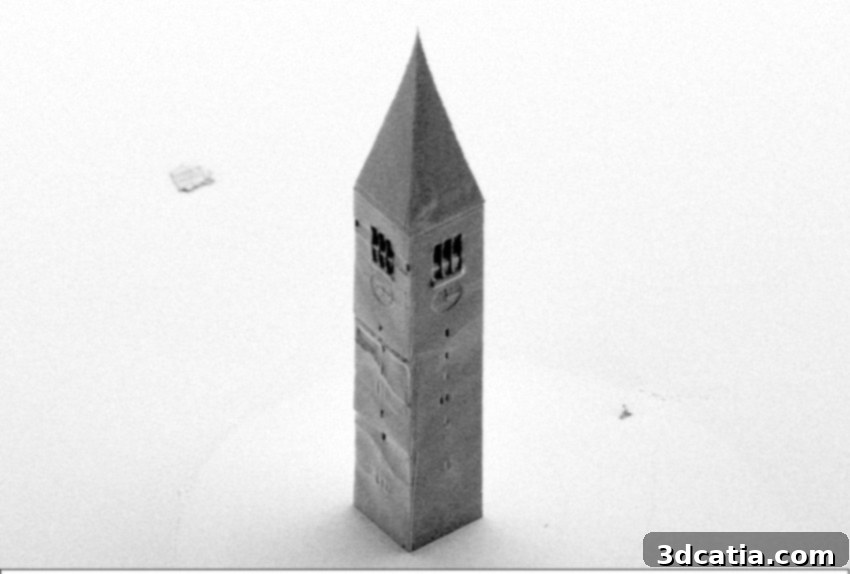
In a groundbreaking feat of precision engineering, a team at the Cornell NanoScale Science and Technology Facility (CNF), nestled within Duffield Hall, has accomplished what is believed to be the creation of the world’s most diminutive replica of Cornell University’s iconic McGraw Tower. Spearheaded by staff photolithographer Ed Camacho, this miniature marvel is not merely a static model but a meticulously detailed rendition, complete with 161 interior steps, two distinct sets of staircases, and 21 intricately placed bells. Standing at an impressive 1 millimeter tall, with a width of 160 microns and a depth of 150 microns, this tiny tower was constructed perfectly to scale. To put this into perspective, a standard penny measures approximately 1.5 millimeters thick, making the entire structure significantly smaller than a common coin. Camacho proudly states, “this is possibly the world’s smallest bell tower,” a claim that underscores the extraordinary capabilities of modern nanoscale manufacturing.
The NanoScribe GT2: A Leap in Nanoscale 3D Printing Technology
This remarkable achievement was made possible through the utilization of a cutting-edge two-photon polymerization volumetric 3D printer, specifically the NanoScribe GT2 Laser Lithography System. This advanced instrument represents one of CNF’s newest and most powerful additions to its extensive array of fabrication tools. Acquired in late 2019, thanks to critical funding from a National Science Foundation (NSF) grant, and subsequently installed in January 2020, the NanoScribe GT2 is a pivotal component of CNF’s nine state-of-the-art photolithography systems.
The NanoScribe GT2 operates on the principle of two-photon polymerization, a sophisticated additive manufacturing technique that allows for the creation of intricate 3D nanostructures with unprecedented resolution. It employs a near-infrared, femtosecond laser that precisely “writes” onto a photosensitive resin. Unlike conventional 3D printing, which often builds layer by layer in a planar fashion, two-photon polymerization enables direct-write fabrication within the volume of the resin itself. This process involves the simultaneous absorption of two photons by the photoinitiator in the resin, triggering a localized polymerization reaction only at the focal point of the laser. This highly localized curing allows for the creation of features far smaller than the wavelength of the laser light itself, breaking the diffraction limit and enabling true nanoscale precision.
Chris Ober, the esteemed director of CNF and a distinguished professor of materials engineering in the College of Arts and Sciences, highlighted the transformative nature of this technology. “Fifteen years ago, only a specialist could do this with very specialized equipment,” Ober commented, reflecting on the historical landscape of nanofabrication. He continued, emphasizing the shift in accessibility, “this is a commercial device.” This transition from highly specialized, bespoke equipment to commercially available systems like the NanoScribe GT2 democratizes access to advanced nanoscale manufacturing. It empowers a broader range of researchers and innovators to push the boundaries of science and engineering without needing to custom-build their fabrication tools, significantly accelerating the pace of discovery and development across various disciplines. The GT2’s ability to bypass many limitations of previous generations of 2-photon 3D nano-printers, particularly in terms of speed and capacity, solidifies its role as a flagship tool in nanoscale research.
Revolutionizing Research: Applications of Nanoscale Fabrication
The strategic acquisition of the NanoScribe GT2 was driven by its capacity to overcome significant limitations inherent in earlier generations of 2-photon 3D nano-printers, particularly concerning fabrication speed and volumetric capacity. Its advanced capabilities have opened doors to unprecedented research opportunities across diverse scientific fields, enabling the development of groundbreaking devices at scales previously unimaginable.
In the realm of life sciences, researchers are now harnessing the NanoScribe GT2 to create intricate cellular scaffolds and sophisticated microfluidic devices. Cellular scaffolds, fabricated with nanoscale precision, can mimic the natural extracellular matrix, providing ideal environments for cell growth, differentiation, and tissue engineering. This capability is crucial for regenerative medicine, drug discovery, and fundamental studies of cellular behavior. Microfluidic devices, on the other hand, allow for precise control and manipulation of fluids at sub-millimeter scales. These devices are invaluable for single-cell analysis, rapid diagnostics, and lab-on-a-chip applications, facilitating high-throughput experimentation and reducing sample volumes. The ability to craft these structures with such fine detail at the nanoscale significantly enhances their functionality and efficacy in biological applications.
Similarly, researchers in photonics are utilizing the NanoScribe GT2 to design and “draw” complex 3D waveguides. These structures are essential for guiding light signals with minimal loss, enabling advancements in optical computing, telecommunications, and advanced sensing technologies. The precision offered by two-photon polymerization allows for the creation of highly efficient and compact photonic circuits that can be integrated into various systems, paving the way for faster data transmission and more sensitive optical instruments. Crafting these waveguides in three dimensions liberates designers from the constraints of 2D planar layouts, offering greater flexibility and performance optimization.
Furthermore, in the burgeoning field of robotics, the NanoScribe GT2 is empowering scientists to fabricate incredibly small, soft structures, which are vital for the development of soft robotics. Unlike rigid robots, soft robots are designed to be compliant and adaptable, making them ideal for applications such as minimally invasive medical devices, flexible sensors, and biomimetic grippers. The ability to create these components at a minuscule length scale allows for the development of robots that can operate in very confined spaces, interact safely with delicate biological tissues, or mimic the dexterity of natural organisms. This precision at the micro and nano scale is transformative, allowing for innovations that could redefine how we interact with technology and the physical world.
The Meticulous Design of a Miniature Icon: Replicating McGraw Tower
The choice of Cornell’s iconic McGraw Clock Tower as the subject for this nanoscale replication was a deliberate one by Ed Camacho. He explained that the tower “is unique and has the right combination of complexity to display 3D printing at the nanoscale for this flagship tool.” Its distinctive Romanesque Revival architecture, with its intricate details, varying textures, and historical significance, presented an ideal challenge to fully showcase the unprecedented capabilities of the NanoScribe GT2 and two-photon polymerization.
The process of replicating such an intricate structure began with a significant hurdle: the absence of a detailed, readily available 3D CAD (Computer-Aided Design) model of the McGraw Tower. This necessitated Camacho to embark on an extensive and meticulous design phase. “I did not find a detailed 3D CAD model of the structure, so I created my own,” he stated, highlighting the extraordinary effort involved. His design process relied heavily on historical documentation and visual references. “Pictures from the Cornell [library] online archive and the building’s website were used as a reference,” Camacho elaborated, illustrating the blend of historical research and modern design techniques.
From these diverse sources, Camacho painstakingly derived the essential specifications and architectural assumptions required to build a highly accurate digital model. These specifications included the tower’s original height of 173 feet (approximately 53 meters), the precise count of 161 interior steps, the presence of 21 bells, the symmetry of its identical sides, the layout of two distinct internal staircases, the existence of two upper floors near the belfry, and the characteristic pyramidoid roof, all meticulously rendered within the digital environment.
Armed with this comprehensive CAD model, Camacho was then able to achieve an astonishing level of detail in the physical miniature. The resulting 1-millimeter-tall replica is a complete reconstruction, capturing the essence and intricacy of the original tower. This includes not only the grand external features but also astonishingly fine elements such as the individual external bricks that form the tower’s facade. More impressively, the miniature faithfully reproduces the internal complexities, including the dual internal stairways that wind upwards and the delicate structure of the bells within the belfry. This unparalleled fidelity to the original design, realized at a microscopic scale, truly showcases the transformative potential of advanced nanoscale 3D printing and the dedication of the researchers at CNF.
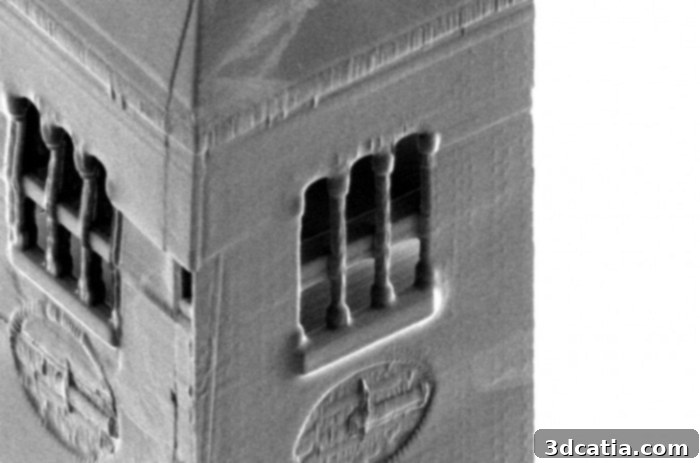
The McGraw Tower 1-millimeter-tall scale model is highly detailed. (Photo Credit: Edward Camacho)
The Future of Precision: Impact of Nanoscale Manufacturing
The creation of the world’s smallest McGraw Tower is more than just an impressive novelty; it stands as a powerful testament to the advancements in nanoscale manufacturing and the cutting-edge capabilities housed within facilities like the Cornell NanoScale Science and Technology Facility. This achievement underscores the critical role that precision 3D printing plays in pushing the boundaries of what is possible, bridging the gap between imagination and tangible reality at incredibly small scales.
The work of Ed Camacho and the CNF team highlights the potential for rapid prototyping and fabrication of complex structures with unparalleled detail, which has far-reaching implications across numerous industries. From developing advanced biomedical implants and drug delivery systems that interact with biological processes at the cellular level, to engineering next-generation electronics and optical components that operate with enhanced efficiency and speed, nanoscale 3D printing is poised to revolutionize technology. It empowers researchers to design and test new hypotheses, creating bespoke tools and devices that address specific challenges in ways that were previously unattainable. As the technology continues to evolve and become more accessible, we can anticipate a future where the constraints of scale are increasingly diminished, leading to innovations that will profoundly impact medicine, materials science, environmental solutions, and beyond. This miniature McGraw Tower is not just a model; it’s a beacon for the future of precision manufacturing.

Cornell’s McGraw Clock Tower (Photo Credit: Cornell University)
What are your thoughts on Ed Camacho’s extraordinary scale replica of Cornell’s McGraw Clock Tower and the incredible capabilities of nanoscale 3D printing? We invite you to share your insights in a comment below or join the conversation on ourFacebook,Twitter andLinkedIn pages! Don’t miss out on the latest advancements in additive manufacturing—sign up for our free weeklyNewsletter here to get the most important 3D printing news delivered straight to your inbox!
*Cover picture: Ed Camacho of the Cornell NanoScale Science and Technology Facility created a scale replica of Cornell’s iconic McGraw Tower. The model, just 1 millimeter tall, contains the tower’s 161 steps and chimes. Courtesy of Edward Camacho.