
The Environmental Reality of 3D Printing: A Comprehensive Look Beyond the Hype
The rapid evolution of 3D printing, also known as additive manufacturing, has ignited considerable excitement across various industries. Often hailed as a transformative technology with significant environmental advantages, its true ecological footprint warrants a meticulous and comprehensive examination. This very topic was the focus of a recent study published in the esteemed “Journal of Industrial Ecology” by Yale University in the United States. Collaborating with leading researchers from MIT and the University of Nottingham, the study meticulously delved into existing research and quantitative analyses to provide a balanced perspective.
The overarching conclusion, particularly regarding whether 3D printing qualifies as an inherently sustainable manufacturing method, is nuanced yet clear: **the widespread enthusiasm surrounding 3D printing’s “spectacular” environmental impact must be moderated with a dose of realism.** A truly accurate assessment necessitates considering all components of the additive manufacturing lifecycle, from the energy-intensive production of raw materials to the often-complex challenges of waste management and end-of-life disposal. This holistic approach moves beyond simplistic views, aiming for a deeper understanding of its true impact.
Understanding 3D Printing’s Environmental Footprint: The Need for Holistic Analysis
While various environmental initiatives have emerged to address aspects of 3D printing, particularly accelerating the recycling of plastic waste, their impact often represents only a fraction of the broader environmental equation. We are familiar with commendable developments such as Precious Plastic, an organization dedicated to establishing local plastic recycling centers worldwide, or Plast’if, which focuses on recycling plastic waste generated in office environments into new products. These efforts are invaluable, yet a critical question remains: are they sufficient to truly categorize 3D printing as universally sustainable?
Professor Tim Gutowski, an expert in mechanical engineering at MIT and a key contributor to the Yale study, emphasizes a crucial limitation in previous assessments: the quantitative analysis of 3D printing’s environmental performance has historically been quite restricted. Much of the earlier research predominantly focused on the energy consumed during the printing process itself. This narrow scope often overlooked equally significant environmental impacts associated with the production of raw materials, the energy and resources expended during the product’s use phase, and the complex challenges of waste management once the product reaches its end-of-life. To overcome this analytical gap and provide a more comprehensive understanding, the collaborative research effort by Yale University, MIT, and the University of Nottingham undertook more extensive and integrated studies, employing a life cycle assessment (LCA) approach to quantify these broader impacts.
The “Green” Potential: Why 3D Printing is Seen as Sustainable
According to Professor Gutowski and the findings of the collaborative study, two primary elements have historically contributed to 3D printing’s widespread reputation as a “green technology” and a sustainable manufacturing method. These perceived advantages are certainly compelling and represent genuine benefits when leveraged effectively within the appropriate contexts.
Reduced Material Waste
Firstly, 3D printing is celebrated for its ability to **significantly reduce material waste** compared to traditional subtractive manufacturing processes. Unlike methods such as milling or turning, which involve cutting away material from a larger block to achieve the desired shape, additive manufacturing builds objects layer by layer. This process uses only the precise amount of material needed for the final product, leading to dramatically less scrap material. This inherent efficiency minimizes waste generation at the point of production, which is a major environmental benefit, especially for complex geometries or custom parts where traditional methods would generate substantial offcuts.
Leveraging Recycled Plastics and New Materials
Secondly, 3D printing holds immense potential for **reusing and repurposing plastic waste**. Various innovations have demonstrated the feasibility of converting post-consumer and industrial plastic waste into usable printing filaments, thus closing the loop and giving new life to materials that would otherwise end up in landfills. Projects like the OWA filament range exemplify this circular economy approach, offering sustainable alternatives made from recycled or bio-sourced materials. This capability not only reduces reliance on virgin plastics but also mitigates the environmental burden of plastic pollution. Furthermore, the development of new, more eco-friendly materials such as filaments based on hemp or biodegradable PLA (polylactic acid) continues to grow, broadening the scope for truly sustainable 3D printing applications.

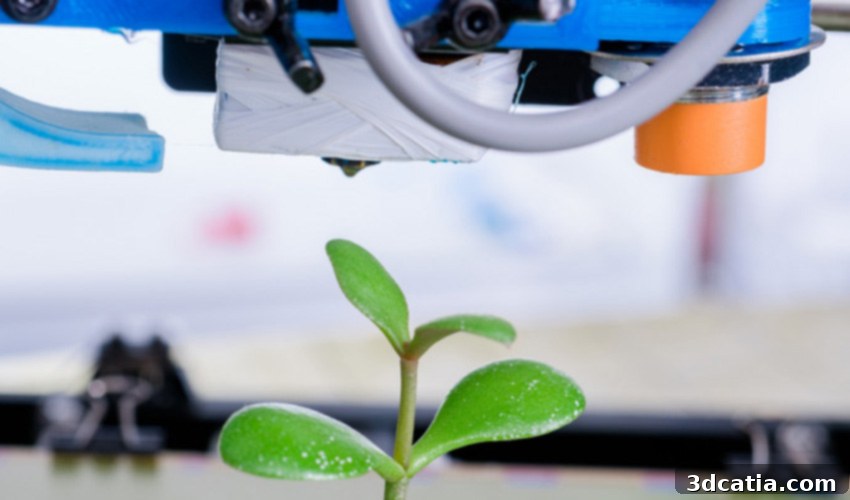
Striving for more sustainable manufacturing through 3D printing.
Decentralized Manufacturing and Supply Chain Benefits
The third key point concerns the **accessibility and flexibility of 3D printing technologies**. The ability for manufacturers to produce parts and products directly in-house or closer to the point of consumption significantly reduces the need for extensive logistics and long-distance transportation. This decentralized manufacturing model can lead to a substantial decrease in the carbon footprint associated with global supply chains, including fuel consumption from shipping and warehousing. On-demand production also minimizes inventory, reducing waste from overproduction and obsolescence, thereby enhancing overall resource efficiency and potentially accelerating innovation cycles.
Unpacking the Challenges: A Closer Look at Environmental Concerns
Despite the compelling advantages, Professor Gutowski cautions against prematurely labeling additive manufacturing as universally environmentally safe. Several critical aspects must be thoroughly considered to form an accurate picture of its environmental impact. The Yale study highlights these indirect disadvantages and areas requiring further research and development to truly unlock 3D printing’s sustainable potential.
Support Structures and Material Recyclability
First and foremost, the issue of **support structures** in 3D printed objects is often overlooked. Many complex prints require temporary supports to prevent collapse during the building process. These supports, which can be quite substantial depending on the geometry, are typically removed and discarded after printing. As Professor Gutowski notes, “These supports cannot always be reprocessed back into raw materials.” This creates a waste stream that can be difficult to recycle, especially if composed of different materials or intricate designs that defy easy separation. Beyond supports, it is equally important to consider whether the primary plastics, metals, or mixed materials used in finished additive manufacturing parts can be effectively recycled at the end of their lifespan. The diversity of materials, often blended or reinforced, presents a significant challenge for existing recycling infrastructures, frequently rendering them non-recyclable in practice.
The Risk of Increased Disposable Products
Yale University’s research also suggests a paradoxical environmental challenge: 3D printing’s capabilities for on-demand production and rapid prototyping could **potentially lead to an increase in the number of disposable consumer products**. The ease and speed with which new items can be designed, produced, and customized might inadvertently encourage a “fast-product” culture, where items are used briefly and then discarded. This trend, if unchecked, could counteract the benefits of material efficiency, even with the growing availability of filaments based on hemp or biodegradable PLA. The focus must shift not just to material choice, but also to product longevity, repairability, and responsible disposal.
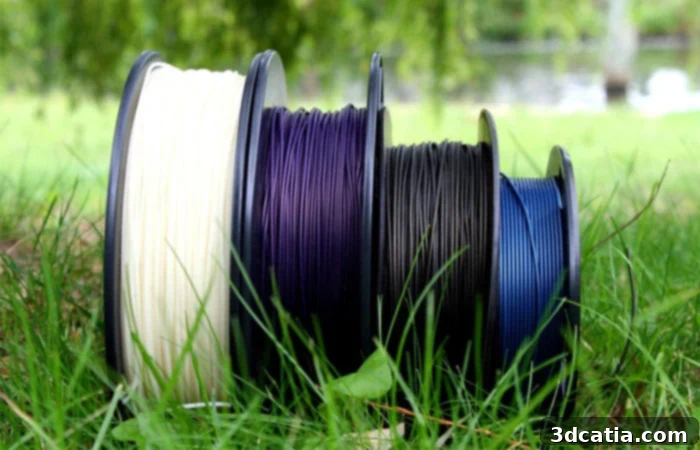
An increasing number of consumables manufacturers are developing recyclable and biodegradable filaments, contributing to more sustainable 3D printing.
Energy Consumption in Additive Manufacturing
While 3D printing can reduce overall material waste, the energy consumption of the printing process itself can be substantial, particularly for certain technologies and larger prints. Many additive manufacturing processes, such as selective laser sintering (SLS) or metal additive manufacturing, require considerable energy to heat chambers, operate lasers, and maintain precise temperatures throughout the build. The Yale study highlighted that previous analyses often focused solely on this production energy, without considering the full life cycle. However, when the energy grid relies heavily on fossil fuels, even an efficient material process can contribute significantly to carbon emissions. Future advancements in machine efficiency and the increasing adoption of renewable energy sources will be crucial in mitigating this aspect of 3D printing’s environmental impact.
Volatile Organic Compound (VOC) Emissions
Another critical environmental and health concern discussed by the researchers is the **release of volatile organic compounds (VOCs)** and ultrafine particles (UFPs) associated with 3D printing. These emissions, particularly from certain types of filaments and machines, can be dangerous in poorly ventilated or closed work environments, posing risks to indoor air quality and human health. Although many manufacturers are actively developing technologies to reduce these emissions, some machines continue to release toxic nanoparticles during operation. Researchers emphasize that taking necessary precautions is relatively easy and imperative. Solutions are already emerging in the market, such as air filtration systems offered by companies like Zimple, which are designed to capture these harmful substances and ensure a safer working environment. Adherence to safety protocols and adequate ventilation are non-negotiable for responsible 3D printing implementation.
Towards a Truly Sustainable Future for Additive Manufacturing
In concluding the comprehensive research, Professor Gutowski reiterates the undeniably innovative capabilities of 3D printing as a manufacturing method. He reaffirms its potential to liberate creativity, enable unprecedented design complexities, and offer enhanced performance and customization options to various industries. However, he carefully balances this enthusiasm with a pragmatic recognition of the indirect disadvantages to the environment, some of which are indeed related to historical and ongoing challenges in manufacturing, including those associated with subtractive processes.
The professor is convinced that **additive manufacturing should be viewed as an additional, powerful tool to complement traditional manufacturing methods, rather than a direct substitute for them**. This perspective encourages a strategic integration of 3D printing where its unique benefits — such as geometric freedom, mass customization, and on-demand production — can be maximized, while its environmental drawbacks are minimized through conscious design and operational choices. “While some 3D printing applications may not be environmentally desirable, there are many opportunities for improvement that have not yet been pursued,” he states. This highlights a clear path forward for the industry, focusing on innovation in materials, process optimization, and circular economy principles.
The journey towards truly sustainable 3D printing involves continued research into material science, aiming for more recyclable, biodegradable, and low-impact feedstock. It necessitates developing closed-loop systems for waste reduction and recycling, improving energy efficiency of machines, and integrating smart manufacturing practices that optimize resource use throughout the product lifecycle. Furthermore, responsible design principles, focusing on durability, repairability, and end-of-life considerations, will be crucial in mitigating the risk of increased disposability. By embracing these challenges and opportunities, additive manufacturing can fulfill its promise as a genuinely transformative and environmentally responsible technology.

Innovative filaments derived from recycled or natural materials like hemp, cork, and coffee are emerging, offering greener alternatives for 3D printing.
What are your thoughts on 3D printing’s role as a sustainable manufacturing method? We invite you to share your insights in a comment below or join the conversation on our Facebook and Twitter pages! Don’t forget to sign up for our free weekly Newsletter to receive all the latest news and developments in 3D printing delivered straight to your inbox!