
3D-Printed Skin: A Humane & Innovative Alternative to Animal Testing for Product Safety
The skin, our body’s largest organ by surface area, acts as a crucial barrier, protector, and regulator. Everything applied to its intricate layers – from moisturizers and sunscreens to medicinal ointments – has the potential to directly affect the human body, either by fulfilling a beneficial purpose like pain relief or regeneration, or by causing harm if toxic substances are present. To ensure consumer safety and product efficacy, particularly for cosmetics and pharmaceuticals, rigorous testing is indispensable. Traditionally, this often involved extensive animal testing, a practice increasingly viewed as ethically reprehensible due due to the significant suffering inflicted upon animals. This growing ethical concern has spurred a global search for humane and scientifically robust alternatives. In a groundbreaking development, a collaborative team of researchers from Graz University of Technology (TU Graz) in Austria and the Vellore Institute of Technology (VIT) in India has engineered a sophisticated 3D-printed skin model. This innovative biomimetic skin closely imitates human tissue and is poised to revolutionize tolerance and safety studies, offering a viable, ethical substitute for traditional animal experimentation.
The Ethical Imperative: Moving Beyond Animal Testing
For decades, animal testing has been a standard practice in product development, particularly within the cosmetics and pharmaceutical industries. While these tests aimed to ensure product safety for human use, they often involved procedures that caused immense suffering, pain, and death to countless animals. Public awareness of these ethical concerns has grown exponentially, leading to strong demands for more humane testing methods. Many countries and regions, including the European Union, India, Israel, and others, have already banned or restricted cosmetic testing on animals, signaling a global shift towards ethical alternatives. Beyond the moral arguments, the scientific validity of animal testing is also frequently questioned. Physiological differences between species mean that results obtained from animals do not always accurately predict human reactions, potentially leading to misleading data and delaying the development of truly safe and effective products. This situation underscores the urgent need for advanced, human-relevant testing platforms that can provide reliable data without compromising ethical standards.
Pioneering a Solution: 3D-Bioprinted Skin Models
The collaborative research between TU Graz and VIT represents a significant leap forward in addressing these challenges. By harnessing the power of 3D bioprinting technology, the teams have successfully created a skin imitation enriched with living human cells. This sophisticated model is not merely a superficial representation; it replicates the complex, three-layered tissue structure characteristic of human skin. This intricate architecture, comprising the epidermis, dermis, and hypodermis, is crucial for mimicking the skin’s natural barrier function, metabolic activity, and response to external stimuli. The development of such a highly realistic and functional skin model holds immense promise for various applications, including the testing of new cosmetic formulations, pharmaceutical compounds, and medical devices, all while adhering to the highest ethical considerations.
The Science Behind the Skin: Hydrogel Innovation
The creation of this biomimetic skin began with the challenging task of developing suitable hydrogel formulations. Hydrogels are three-dimensional polymer networks capable of absorbing and retaining large amounts of water, making them ideal candidates for mimicking biological tissues. However, engineering hydrogels for bioprinting applications presents a unique set of hurdles. Karin Stana Kleinschek, a leading researcher from the Institute of Chemistry and Technology of Biobased Systems at TU Graz, elaborated on the intricate requirements: “The hydrogels for our 3D-printed skin imitation had to fulfill a number of demanding requirements.” She explained that these hydrogels must not only be biocompatible – meaning they can interact harmoniously with living skin cells – but also create an environment conducive to cell survival, growth, and multiplication. This delicate balance is essential for the cells to differentiate and form a functional tissue structure that truly mimics human skin.
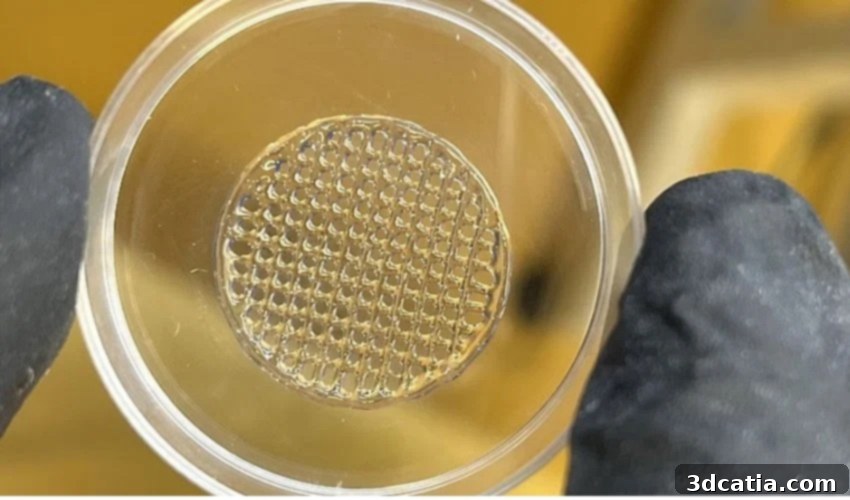
3D-printed structure of the skin with human keratinocytes
While the high water content of hydrogels is advantageous for cell integration and proliferation, it also poses significant challenges to their mechanical and chemical stability. For a material to be successfully printed layer-by-layer by a 3D bioprinter, it needs to maintain a specific viscosity and structural integrity. A high water content can make the material too fluid, causing it to lose shape during printing or after deposition, thus hindering the formation of a precise, multi-layered structure. To overcome this critical stabilization problem, the researchers at TU Graz explored various cross-linking methods. Crucially, their experimental approach was inspired by nature, prioritizing the avoidance of any cell-toxic chemicals. This commitment to non-toxic, biologically friendly materials ensures that the resulting 3D-printed skin models are as close as possible to natural human tissue, enhancing the reliability and relevance of future testing.
Rigorous Validation: Ensuring Safety and Efficacy
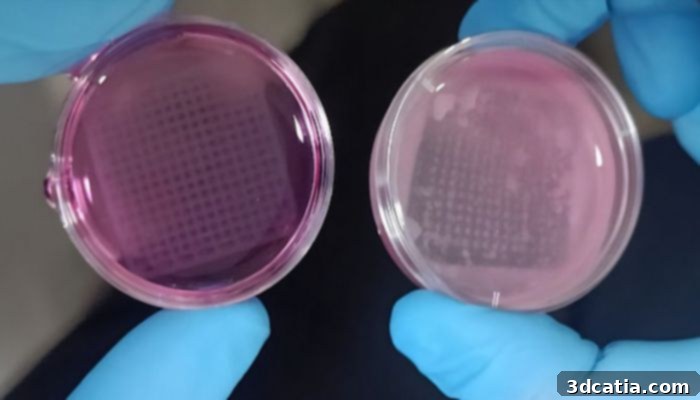
Following the successful stabilization of the hydrogels and the subsequent 3D printing process, the newly fabricated skin models underwent extensive testing to assess their resistance and toxicity. These vital cell culture studies were meticulously conducted at the Vellore Institute of Technology (VIT) in India, leveraging their specialized expertise in molecular and cell biology. A primary objective was to confirm that the embedded cells could not only survive but thrive within the imitation skin for an extended period, specifically two to three weeks. This duration is critical as it allows for the development of complete skin tissue, including the differentiation of various cell types and the formation of extracellular matrix components, all essential for functional integrity. Only after this crucial phase, demonstrating robust cell viability and tissue formation, could the 3D-printed models be subjected to further, more complex cell-based assays to evaluate product interactions and safety profiles.
The initial results emanating from Graz University of Technology were exceptionally promising. The comprehensive tests unequivocally demonstrated that the novel cross-linked materials utilized for stabilizing the hydrogels were entirely non-toxic to the living cells, a fundamental requirement for any successful biomedical application. Furthermore, the 3D-printed skin models exhibited remarkable mechanical stability, retaining their structural integrity throughout the testing period. This stability is paramount for accurate and repeatable experimental outcomes, ensuring the reliability of data generated from the models. These positive findings mark a significant milestone in the development of realistic, functional, and ethically sound alternatives to animal testing.
Promising Outcomes and Future Frontiers
Building on this solid foundation of success, the research teams are already looking ahead to the next phase of development and application. Karin Stana Kleinschek outlined the exciting prospects: “In the next step, the 3D-printed models (skin imitations) will be used to test nanoparticles.” This application is particularly significant given the increasing use of nanoparticles in various products, from cosmetics to drug delivery systems, and the need for robust methods to assess their safety and penetration through the skin barrier. Kleinschek further emphasized the power of inter-institutional collaboration, highlighting how the combined expertise of TU Graz in material research for tissue imitations and VIT’s deep knowledge in molecular and cell biology are synergistically contributing to the reduction of cosmetic tests on animals and, consequently, the alleviation of immense animal suffering.
“This is a success for the complementary research at TU Graz and VIT. Our many years of expertise in the field of material research for tissue imitations and VIT’s expertise in molecular and cell biology have complemented each other perfectly. We are now working together to further optimize the hydrogel formulations and validate their usefulness as a substitute for animal experiments,” she stated, underscoring the ongoing commitment to refining this technology. The continuous optimization of hydrogel formulations will enhance the realism and functionality of the skin models, while rigorous validation studies will solidify their position as reliable and accepted alternatives to conventional testing methods.
The Transformative Potential: Ethics, Research, and Industry
The successful development and validation of this 3D-printed human skin model signify a paradigm shift in product development and biomedical research. Beyond simply replacing animal testing, this technology offers numerous advantages. It provides a human-relevant model, allowing for more accurate predictions of how human skin will react to specific compounds. This increased accuracy can lead to safer products reaching the market faster and more efficiently. For the cosmetics industry, it opens doors to developing innovative products without ethical compromises, fostering a more responsible and sustainable approach to beauty and personal care. In the pharmaceutical sector, it could accelerate drug discovery and development by enabling rapid screening of compounds for skin penetration, toxicity, and efficacy in a physiologically relevant environment. Furthermore, this bioengineered skin could also be invaluable for dermatological research, allowing scientists to study skin diseases, wound healing, and regenerative processes in a controlled laboratory setting, leading to advanced therapeutic strategies. This collaborative effort between TU Graz and VIT exemplifies how interdisciplinary research and cutting-edge technologies like 3D bioprinting are paving the way for a more ethical, efficient, and scientifically robust future in product safety testing and biomedical innovation.
You can find out more HERE about this remarkable innovation. What are your thoughts on this groundbreaking 3D-printed skin technology and its potential impact on animal welfare and product safety? Share your insights and join the conversation in a comment below or connect with us on our LinkedIn, Facebook, and Twitter pages! Don’t forget to sign up for our free weekly Newsletter here to receive the latest 3D printing news straight to your inbox! You can also find all our compelling videos on our YouTube channel. For more news and updates specifically within the medical and dental 3D printing sector, explore further HERE.
*All Photo Credits: Manisha Sonthalia – Vellore Institute of Technology