
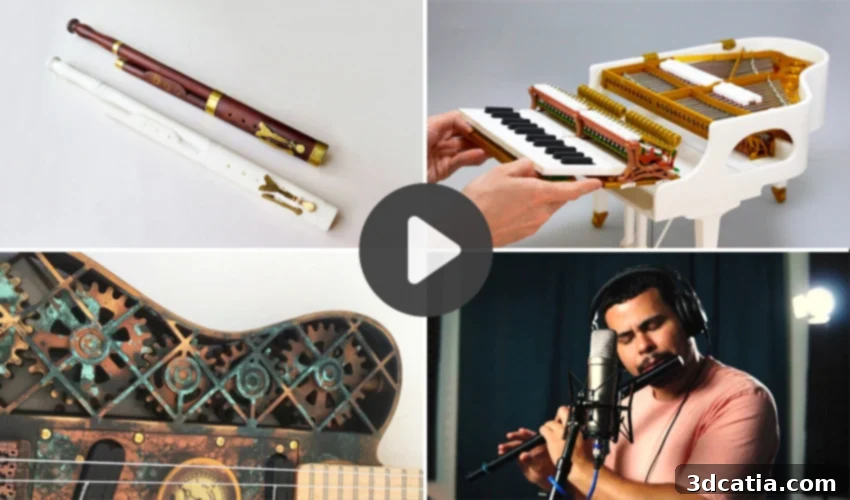
Harmonizing Innovation: Discovering the World of 3D Printed Musical Instruments
Every year, music lovers worldwide celebrate the Fête de la Musique, also known as World Music Day, on June 21st. This global celebration is a perfect occasion to appreciate the universal language of music and to explore the innovative ways technology is shaping its future. In recent years, 3D printing, or additive manufacturing, has emerged as a groundbreaking force, offering unprecedented possibilities in the creation and customization of musical instruments. From crafting entirely new designs to replicating rare historical pieces and even upcycling materials, 3D printing is rapidly becoming an indispensable tool for musicians, designers, and researchers alike. It empowers creators to transcend traditional manufacturing limitations, enabling the production of instruments that are more efficient, highly personalized, acoustically innovative, and often surprisingly sustainable. This article delves into some of the most fascinating recent applications, showcasing how 3D technologies are truly at the heart of music innovation.
Olaf Diegel Unveils a Masterpiece: The Wooden 3D Printed Guitar
When discussing the frontier of 3D printed instruments, it’s impossible not to mention Olaf Diegel. The acclaimed Australian professor has become a prominent figure in the additive manufacturing community, renowned for his captivating 3D printing projects shared across YouTube and various social media platforms. His portfolio boasts an impressive array of instruments, including innovative guitars, saxophones, and even critical medical devices like ventilators. For this celebration of musical innovation, we spotlight one of his particularly unique recent creations: a stunning 3D printed wooden guitar.
Olaf utilized binder jetting technology, specifically from Forust, a company now integrated with Desktop Metal. This cutting-edge process involves an inkjet printer depositing a bio-epoxy resin, derived from lignin, onto a bed of sawdust. The result is a solid, wood-like material that can be shaped into intricate designs. What makes this project truly remarkable is its dual commitment to aesthetics and sustainability. By repurposing sawdust – typically a waste product from the timber industry – Forust’s technology offers an incredibly eco-friendly approach to manufacturing. The guitar’s design is distinctively unique, a hallmark of 3D printing’s capacity for complex geometries and internal structures not achievable with traditional methods. As the video below demonstrates, the visual appeal is matched by its fantastic sound quality, proving that sustainable innovation doesn’t compromise on performance. This project exemplifies how 3D printing can push the boundaries of instrument design while simultaneously promoting environmental responsibility.
Upcycling Creativity: Maracas Crafted from Failed 3D Prints
While the sight of 3D printed guitars and wind instruments is gradually becoming more common, instruments like maracas, traditionally simpler in construction, are less frequently encountered in the additive manufacturing space. This rarity is precisely why the following video caught our attention and earned its place in our exploration. It showcases a brilliant application of 3D printing that combines creativity with sustainability: making maracas from what would otherwise be discarded as failed 3D prints.
Avel, the talented maker featured in the video, eloquently explains the numerous advantages that 3D printing offers for such an application. Beyond the novel approach of recycling waste material, the technology provides unparalleled flexibility during the design and modeling stages. For example, Avel highlights the ability to precisely modify the dimensions and internal geometry of the maracas. This means instruments can be custom-tailored to perfectly fit the hands of the player – a particularly valuable feature for children, ensuring a comfortable grip and an optimal playing experience. Furthermore, the internal structure of the maracas can be intricately designed to influence the sound produced, allowing for experimentation with different tones and textures depending on the infill patterns and chosen materials. This project serves as a powerful reminder of 3D printing’s potential to foster innovation, promote eco-conscious practices, and democratize instrument creation, turning perceived failures into new opportunities for musical expression.
Bridging Eras: Comparing 3D Printed Instruments to Traditional Masterpieces
One of the most compelling applications of 3D printing in music involves the replication and revival of rare and historically significant instruments. Take the fagottino, for instance – a smaller, higher-pitched relative of the bassoon that has become increasingly rare and almost forgotten in contemporary music. As part of the extensive research project “Out of the Bass Register,” a 3D printed fagottino was meticulously produced, aiming to bring this unique instrument back into the spotlight and study its acoustic properties.
The video below offers a fascinating comparative demonstration, where the 3D printed fagottino is played alongside a traditional counterpart during the prestigious Handel Festival in Halle in 2021. The creation process began with detailed 3D scans of an original, historical fagottino. These scans provided precise geometric data, which was then converted into accurate 3D models. Advanced computer programs were subsequently employed to analyze these models, optimize their structures for additive manufacturing, and finally, produce the instrument layer by layer. The “Out of the Bass Register” project has successfully applied this methodology to create several 3D printed instruments, including fagottinos and tenoroons. This initiative not only helps preserve the heritage of these instruments but also provides invaluable tools for musicologists and performers to explore their sound and playability without risking fragile originals. The critical question, as you listen, is whether your ear can detect any discernible difference in tone, timbre, or projection between the traditional and the modern, 3D printed versions. This experiment highlights the incredible fidelity and potential of additive manufacturing in musical instrument reproduction and acoustic research.
The Elegance of History: A 3D Printed Baroque Flute
Another remarkable example of 3D printing’s impact on musical heritage comes in the form of a baroque flute, meticulously crafted by Jomalier Figueroa. What makes this particular instrument so captivating is the intricate nature of the baroque flute itself. Unlike its modern classical successor, the baroque flute features a narrower, reverse conical bore design, which profoundly influences its acoustic characteristics, producing a tone that is often described as louder, more powerful, and notably sharper. Replicating such precise historical geometries with traditional manufacturing methods can be exceptionally challenging and costly.
Additive manufacturing, however, offers a solution that combines precision with accessibility. This specific baroque flute was brought to life using an Ender 3 V2 3D printer and readily available PLA filament. The use of FDM (Fused Deposition Modeling) technology allowed Figueroa to accurately reproduce the complex internal and external structures essential for the instrument’s distinctive sound. The ability to prototype and iterate designs rapidly also means that subtle variations in bore, finger hole placement, or embouchure hole shape can be tested and refined with ease, optimizing the flute’s playability and tonal quality. The video below provides an excellent opportunity to hear the enchanting sound produced by this 3D printed baroque flute. Its historical significance and innovative production method have even earned it a place for admiration in person at the prestigious Rijksmuseum in Amsterdam, underscoring the acceptance and appreciation of 3D printing in cultural preservation and artistic innovation.
Miniature Marvel: The Functional 3D Printed Grand Piano
The very word “piano” is a testament to its dynamic capabilities, being an abbreviation of “pianoforte.” In Italian, “piano” translates to “soft,” and “forte” means “loud,” reflecting the instrument’s unique ability to produce a wide range of volumes simply by varying the force with which the pianist presses the keys. The faster a key is depressed, the greater the force imparted by the hammer striking the strings, resulting in a louder note. The internal mechanism of a grand piano is a marvel of engineering, a complex interplay of levers, hammers, and strings designed to translate subtle finger movements into rich musical expression.
In any compilation showcasing musical innovation, a piano is an absolute must-include, and we are thrilled to introduce you to the first fully functional 3D printed grand piano. For enthusiasts of intricate mechanical designs, this project is nothing short of captivating. While it draws inspiration from the iconic Lego Grand Piano, a popular toy model, this 3D printed version goes far beyond mere aesthetics. Unlike its plastic block counterpart, this creation is entirely functional, albeit at a reduced scale. It serves as a perfect, tangible sample of the sophisticated mechanism found within a real grand piano, demonstrating the precise interplay of its numerous components in a compact, accessible format. This achievement underscores 3D printing’s capacity for replicating complex mechanical assemblies with high fidelity, not only for educational purposes but also for rapid prototyping new instrument designs, custom key actions, or even exploring alternative materials for internal components that might influence a piano’s unique tonal character.
The Future of Sound: What’s Next for 3D Printed Instruments?
As we’ve explored these diverse applications, it’s clear that 3D printing is not just a passing trend but a transformative force in the world of music. The ability to create highly customized instruments, replicate historical pieces with incredible accuracy, and even find sustainable uses for waste materials opens up a new frontier for musicians, instrument makers, and researchers. From the ergonomic benefits of custom-fitted instruments to the acoustic experimentation possible with unique internal geometries, additive manufacturing empowers a level of innovation previously unimaginable.
The continuous advancements in materials, printing technologies, and design software promise even more sophisticated and accessible 3D printed instruments in the future. Imagine orchestras featuring sections of instruments designed for optimal acoustics in specific venues, or aspiring musicians having access to high-quality, affordable replicas of rare instruments for practice and performance. The harmony between technology and artistry is creating exciting new melodies, expanding the possibilities for musical expression and enjoyment globally. Which of these innovative 3D printed instruments resonated most with you? We invite you to share your thoughts in the comments below or connect with us on our LinkedIn, Facebook, and Twitter pages! Don’t forget to sign up for our free weekly Newsletter here to receive the latest 3D printing news straight to your inbox! You can also find all our videos on our YouTube channel.