
3D Printed Hydrogels: A Revolutionary Shield Against Space Radiation for Astronauts
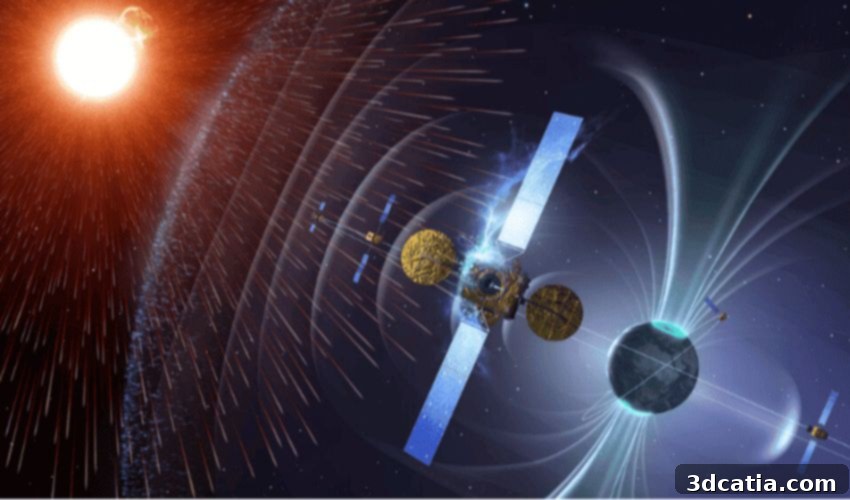
Space is an environment of extreme conditions, where numerous perils lurk, and pervasive radiation stands out as one of the most significant. During missions beyond Earth’s protective atmosphere, astronauts and their sophisticated equipment are exposed to radiation levels far exceeding those encountered on our planet. Without robust and reliable protection, vital electronic systems can malfunction, leading to mission failure. More critically, prolonged exposure to this intense radiation poses severe health risks to astronauts, including increased cancer risk, central nervous system damage, and acute radiation sickness. This makes developing effective countermeasures against space radiation a paramount challenge for the future of space exploration and the safety of human spaceflight.
Addressing this critical challenge, a team of dedicated researchers at Ghent University in Belgium is pioneering an innovative solution: 3D printed hydrogels. These remarkable materials, renowned for their exceptional capacity to absorb and retain vast quantities of water, hold the potential to become powerful shields against the relentless barrage of cosmic radiation. But what exactly are hydrogels, and how can these water-filled polymers effectively block harmful radiation? This article delves into their properties, the groundbreaking research, and the immense promise they offer for safeguarding humanity’s journey into the cosmos.
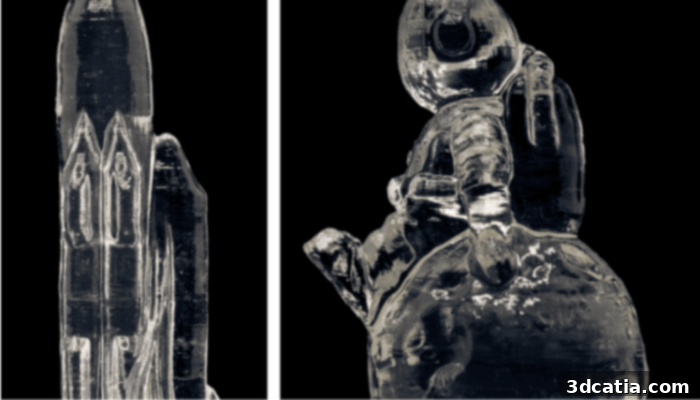
A 3D printed hydrogel astronaut and space shuttle. Image courtesy of The European Space Agency.
Understanding Space Radiation: A Silent and Pervasive Threat
When we envision the vastness of space, a common misconception is that it’s a perfect vacuum. In reality, space is permeated by a continuous flow of highly energetic particles, often traveling at speeds approaching the speed of light. These particles, originating primarily from the Sun (solar particle events, SPEs) and distant galactic sources (galactic cosmic rays, GCRs), constitute the formidable threat known as space radiation. GCRs, in particular, are extremely energetic atomic nuclei that can penetrate conventional shielding with ease, causing significant damage. SPEs, while less energetic, can occur unpredictably and in massive bursts, posing an immediate danger.
For astronauts, exposure to these radiation types can lead to a cascade of adverse health effects. Short-term consequences might include acute radiation syndrome, characterized by nausea, fatigue, and immune system suppression. Long-term risks are far more insidious, encompassing an elevated lifetime risk of cancer, degenerative diseases affecting the cardiovascular and central nervous systems, and even permanent cognitive impairment. Beyond human health, this radiation can also degrade sensitive electronic components in spacecraft, interfere with communication systems, and ultimately compromise the integrity and success of vital space missions. Thus, developing effective and adaptable radiation protection strategies is not just a scientific pursuit but a critical enabler for sustainable deep-space exploration.
Water: Nature’s Unexpected Shield Against Radiation
Recent scientific investigations have increasingly highlighted water’s surprising efficacy in offering protection against high-energy radiation. This effectiveness is largely attributed to water’s unique molecular composition. Each water molecule (H2O) contains two hydrogen atoms, which are exceptionally rich in protons. When high-energy radiation particles, such as those found in cosmic rays, collide with water molecules, the hydrogen nuclei (protons) act as efficient scatters, slowing down and absorbing the radiation energy. Water’s relatively high density also contributes to its shielding capabilities, allowing it to attenuate radiation more effectively than many other common materials.
However, despite its natural shielding prowess, implementing a system that uses bulk water for radiation protection in spacecraft or spacesuits presents significant engineering and practical challenges. Integrating large water tanks into spacesuits would severely impede astronauts’ mobility and dexterity, crucial for conducting extravehicular activities (EVAs). Furthermore, ensuring an even distribution of water across a protective barrier is difficult; uneven distribution would result in insufficient protection in vulnerable areas. The risk of leaks is another major concern; any water escaping its containment could short-circuit delicate electronic equipment, endangering both the mission and the crew. These logistical hurdles have prompted researchers to seek alternative, more adaptable solutions that can harness the protective qualities of water without its inherent drawbacks.
Ghent University’s Innovative Approach: Superabsorbent Polymers and Hydrogels
In light of the complexities associated with traditional water-based shielding, researchers at Ghent University in Belgium are exploring a revolutionary new methodology for radiation protection. Their focus is on superabsorbent polymers (SAPs), which are poised to become a safer, more adaptable, and ultimately more effective alternative to free-standing water for creating protective shields. SAPs are unique synthetic materials characterized by their extraordinary ability to absorb and retain liquid up to several hundred times their own weight. When these polymers become saturated with water, they undergo a transformation, swelling significantly to form a stable, gel-like substance known as a “hydrogel.”
Hydrogels are not new to our daily lives; they are ubiquitous in a wide array of consumer products due to their exceptional water retention capabilities and biocompatibility. As Researcher Lenny Van Daele from Ghent University elaborates, “Hydrogels are found in many things we use every day, from contact lenses to diapers and sanitary products. Our research group has experience with applications in the medical field – using hydrogels as a soft implantable material to repair damaged tissues and organs.” This extensive background in various applications, particularly in the medical sector where material safety and reliability are paramount, provides a strong foundation for their innovative use in space radiation shielding. The stability and contained nature of water within a hydrogel structure offer a compelling advantage over bulk water, promising consistent protection without the risks of spillage or uneven distribution.
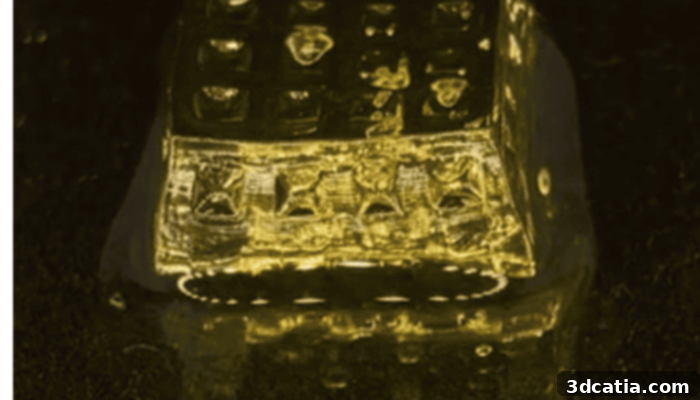
Hydrogel swelling demonstration. Image courtesy of The European Space Agency.
The Game-Changer: 3D Printing Hydrogels for Space
The unique properties of hydrogels make them exceptionally well-suited for radiation protection in the harsh space environment, whether integrated into space station modules or directly into astronauts’ suits. The water contained within these gel structures remains stable and does not freely spill or slosh around, guaranteeing consistent and uniform protection across the shielded area. This stability is critical; in the unlikely event of a puncture or minor leak, the water would not immediately escape, giving astronauts crucial time to identify and address the issue, thus ensuring their safety and the integrity of their equipment.
A key aspect of Ghent University’s research lies in their innovative manufacturing approach. Manon Minsard, another leading researcher at Ghent University, highlights this advantage: “The superabsorbent polymer that we are using can be processed using multiple different techniques, which is a rare and advantageous quality amongst polymers. Our method of choice is 3D printing, which allows us to create a hydrogel in almost any shape we want.” This capability for 3D printing is a true game-changer. Additive manufacturing enables the creation of complex, customized geometries that can be perfectly integrated into the intricate designs of spacesuits, habitat walls, or equipment enclosures. This level of customization ensures optimal shielding for specific body parts or sensitive instruments, maximizing protection where it is needed most. Furthermore, 3D printing facilitates on-demand manufacturing, potentially allowing for the creation or repair of shielding components even during long-duration missions, reducing the need for extensive pre-mission stockpiling.
Advancing the Research: From Lab to Orbit
Having successfully demonstrated that hydrogels possess the ideal characteristics for radiation shielding in the challenging space environment, the Ghent University researchers are now channeling their efforts into refining and enhancing their manufacturing processes. Their primary objective is to develop robust methods for creating intricate 3D structures from these advanced materials, pushing the boundaries of what’s possible with additive manufacturing. This includes exploring various 3D printing techniques suitable for SAPs and optimizing parameters to achieve desired mechanical properties and water retention capabilities. The ultimate goal is to make the production of these hydrogel shields highly efficient and scalable, paving the way for large-scale production suitable for future lunar bases, Martian habitats, and spacecraft designed for interstellar travel.
The potential applications are vast and transformative. Imagine spacesuits with integrated hydrogel layers providing lightweight yet effective radiation protection, or entire sections of spacecraft and planetary habitats constructed with hydrogel-infused materials. This research moves beyond conceptual ideas, aiming to deliver practical, deployable solutions that can significantly mitigate the risks associated with deep-space missions, making long-duration human presence in space a much safer and more viable endeavor.
The Future of Space Exploration and Radiation Safety
The development of 3D printed hydrogels represents a significant leap forward in the ongoing quest to enhance radiation safety for astronauts and equipment. As humanity sets its sights on increasingly ambitious missions to the Moon, Mars, and beyond, the need for advanced shielding solutions becomes ever more critical. Current spacecraft often rely on dense, heavy materials for radiation protection, which add considerable mass and cost to missions. Hydrogels, by leveraging the protective power of water in a stable, lightweight, and customizable form, offer a promising alternative that could revolutionize spacecraft design and mission planning.
This pioneering research by Ghent University underscores the crucial role of materials science and additive manufacturing in overcoming the inherent challenges of space exploration. By combining innovative polymer chemistry with the versatility of 3D printing, scientists are creating a new generation of protective materials that are not only effective but also adaptable and sustainable. The success of this project could pave the way for safer long-duration missions, enabling astronauts to explore further and for longer, pushing the boundaries of human knowledge and presence in the solar system. The synergy between advanced materials and cutting-edge manufacturing techniques is poised to unlock unprecedented possibilities for future space endeavors.
What are your thoughts on the potential of 3D printed hydrogels for space radiation protection? Share your insights and join the conversation by leaving a comment below or connecting with us on our LinkedIn, Facebook, and Twitter pages! If you’re interested in more content on 3D printing applications in aerospace and defense, be sure to explore our dedicated page HERE. Don’t miss out on the latest advancements; sign up for our free weekly Newsletter here to get the freshest 3D printing news delivered straight to your inbox! You can also find all our compelling videos on our YouTube channel.
*All Photo Credits: The European Space Agency