
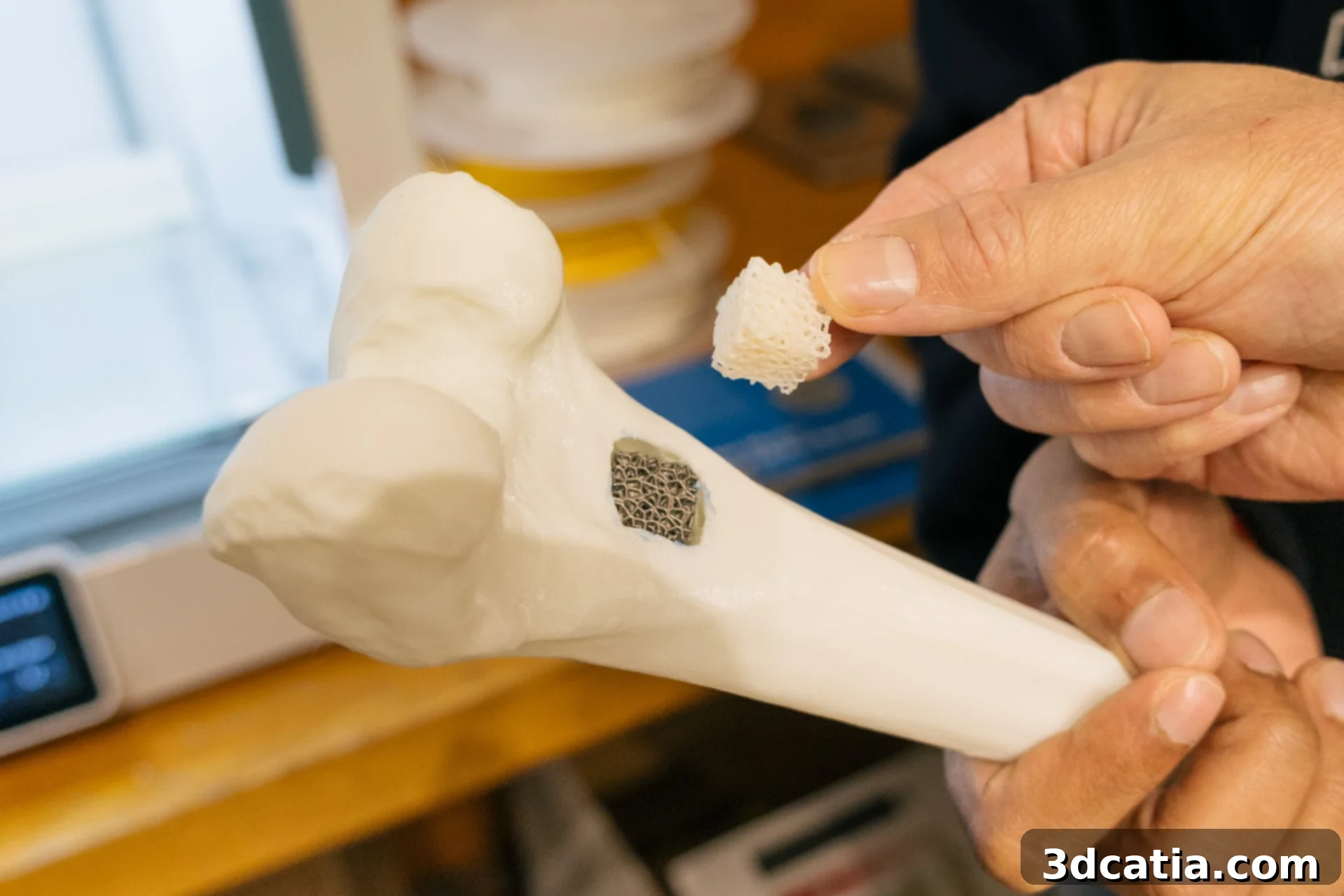
Revolutionizing Bone Repair: 3D Printed Scaffolds Mimic Natural Bone Structure
Bone is a marvel of biological engineering, simultaneously lightweight, porous, and remarkably strong. This unique combination of properties has long been a challenge for engineers and clinicians seeking to develop effective bone replacements and repair solutions. While metal implants and bone grafts have been the traditional approaches, they often fall short of replicating the natural behavior and functionality of real bone within the body.
Researchers at UNSW Canberra are pioneering a new frontier in bone repair through the innovative application of 3D printing technology. Their research focuses on developing biodegradable bone scaffolds meticulously designed to mirror the intricate internal structure and mechanical response of natural bone, going beyond simply filling a defect. This approach holds the potential to significantly improve patient outcomes and revolutionize orthopedic treatments.
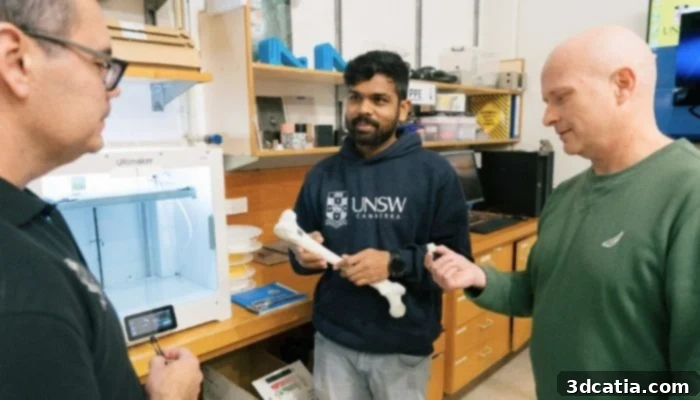
PhD student Kaushik Raj Pyla (center), with supervisors Juan Pablo Escobedo-Diaz (left) and Paul Hazell (right). (Photo credits: UNSW Canberra)
Moving Beyond Uniform Scaffold Designs for Enhanced Bone Regeneration
The research team has successfully developed 3D printed scaffolds that meticulously replicate crucial characteristics of natural bone, including its inherent strength and porosity. These scaffolds are designed to act as temporary support structures once implanted, facilitating the formation of new bone tissue before gradually dissolving. This innovative approach promises to minimize the need for subsequent surgeries, reducing patient burden and healthcare costs.
The key to the success of these scaffolds lies in their advanced design. Rather than relying on uniform, repeating patterns, the researchers have embraced stochastic lattice structures. These irregular architectures more closely resemble the complex structure of natural bone, which exhibits varying density depending on its location and functional requirements within the body. The scaffolds are fabricated using polylactic acid (PLA), a biodegradable polymer widely researched and utilized in various medical applications due to its biocompatibility and degradation properties.
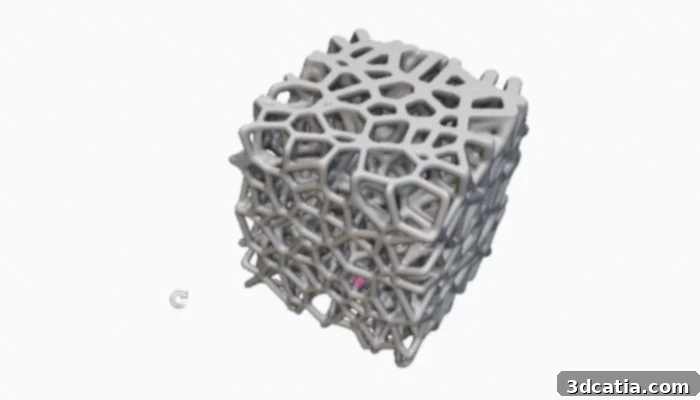
A 3D-printed stochastic lattice structure designed to mimic the internal architecture of natural bone. (Photo credit: Kaushik Raj Pyla)
Testing Strength Under Real-World Conditions: Ensuring Scaffold Durability and Performance
To comprehensively evaluate the performance of the 3D printed scaffolds, the team meticulously fabricated structures with varying internal grading directions, including lengthwise, transverse, and diagonal layouts. These scaffolds were subjected to rigorous mechanical testing to assess their ability to withstand different types of forces. The results revealed that the structures exhibited superior resistance to sudden impacts compared to slow, steady loading. Furthermore, the fracture behavior of the scaffolds varied significantly depending on the internal architecture, highlighting the critical role of design in determining the overall strength and durability of the implant.
“Under fast loads, the material behaves more brittle, but it also absorbs energy more efficiently. This is particularly important for real-world scenarios such as falls or accidents,” explains Kaushik Raj Pyla, the lead author of the study. His research highlights the importance of considering real-world loading conditions when designing bone scaffolds to ensure they can withstand the forces encountered during daily activities.
The Importance of Fluid Flow in Bone Scaffold Design for Optimal Healing
While mechanical strength is undoubtedly a crucial factor, the researchers emphasize that it is only one piece of the puzzle. The team also meticulously investigated how fluids move through the scaffolds, recognizing that this is a critical aspect of the healing process. Efficient circulation of blood and nutrients is essential to support cell growth, tissue regeneration, and ultimately, successful bone healing.
“We found that certain designs performed especially well in both strength and fluid flow. This suggests that implants can be tailored depending on the stresses different bones experience,” Pyla added. This finding underscores the potential for creating patient-specific implants that are optimized not only for mechanical performance but also for promoting efficient nutrient transport and cellular activity.
The 3D printed bone scaffolds are not yet ready for clinical use, and further biological testing and regulatory approvals are required before they can be widely adopted. However, the results of this research are highly promising, paving the way for more personalized and effective approaches to bone repair. As medical additive manufacturing continues to advance, studies like this demonstrate the increasing importance of design choices in maximizing the effectiveness of bone implants.
The future of orthopedic and regenerative medicine holds immense potential for 3D printed bone scaffolds. These innovative devices promise to revolutionize bone repair by providing tailored solutions that promote natural healing and improve patient outcomes. With continued research and development, 3D printed bone scaffolds have the potential to become a standard of care for a wide range of bone injuries and conditions.
These advances highlight the synergy between engineering, materials science, and medicine, offering a glimpse into a future where personalized implants and regenerative therapies can restore function and improve the quality of life for millions of people suffering from bone-related ailments.
Consider the impact of personalized medicine. Imagine a future where a surgeon can create a bone graft perfectly fitted to a patient’s specific anatomy, promoting faster healing and reducing the risk of complications. 3D printed bone scaffolds are poised to make this vision a reality, ushering in a new era of precision and effectiveness in orthopedic care.
The development of 3D printed bone scaffolds is a testament to the ingenuity of researchers and the transformative power of technology. As research continues, we can expect even more exciting advances that will shape the future of bone repair and regenerative medicine.
What role do you see 3D printed bone scaffolds playing in future orthopedic and regenerative medicine applications? Let us know in a comment below or on our LinkedIn or Facebook pages! Plus, don’t forget to sign up for our free weekly Newsletter to get the latest 3D printing news straight to your inbox. You can also find all our videos on our YouTube channel.
*Cover Photo Credits: UNSW Canberra