

Revolutionizing Healthcare: $2 Million Grant Propels Personalized Multi-Material 3D Printed Medical Devices
The landscape of modern medicine is continually evolving, driven by innovations that promise more effective and personalized patient care. At the forefront of this transformation is advanced manufacturing, particularly 3D printing, which is now poised to revolutionize the creation of medical devices. In a significant boost to this burgeoning field, a multi-disciplinary US team has been awarded a substantial $2 million grant. This vital funding, provided by the National Science Foundation’s (NSF) LEAP-HI program, is earmarked for a groundbreaking research project dedicated to developing personalized 3D-printed medical devices that integrate multi-material capabilities and dynamic functionality.
This pioneering research effort is a collaborative endeavor between two prestigious institutions: the University of Texas at Austin and Penn State. Their shared vision is to push the boundaries of what 3D printing can achieve in healthcare, moving beyond static devices to create intelligent, adaptive medical solutions tailored precisely to individual patient needs. The project underscores a commitment to fostering innovation that has a direct, positive impact on patient outcomes, particularly in areas requiring highly specialized and adaptable equipment.
Leading this exciting initiative is an exceptional all-female research team, bringing together diverse expertise from engineering and social sciences. Dr. Carolyn Seepersad, a distinguished professor in the Cockrell School of Engineering’s Walker Department of Mechanical Engineering at the University of Texas Austin, co-leads the project, leveraging her extensive knowledge in design and manufacturing. Her team at UT Austin is collaborating closely with Actuated Medical Inc., a Pennsylvania-based company renowned for its innovative medical technologies, ensuring that the research has strong translational potential for real-world application. The academic leadership from Penn State comprises three eminent professors: Mary Frecker, who serves as department head and professor of mechanical engineering, bringing expertise in adaptive structures and soft materials; Zoubeida Ounaies, also a professor of mechanical engineering, contributing deep insights into advanced materials and smart systems; and Lorraine Dowler, a professor of geography, women’s, gender and sexuality studies, whose involvement highlights the crucial importance of considering social, gender, and ethical dimensions in medical device design and accessibility. This interdisciplinary approach is key to developing solutions that are not only technologically advanced but also human-centered and equitable.
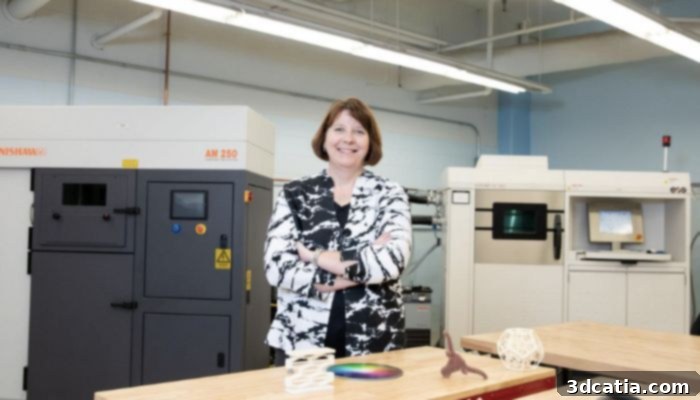
Dr Carolyn Seepersad was one of the leads on the project. (Photo credit: The University of Texas at Austin)
The Promise of Adaptive Manufacturing: Overcoming Current Limitations
The potential of 3D printing in the medical field has long been recognized for its unparalleled ability to create personalized devices with intricate and complex geometries. From custom prosthetics to patient-specific surgical guides, additive manufacturing has opened doors to treatments previously considered impossible. However, a significant limitation has persisted: the challenge of creating truly “smart” and multi-material objects that can dynamically adapt to changing conditions. Traditional 3D printing often produces static structures made from a single material or a limited combination, which falls short when medical devices require flexibility, responsiveness, or shape-changing capabilities over time.
This project directly addresses this critical gap. The research team aims to pioneer techniques that allow 3D printers to combine diverse materials with varying properties into a single, cohesive device. More importantly, they seek to imbue these devices with “smart” capabilities, enabling them to change shape or function in response to specific stimuli or evolving physiological requirements. A key application targeted by this research is the development of pediatric ventilation devices. These devices must be able to change shape to match the rapidly changing requirements of growing children, such as fluctuations in size and anatomical development, ensuring optimal fit and efficacy at every stage.
Interdisciplinary Innovation: Combining Soft Materials and Adaptive Structures
“The project allows us to collaborate at the exciting intersection of advanced manufacturing, soft materials, and adaptive structures,” remarked Mary Frecker, project co-lead, professor of mechanical engineering and of biomedical engineering, head of the Department of Mechanical Engineering and Reiss Chair of Engineering at Penn State. Her statement highlights the core scientific and engineering challenges and opportunities that the grant aims to tackle. The integration of advanced manufacturing techniques with novel soft materials is crucial for creating devices that are both functional and biocompatible, capable of interacting safely and effectively with the human body.
Soft materials, by their very nature, possess a flexibility and compliance that is often absent in traditional rigid medical devices. When combined with principles of adaptive structures, these materials can be engineered to undergo controlled deformations, enabling dynamic changes in shape or stiffness. This capability is paramount for devices that need to conform to complex anatomical contours, adjust to movement, or even grow with a patient. “The results will benefit patients by enabling shape change in medical devices,” Frecker added, emphasizing the direct clinical advantages of this research. Such devices could significantly improve patient comfort, reduce complications, and enhance the longevity and effectiveness of medical interventions by continually optimizing their fit and performance.
Beyond Personalization: The Drive Towards Automation and Sophistication
The research team expressed profound enthusiasm for the opportunities unlocked by the NSF grant. “With this grant, we plan to take the capabilities of 3D printers to a new level of sophistication and automation,” stated Carolyn Seepersad, also a project co-lead. This ambition points to a future where the design and fabrication of personalized, multi-material medical devices are not only possible but also efficient and scalable. Sophistication in this context refers to the ability to print increasingly complex internal structures, integrate sensing capabilities, and precisely control material properties at a microscopic level.
Automation, on the other hand, is a critical enabler for translating laboratory breakthroughs into widespread clinical applications. In the realm of 3D printing research, enhanced automation offers manifold benefits. It allows research groups to significantly save on manpower, as repetitive or complex tasks can be performed by machines with higher precision and consistency. This reduction in manual labor directly translates into substantial time savings, accelerating the pace of experimentation, prototyping, and validation. Furthermore, automation can drastically lower overall project costs by optimizing material usage, minimizing errors, and increasing throughput. By streamlining the entire additive manufacturing workflow, from digital design to final product, automation promises to make these advanced personalized medical devices more accessible and affordable in the long run, truly democratizing cutting-edge healthcare solutions.
The Broader Impact: Reshaping the Future of Healthcare
The implications of this $2 million grant extend far beyond the specific development of pediatric ventilation devices. The methodologies and technologies developed during this project are expected to have a transformative impact across a wide spectrum of medical applications. Imagine surgical tools that can adapt their shape to navigate complex anatomical pathways, or implants that can change their mechanical properties over time to better integrate with regenerating tissue. The ability to create multi-material devices means that different sections of a device can perform distinct functions – one part might be soft and flexible for patient comfort, while another is rigid for structural support, and yet another integrates electronics for sensing or actuation.
This research represents a significant leap towards truly personalized medicine, where treatments are not just tailored to a patient’s diagnosis but to their unique physiology, growth patterns, and individual needs. By fostering innovation in adaptive structures and smart materials, the project has the potential to spawn entirely new categories of medical devices that can dynamically interact with the body, enhancing diagnostic capabilities, improving therapeutic outcomes, and significantly boosting the quality of life for countless patients. Moreover, the interdisciplinary nature of the team, including insights from geography and gender studies, ensures that these technological advancements are considered within a broader societal context, aiming for solutions that are inclusive and address the needs of diverse patient populations, considering accessibility and utility for all.
The NSF’s LEAP-HI program’s investment in this research is a testament to the recognized potential of additive manufacturing to solve some of healthcare’s most pressing challenges. By bridging the gap between advanced engineering and clinical necessity, the University of Texas at Austin and Penn State, in collaboration with Actuated Medical Inc., are setting a new standard for medical device innovation. This project is not merely about printing objects; it’s about printing a healthier, more adaptable future for patient care.
To learn more about the specifics of this groundbreaking research from both Penn State and the University of Texas, you can find the respective press releases HERE and HERE.
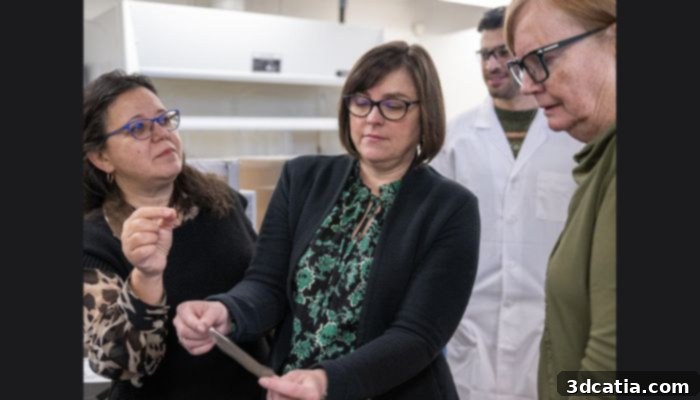
The project co-leads from Penn State. (Photo credit: Jeff Xu/Penn State)
What are your thoughts on the future of 3D printing in medical devices and personalized healthcare? We’d love to hear from you! Let us know in a comment below or connect with us on ourLinkedIn,Facebook, andTwitter pages. Don’t forget to sign up for our free weeklyNewsletter here, to get the latest 3D printing news straight to your inbox! You can also find all our insightful videos on ourYouTube channel, featuring interviews, demonstrations, and analyses of the most impactful developments in the additive manufacturing world.
*Cover photo credits: Peace Point Hospitals