
Revolutionizing Industries: A Weekly Roundup of Cutting-Edge 3D Printing Innovations
Welcome to our latest weekly compilation, where we dive into the most fascinating and impactful applications of 3D printing technology across diverse sectors. Additive manufacturing continues to push boundaries, transforming everything from automotive design and high-speed transport to industrial tooling and consumer products. This week, we explore how leading companies and innovative minds are leveraging the power of 3D printing to enhance comfort, accelerate development, improve safety, and even bring pop culture phenomena to life. Join us as we uncover five compelling stories that showcase the versatility and immense potential of 3D printing.
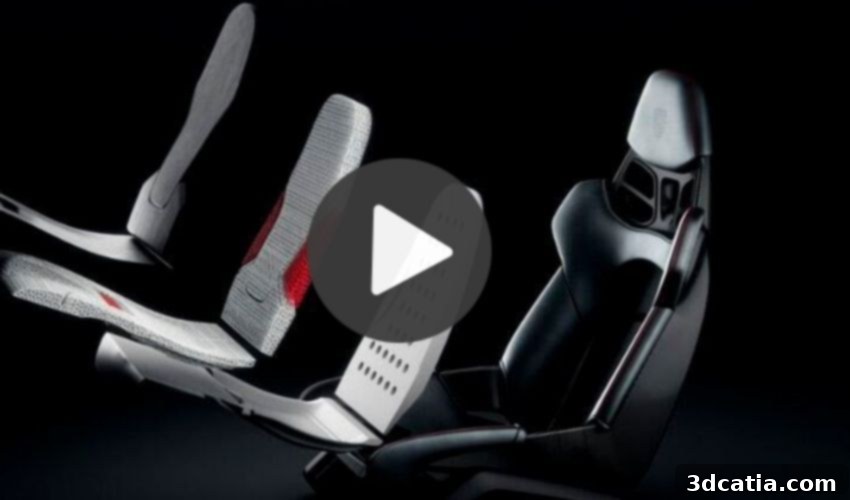
Top 1 – Porsche Elevates Driver Comfort with 3D-Printed Full-Shell Bodyform Seats
Since March 2020, Porsche, a name synonymous with high-performance sports cars and unparalleled driving experiences, has been at the forefront of integrating additive manufacturing into its vehicle production. The German automotive giant embarked on an ambitious project to develop 3D-printed seat components, aiming to redefine driver comfort and personalization. This initiative has since progressed significantly, with a select group of Porsche drivers having already had the exclusive opportunity to test a revolutionary 3D-printed bodyform full bucket seat. These tailor-made seats are now available as a premium offering within Porsche’s performance parts range, compatible with popular models such as the Porsche Boxster, Cayman, and 911 series.
The innovation doesn’t stop there; Porsche’s groundbreaking Mission R, an all-electric concept study for a future customer racing car, also features these advanced 3D-printed full bucket seats. Starting from February 2022, these seats will be made standardly available through Porsche Exclusive Manufaktur, seamlessly integrated into the Porsche Car Configurator for customers to personalize their new vehicles. A key feature distinguishing these seats is the adaptability of their 3D-printed upholstery and backrest surfaces, which come in three distinct degrees of rigidity. This allows drivers to meticulously customize their seating experience, ensuring optimal comfort and support tailored to individual preferences and driving styles. This level of customization, once unimaginable with traditional manufacturing methods, highlights the transformative power of 3D printing in the luxury automotive sector. It promises not just enhanced comfort but also potential weight savings and improved ergonomics, further contributing to the legendary Porsche driving dynamic. Dive deeper into Porsche’s journey with 3D printing in the video below.
Top 2 – Hyperloop Capsule Competition: 3D Printing Accelerates the Future of Transport
In Valencia, Spain, the Hyperloop capsule competition served as a vibrant arena for innovation, challenging participants to conceptualize and build prototypes of high-speed subsonic trains. These competitions are crucial for pushing the boundaries of future transportation, where speed, efficiency, and novel engineering solutions are paramount. One particular team distinguished itself by strategically leveraging the manifold advantages of 3D printing. They utilized an Epsilon W50 machine, a state-of-the-art 3D printer from the renowned Spanish manufacturer BCN3D, to produce various critical parts for their capsule prototype. The application of additive manufacturing allowed the team to fabricate complex components with remarkable precision and speed, far surpassing the capabilities of conventional methods.
Beyond direct part manufacturing, 3D printing also proved instrumental in the rapid and efficient creation of 3D molds, an essential step in developing advanced composite structures often found in aerospace and high-speed vehicle design. The ability to work with a wide array of different materials was another significant benefit, enabling the team to experiment with various properties and optimize their prototype for specific performance metrics, such as strength-to-weight ratio and aerodynamic efficiency. Members of the team enthusiastically shared insights into their manufacturing process, elaborating on how 3D printing significantly reduced their development cycles, allowed for rapid iteration, and ultimately contributed to a more innovative and competitive design. This project underscores how additive manufacturing is not just a tool for production, but a catalyst for accelerating research and development in cutting-edge fields like hyperloop technology, paving the way for the next generation of transportation. Witness their inventive process in the video.
Top 3 – ERIKS Leverages Ultimaker to Optimize Industrial Operations and Enhance Safety
ERIKS, a company with a strong global presence and specialized expertise in the production and distribution of high-quality technical components for a vast range of industrial applications, has strategically integrated additive manufacturing into its internal operations. Recognizing the profound benefits that 3D printing offers, ERIKS has adopted this technology not only to enhance efficiency but also to significantly improve workplace safety for its employees. By developing custom tools and fixtures in-house using 3D printers, ERIKS is demonstrating a forward-thinking approach to operational excellence.
A compelling illustration of this commitment is the creation of a specialized safety stop, meticulously 3D printed with an Ultimaker machine. This ingenious device is designed to be placed securely on a roll of wrapping film, allowing employees to safely and effortlessly remove and replace empty rolls without the risk of injury or operational delays. Such tailored tools are often too expensive or time-consuming to procure through traditional manufacturing channels, making 3D printing an ideal solution for on-demand production of highly specific, ergonomic, and safety-critical components. The ability to rapidly design, prototype, and produce these custom solutions not only streamlines workflows and boosts productivity but also underscores ERIKS’ dedication to fostering a safer working environment. This strategic investment in additive manufacturing with Ultimaker printers is a testament to the technology’s capability to deliver tangible benefits in real-world industrial settings, optimizing processes from the ground up. Explore this innovative application in the video provided.
Top 4 – DIY Fun: How to 3D Print Your Own Squid Game Mask
In an era where cultural phenomena quickly spread across the globe, few television series have captivated audiences quite like Netflix’s “Squid Game.” The distinctive masks worn by the show’s mysterious guards and the Front Man have become instantly recognizable symbols, sparking immense interest among fans worldwide. For enthusiasts of the series and the burgeoning maker community, 3D printing offers an incredible avenue to bring these iconic masks to life right in their own homes. This week, we feature a captivating video tutorial where a skilled maker meticulously guides viewers through each essential step required to 3D print their very own Squid Game mask. From selecting the right digital model to the intricacies of printing and post-processing, the video demystifies the entire process, making it accessible even for those relatively new to additive manufacturing.
The appeal of 3D printing extends far beyond mere replication; it empowers individuals to engage in personalized fabrication, transforming digital designs into tangible objects. With Halloween night often just around the corner, or simply for costume parties and display, creating a custom Squid Game mask becomes the perfect opportunity for creative expression and a fun, engaging project. This trend highlights the democratization of manufacturing, where anyone with access to a 3D printer can become a producer of bespoke items, reflecting their interests and passions. Whether it’s for cosplay, a unique decoration, or just to impress friends, the ability to replicate such a recognizable prop showcases the versatility of personal 3D printing and its role in fostering a vibrant community of creators and innovators. Don’t miss this chance to transform into your favorite character with the help of your 3D printer!
Top 5 – A Landmark Achievement: 3D-Printed Part Deployed in the Energy Sector
The energy sector, with its demanding environments and critical infrastructure, is increasingly turning to additive manufacturing for innovative solutions. This week, we highlight a groundbreaking project championed by Edwige Ravry, the esteemed Head of Additive Manufacturing at TotalEnergies, a global multi-energy company. Edwige Ravry played a pivotal role in a collaborative initiative with Vallourec, a world leader in premium tubular solutions. Their joint effort culminated in a significant milestone: the successful installation of the first 3D-printed *waterbushing* in the challenging and remote conditions of the North Sea.
The deployment of a 3D-printed component like a waterbushing in such a critical and harsh environment represents a monumental leap forward for industrial additive manufacturing. Waterbushings are essential components in various energy operations, often subjected to extreme pressures, temperatures, and corrosive elements. Traditional manufacturing methods for such parts can be complex, time-consuming, and limited in terms of geometric complexity and material properties. 3D printing, however, offers unparalleled design freedom, allowing for optimized geometries that can enhance performance, reduce material waste, and potentially extend the lifespan of components. Furthermore, the ability to produce these parts on demand, even in remote locations, significantly reduces lead times and logistics challenges inherent in offshore energy projects. In this compelling final video, Edwige Ravry provides an insightful analysis, dissecting all the intricate details and broad implications of this pioneering project. It serves as a powerful testament to how additive manufacturing is not just improving existing processes but fundamentally reshaping the future of critical infrastructure in the energy sector, offering robust, efficient, and sustainable solutions for global energy demands.
This week’s compilation truly underscores the incredible versatility and transformative power of 3D printing across a spectrum of industries. From enhancing personal comfort in high-performance vehicles and accelerating the development of future transportation systems, to boosting industrial safety and enabling creative consumer projects, additive manufacturing is proving to be an indispensable technology. The successful deployment of 3D-printed components in critical energy infrastructure further solidifies its role as a key driver of innovation and efficiency in challenging environments.
What are your thoughts on this week’s extraordinary showcase of 3D printing applications? We encourage you to share your insights and comments below, or engage with us on our social media platforms: LinkedIn, Facebook, and Twitter. To stay consistently informed about the latest breakthroughs and essential news in the world of additive manufacturing, don’t forget to sign up for our free weekly newsletter here, delivered directly to your inbox. You can also explore our extensive library of videos on our dedicated YouTube channel for even more compelling content. Thank you for joining us on this journey through the cutting-edge world of 3D printing!