
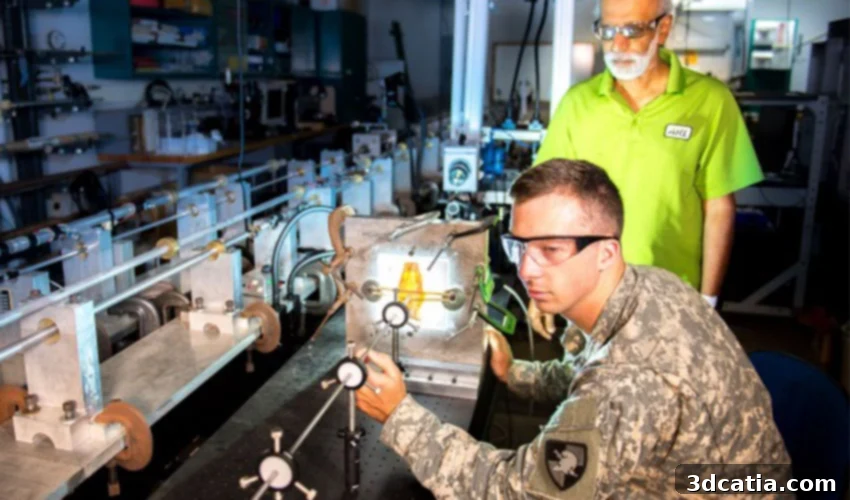
Revolutionizing Military Readiness: The US Army’s Advanced Fatigue Monitoring for 3D Printed Maraging Steel
The United States Army is at the forefront of integrating cutting-edge technologies to enhance its operational capabilities and maintain a decisive advantage. A significant area of investment and innovation lies within additive manufacturing (AM) technologies, commonly known as 3D printing. This strategic embrace of AM is driven by its profound potential to deliver unparalleled benefits, including vastly increased design freedom, significantly shorter lead times for critical components, substantial cost reductions for unique or low-volume parts, and ultimately, a remarkable boost in the performance and reliability of military equipment. These advantages are particularly crucial in defense applications, where customized solutions, rapid prototyping, and on-demand production can make the difference in critical missions.
Within this transformative landscape, researchers from the US Army’s Combat Capabilities Development Command (CCDC) Army Research Laboratory (ARL) have undertaken groundbreaking work focusing on one of the most vital aspects of material science: fatigue monitoring. Specifically, their efforts have centered on understanding and predicting the fatigue behavior of additively manufactured maraging steel parts. This research is not merely an academic exercise; it carries immense practical importance for military readiness. By accurately predicting when these high-performance parts will begin to degrade or fail and require replacement, soldiers and maintenance crews can adopt a proactive maintenance strategy, ensuring that equipment remains operational and ready for deployment at all times, thereby significantly reducing unexpected failures in the field and improving overall mission success rates.
Pioneering Research: Unveiling the Durability of 3D Printed Maraging Steel
The extensive findings of this critical research were formally published in the esteemed International Journal of Advanced Manufacturing Technology, under the compelling title “In-Situ Fatigue Monitoring Investigation of Additively Manufactured Maraging Steel.” This comprehensive study delves deep into innovative methodologies for the US Army to effectively detect and continuously monitor the wear and tear experienced by metal additively manufactured maraging steel components. Maraging steels are a class of high-strength steels renowned for their exceptional mechanical properties. They are distinguished by possessing superior strength and outstanding toughness, all without compromising their inherent ductility—a characteristic that makes them incredibly valuable for demanding applications where both robustness and resistance to brittle fracture are essential.
The parts investigated in this study were fabricated using the Laser Powder Bed Fusion (LPBF) process. LPBF is a highly precise additive manufacturing technique where a laser selectively melts metallic powder layer by layer, fusing it to create a solid object. This process is particularly well-suited for producing complex geometries with high accuracy from advanced metal alloys like maraging steel. While these 3D printed components undeniably benefit immensely from the inherent advantages of the AM process, the research underscores that certain features and characteristics introduced by the manufacturing method itself require meticulous examination and ongoing monitoring. As Dr. Jaret C. Riddick, who serves as the Director of the Vehicle Technology Directorate at the US Army’s Combat Capabilities Development Command’s Army Research Laboratory, precisely explains, “3D printed parts display certain attributes, due to the manufacturing process itself, which, unchecked, may cause these parts to degrade in manners not observed in traditionally-machined parts.” This highlights a fundamental distinction in the material science of AM parts compared to those produced through conventional manufacturing routes, necessitating new approaches to ensure long-term reliability.
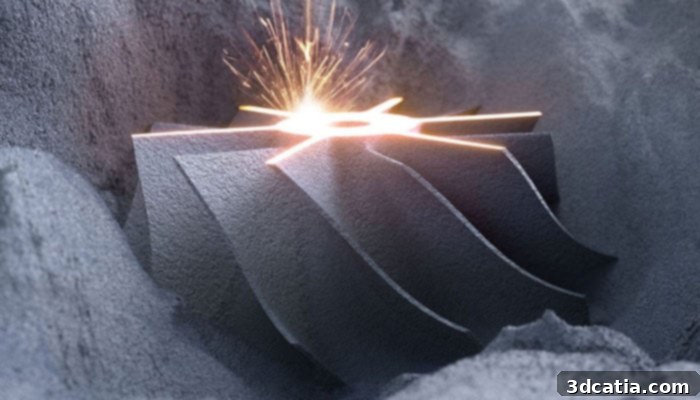
The laser powder bed fusion process: A critical additive manufacturing technique for high-performance metals.
Understanding Material Fatigue: The Paper Clip Analogy and AM Challenges
To truly grasp the concept of material fatigue, one can consider a simple yet illustrative analogy: that of a common paper clip. Imagine taking a paper clip and repeatedly bending it back and forth. Initially, it offers resistance, but with each successive bend, its structural integrity weakens until, inevitably, it breaks. Now, envision repeating this process with a batch of different paper clips. You would observe that they do not all break after the same number of bends; rather, they fail at varying intervals. These inconsistencies are largely attributable to the inherent, subtle internal imperfections and microscopic structural variations present within each individual piece of steel. This seemingly minor variability has profound implications for predicting the lifespan of engineered components.
Dr. Todd C. Henry, a mechanical engineer at the laboratory and a co-author of the seminal study, elaborates on this crucial point: “Every real-world material and structure has imperfections that make it unique in terms of performance, so if the batch of paper clips take 21–30 cycles to break, what we would do today is after fifteen cycles throw the batch of paperclips away to be safe.” This statement succinctly captures the essence of conventional engineering practices, particularly in critical applications. It reflects a deeply conservative approach where, in the absence of precise knowledge about an individual component’s true fatigue life, a safety factor is applied. This often means replacing parts long before their theoretical end-of-life to preempt any potential failures. While this strategy prioritizes safety, it inevitably leads to significant material waste, increased maintenance costs, and potentially unnecessary downtime. The fundamental challenge lies in the fact that, without individual monitoring, all parts within a batch are treated as having the lowest common denominator in terms of expected performance, regardless of their actual condition. Essentially, the same prudent, yet often inefficient, principle holds true for intricate 3D printed parts made of high-performance steels, highlighting the urgent need for more sophisticated, individualized monitoring solutions.
In the realm of additive manufacturing, the nature of these “imperfections” takes on a unique character. A significant portion of these variations stems from the inherent discrepancies that can arise between the meticulously designed geometry modeled on a computer-aided design (CAD) system and the physical attributes of the actual 3D printed output. This gap can manifest in various ways, including porosity (tiny voids within the material), residual stresses introduced during the rapid heating and cooling cycles of the printing process, surface roughness that differs from traditional machining, and anisotropic material properties resulting from layer-by-layer fabrication. These AM-specific imperfections can profoundly influence a part’s fatigue life and its overall mechanical performance, often in ways that are difficult to predict using models based on conventionally manufactured materials. It is precisely these complexities that Dr. Henry’s pioneering sensor technology seeks to address. Developed within the framework of this critical study, this innovative sensor system provides an unprecedented capability: a robust and reliable method to meticulously track individual additively manufactured parts throughout their operational lifespan. By doing so, it enables the prediction of specific failure points with a much higher degree of accuracy, thereby facilitating the proactive replacement of components *before* they catastrophically break or impede critical operations. This represents a paradigm shift from reactive maintenance to a highly efficient, condition-based predictive maintenance strategy, offering significant advantages in military applications where equipment reliability is paramount.
Revolutionizing Maintenance: Sensor Technology and Predictive Analytics
Dr. Henry’s sensor technology represents a crucial step forward in addressing the inherent variability and unpredictable nature of fatigue in additively manufactured components. This innovative system moves beyond the traditional, generalized approach to maintenance by offering a powerful capability to track individual parts. By continuously monitoring the real-time conditions and accumulating stresses on each unique 3D printed component, the sensors can gather vital data that feeds into sophisticated algorithms. These algorithms are then able to predict with remarkable precision when a specific part is approaching its fatigue limit or is likely to fail. This detailed, individualized tracking allows for a radical shift in maintenance philosophy, moving away from broad, time-based replacement schedules—which often discard perfectly functional parts—towards a highly efficient, condition-based, and truly predictive maintenance paradigm. The implications for military readiness and logistical efficiency are profound.
Furthermore, Dr. Henry highlights another compelling aspect of this technology: its potential to broaden the range of materials considered for critical applications. He comments, “With 3D printing, you might not be able to replace a part with the exact same material. There is a cost and time benefit with 3D printing that perhaps warrants using it anyway. Imagine a situation where you always chose the strongest material but there was another material that was cheaper and easier to get; however, you need to prove that this other material can be depended on.” This insight reveals a strategic advantage that goes beyond merely extending the life of existing parts. By enabling precise fatigue monitoring and performance validation, this sensor technology can provide the necessary data and assurance to qualify alternative materials. This means that if a less expensive or more readily available material can be reliably proven to meet performance requirements for a given operational lifespan, it could be adopted, leading to significant cost savings, improved supply chain resilience, and faster deployment of crucial components. This flexibility is invaluable for military operations that often face diverse material availability and budgetary constraints, allowing for optimized material selection based on proven performance rather than just theoretical strength ratings.
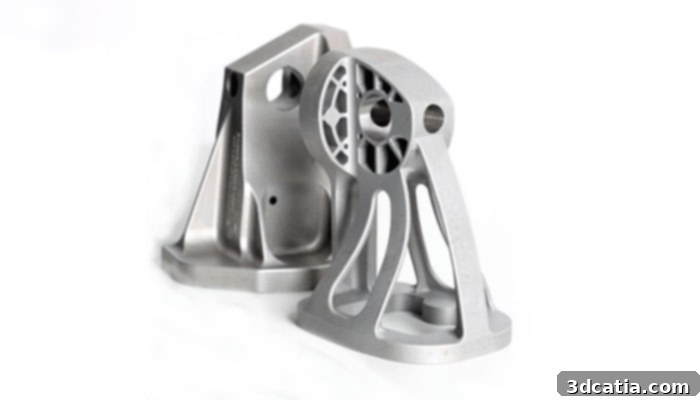
Metal additively manufactured parts undergoing rigorous testing and monitoring to ensure peak performance.
The Future of Durability: Machine Learning and Beyond
The ability to precisely understand and predict the long-term performance and durability of 3D printed metal parts, long after they have been initially manufactured and put into service, holds paramount importance for virtually all sectors, and especially for defense. This knowledge is not just about preventing failures; it’s about optimizing design, extending operational lifespans, and ensuring the highest levels of safety and reliability. The foundational insights derived from this groundbreaking study are not static; rather, they serve as a dynamic springboard for future advancements. Army researchers are actively applying these valuable findings to new and ongoing investigations, particularly focusing on the additive manufacturing of stainless steel parts. This expansion to other widely used military materials underscores the broad applicability and strategic significance of the initial research.
In a further evolution of their approach, the researchers are now exploring sophisticated machine-learning (ML) techniques as an alternative, and potentially more powerful, method for characterizing the lifespan of components, moving beyond the reliance on physical sensors. Machine learning offers a transformative pathway by enabling the analysis of vast datasets related to material properties, manufacturing parameters, operational conditions, and historical failure data. By identifying intricate patterns and correlations that might be imperceptible to human analysis, ML algorithms can develop highly accurate predictive models for fatigue and degradation. This approach could lead to “digital twins” of physical parts, where the performance and remaining useful life of a component are simulated and tracked in a virtual environment based on real-world inputs, offering even greater fidelity and real-time insights than discrete sensors alone. This shift towards AI-driven prognostics represents the next frontier in material science and predictive maintenance, promising to further enhance the reliability and cost-effectiveness of advanced manufacturing for military applications.
The implications of this research extend far beyond merely extending the life of individual parts. It speaks to a broader transformation within military logistics and operations, paving the way for a more resilient, responsive, and efficient defense infrastructure. By enabling true predictive maintenance, the Army can significantly reduce maintenance-related downtime, optimize inventory management by producing parts only when and where they are needed, and ultimately ensure that soldiers have access to the most reliable and high-performing equipment possible. This proactive stance not only saves costs but, more importantly, enhances the safety and effectiveness of personnel in demanding operational environments. For those interested in delving deeper into the specifics of this pivotal research, further information can be accessed HERE.
We’d love to hear your thoughts on this remarkable study and its potential impact on defense manufacturing and beyond! Share your perspectives in the comment section below, or engage with us on our Facebook and Twitter pages. Don’t miss out on the latest breakthroughs and essential updates in the world of 3D printing; make sure to sign up for our free weekly Newsletter, delivering all the crucial news straight to your inbox!