
Unleashing Innovation: The Top 3D Printing Breakthroughs and Videos of 2024
The year 2024 was truly exceptional for the world of 3D printing, witnessing an unprecedented surge in innovation and application. From groundbreaking advancements in medical technology to revolutionary developments in the automotive and aerospace sectors, additive manufacturing continued to push the boundaries of what’s possible. These breakthroughs are not just theoretical; they are tangible, impactful, and reshaping industries globally. To celebrate these achievements, we’ve compiled a selection of our favorite videos from the year. This curated collection showcases where creativity and cutting-edge technology converged to forge the future. Prepare to be inspired by captivating stories, transformative projects, and real-world applications that demonstrate how 3D printing is driving unprecedented progress. Dive into the remarkable videos listed below and discover the incredible trajectory of additive manufacturing in 2024.
NASA’s Strategic Use of Additive Manufacturing for Space Exploration
Embark on a journey into the cosmos with this captivating interview featuring Paul Gradl, Chief Engineer at NASA. He unveils how the esteemed space agency is leveraging additive manufacturing to propel space exploration to unprecedented heights. Gradl provides intricate details on the seamless integration of 3D printing into various mission-critical projects, highlighting NASA’s preferred technologies, the advanced materials being utilized, and the immense benefits derived from this innovative approach. He elaborates on how 3D printing enables the creation of complex geometries, reduces lead times for critical components, and allows for the production of lightweight yet robust parts essential for space vehicles and habitats. This technology is proving indispensable for developing next-generation rocket engines, optimizing spacecraft designs, and even considering on-demand manufacturing for future lunar or Martian bases. Furthermore, Gradl offers an exciting glimpse into the prospective role of additive manufacturing in the future of interstellar travel and deeper space missions, painting a picture of a future where custom-fabricated parts are routine for expanding humanity’s reach.
Ukrainian Soldiers Utilizing 3D Printing for Drone Parts in Defense
Additive manufacturing has firmly established itself as a critical technology within the defense sector, playing a pivotal role in the production of vital equipment such as ammunition, protective gear, and, most notably, drones. This video highlights the innovative approach taken by the Ukrainian army, which harnesses 3D printing to efficiently produce drone components at a significantly reduced cost. These rapidly manufactured “kamikaze” drones are then deployed for tactical missions, targeting and destroying enemy positions and ammunition depots. The ability to produce these parts quickly and locally offers an invaluable advantage, enabling rapid iteration and customization based on evolving battlefield needs. Ukrainian military personnel emphasize that the strategic integration of 3D printing is fundamentally altering the dynamics of modern warfare, providing agility, cost-effectiveness, and decentralized production capabilities that were previously unimaginable. Witness this compelling demonstration of how 3D printing is transforming military logistics and strategy.
High-Speed Thrills: A 3D Printed Drone Races a Formula 1 Car
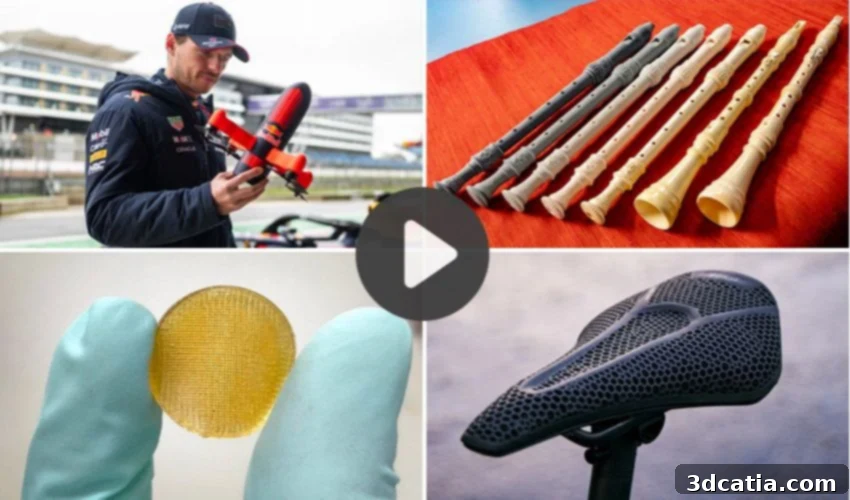
Shifting our focus from defense, we explore another captivating application of drones, this time in the realm of high-performance sports and entertainment. This thrilling video captures an incredible spectacle where speed, precision, and cutting-edge technology converge in an epic race. It showcases a remarkable technological collaboration between Red Bull Racing and Dutch Drone Gods. The latter were instrumental in the development of a bespoke, 3D-printed drone engineered to achieve astonishing speeds of up to 350 km/h. The drone’s exceptional velocity was rigorously tested in a direct competition against Max Verstappen’s formidable new RB20 Formula 1 car on the iconic Silverstone circuit. Equipped with advanced cameras, the drone meticulously captured every exhilarating detail of the car’s performance in real-time action, offering unparalleled perspectives. Beyond the sheer excitement, this serves as a prime example of how 3D printing is being utilized to profoundly enhance the spectator experience. Imagine following an F1 car throughout an entire race with immersive, high-definition image quality that leaves nothing to be desired, all thanks to custom-fabricated drone technology. But the ultimate question remains: who emerged victorious in this electrifying showdown?
Enhanced Performance: 3D Printed Adaptive Bicycle Saddles
In recent years, 3D printing has progressively integrated into the consumer goods and sports sectors, yielding numerous innovative examples – a notable one being Wilson’s airless basketball. The unique combination of rapid prototyping, profound personalization, and the use of advanced, innovative materials is increasingly drawing the attention of sporting goods manufacturers to the expansive possibilities of 3D printing. Fizik, a renowned manufacturer of high-performance bicycle saddles, has enthusiastically embraced additive manufacturing. By adopting Carbon’s Digital Light Synthesis (DLS) technology, Fizik has successfully overcome the inherent limitations of traditional manufacturing methods and conventional materials. This strategic shift has empowered Fizik to engineer saddle padding that dynamically adapts to each individual cyclist’s anatomy, offering unparalleled comfort and significantly boosting performance. The DLS process allows for the creation of intricate lattice structures with varying stiffness zones, precisely tuned for cushioning and support where needed most. Furthermore, 3D printing facilitates a much faster production cycle, enabling quicker design iterations and market delivery. This video demonstrates how Fizik has not only developed a superior product but also discovered a scalable, efficient manufacturing solution for the future of bicycle saddles.
Breaking Olympic and Paralympic Records with 3D Printing Technology
A significant sporting highlight of the year was undoubtedly the Olympic and Paralympic Games in Paris, where elite athletes converged to compete for new records and personal bests. In this high-stakes environment, modern technologies are playing an increasingly crucial role, particularly in para-sports, to provide essential support to athletes striving for excellence. The ability to offer rapid, on-site care and customization for critical equipment is paramount. This ensures that any issues with prostheses, orthoses, wheelchairs, and other adaptive gear can be immediately addressed and rectified, allowing athletes to compete with unwavering confidence in their equipment. At the Paralympic Games, the specialized med-tech company Ottobock is entrusted with this vital responsibility. We were granted exclusive access behind the scenes and had the privilege of speaking with Leon Fiolka, CPO at Ottobock, to gain deeper insights into how advanced 3D printing technologies are being strategically employed to optimize athlete performance, enhance comfort, and facilitate seamless participation at the Paralympic Games. His insights reveal the transformative impact of additive manufacturing on adaptive sports.
The LEAP 71 Rocket Engine: A Testament to AI and Additive Manufacturing
Next on our list is a key player that garnered considerable attention over the past year: LEAP 71. This innovative Dubai-based company is at the forefront of developing groundbreaking products for both the aerospace industry and the burgeoning field of electromobility. Mid-year, they astonished the world with this compelling video showcasing the test launch of their revolutionary TKL-5 rocket engine. What makes this engine truly remarkable is its production method: it was meticulously crafted using advanced additive manufacturing techniques and designed with the company’s proprietary, state-of-the-art computer engineering software, Noyron. Thanks to Noyron’s sophisticated, built-in AI algorithms, the entire model was created autonomously and automatically, bypassing traditional CAD design processes and requiring no human intervention. This groundbreaking approach dramatically reduced the production time to an astonishing mere two weeks. The successful test firing of the TKL-5 engine conclusively demonstrated the incredible capabilities of this revolutionary design and manufacturing paradigm right from its inception, heralding a new era for aerospace engineering.
Revolutionary 3D Printed Food for Individuals with Swallowing Difficulties
Dysphagia, a medical condition characterized by difficulty swallowing food, affects a substantial portion of the population. This includes a significant number of elderly individuals and those with conditions such as stroke, Parkinson’s disease, or dementia, profoundly impacting their quality of life and nutritional intake. The following video introduces an ingenious solution to this widespread problem, meticulously developed by an international team of researchers at UWE Bristol. Leveraging a specialized 3D extrusion printer, these researchers have successfully engineered nutritionally balanced and visually appealing meals specifically tailored for individuals experiencing swallowing difficulties. These innovative meals are crafted from pure, carefully selected ingredients and are innovatively combined into textures that are不仅 safe to swallow but also offer a pleasant mouthfeel and taste, a common challenge in restrictive diets. While other similar projects exist, this particular development stands out due to its focus on creating highly nutritious, multi-ingredient “inks,” ensuring comprehensive dietary benefits alongside safety and palatability. This breakthrough holds immense promise for improving the daily lives and health of countless individuals.
Inside Prusa: A Glimpse into the Renowned 3D Printer Farm
Ever wondered how some of the most popular and reliable 3D printers on the market are meticulously manufactured? This year, a segment of the 3Dnatives team had the exclusive opportunity to visit Prusa’s impressive headquarters in the Czech Republic. During their visit, they witnessed the exciting launch of a new, advanced printer, the Prusa Pro HT90, showcasing the company’s continuous innovation. In this compelling video, Štěpán from Prusa graciously guides us through the inner workings of their facility, providing an intimate, behind-the-scenes look at their rigorous quality control processes and the meticulous assembly lines that ensure every printer meets their high standards. The highlight of the tour is undoubtedly the awe-inspiring “farm” – an expansive array of 700 Prusa printers operating around the clock, engaged in self-replication and production of parts for new machines. This unique approach to manufacturing, where their own products contribute to future production, underscores Prusa’s commitment to efficiency and quality. This video offers invaluable insights into the scale and precision of modern large-scale additive manufacturing operations, providing a fascinating perspective on how these complex machines come to life.
Relativity Space: Pioneering Fully 3D Printed Rockets
Throughout the year, we’ve witnessed countless examples of how 3D printing is fundamentally transforming space travel. While SpaceX frequently dominates headlines, numerous other ambitious companies are also leveraging additive manufacturing to conquer distant galaxies. Relativity Space stands as a prominent innovator among them. This American company is unique in being one of the few private space entities to possess its own dedicated launch site for rockets, a testament to their comprehensive approach. For the development of their Terran R rocket, Relativity Space employs a sophisticated process using an aluminum alloy in wire form. This material is precisely extruded and printed by a robotic head, incrementally constructing the rocket’s structure upon a rotating platform. This groundbreaking method significantly reduces part count, speeds up the manufacturing process, and allows for unprecedented design complexity and optimization. Beyond the incredible engineering behind their 3D printed rockets, the accompanying video also delves into the inspiring and impressive history of the company, showcasing its journey from an ambitious startup to a leading force in space technology. It’s a compelling narrative of how advanced manufacturing is literally building the future of space exploration.
Reviving History: 3D Printed 18th-Century Musical Instruments
Can you envision a unique synergy where history, cutting-edge technology, and music intertwine to create something truly extraordinary? The following video presents a fascinating case study of how 3D printing is revolutionizing our understanding and interaction with historical musical instruments. A talented teacher and flutist from the Royal College of Music in London shares her captivating experience as she tests replicas of exquisite 18th-century flutes. These instruments were meticulously recreated through the combined power of 3D scanning and 3D printing technologies. By accurately reproducing instruments from the Academy’s precious museum collection, musicians are now able to physically experience and deeply understand the evolution of sound across centuries. This innovative application allows for the study and performance of instruments that, due to their advanced age and extreme fragility, can no longer be safely played in their original form. Thanks to this remarkable technology, the authentic sounds of the past can be vividly revived, offering invaluable insights for historical performance, musical education, and cultural preservation, bridging the gap between historical artifacts and contemporary musicianship.
The Future of Materials: 3D Printed, Self-Repairing Polymers
At the University of Alabama, dedicated scientists are making incredible strides in materials science, actively researching and developing polymers that possess the remarkable ability to heal or repair themselves autonomously. Their pivotal research relies heavily on the Desktop Health 3D bioplotter, which has proven to be an indispensable ally in this complex field of study. The structures meticulously printed with these advanced polymers demonstrate an astonishing capacity to self-repair after incisions or various forms of damage, effectively growing back together and restoring their integrity. This groundbreaking innovation holds immense potential for transformative applications across a diverse range of sectors. In the medical field, these self-healing polymers could revolutionize everything from biocompatible implants to advanced wound dressings and tissue engineering. For the automotive industry, they promise more durable and resilient components, reducing maintenance and replacement costs. In aerospace, these materials could lead to components that automatically repair micro-fractures, enhancing safety and extending the lifespan of critical parts. This video offers an in-depth look at how these innovative materials are conceived and developed, and how the fascinating process of self-healing polymers actually works, pointing towards a future of highly resilient and sustainable products.
Czinger Hypercar 21C: Where AI and 3D Printing Break Records
This captivating video showcases a true synergy of artificial intelligence and 3D printing that is quite literally breaking records. Both revolutionary technologies played an absolutely crucial role in the meticulous development and engineering of Czinger’s 21C hypercar, a vehicle that redefines automotive performance. In August, this extraordinary vehicle set a new lap record for production cars at the challenging Laguna Seca race track in California, a testament to its unparalleled design and engineering. What’s particularly noteworthy is that the Czinger 21C is not exclusively a racing machine; it is a street-legal car available for purchase by discerning customers. Czinger’s approach brilliantly demonstrates the limits that can be surpassed when various modern technologies are seamlessly combined. The integration of generative design, driven by artificial intelligence, allowed engineers to optimize every component for minimal weight, maximum strength, and superior aerodynamics. Concurrently, advanced 3D printing techniques enabled the production of incredibly complex, lightweight metal parts that would be impossible to achieve with traditional manufacturing methods. This approach not only yields extreme performance but also promotes resource conservation, pointing towards a more sustainable future for high-performance automotive engineering and personalized luxury vehicles.
The year 2024 has unequivocally demonstrated that 3D printing is not merely an emerging technology but a transformative force reshaping industries worldwide. From propelling humanity deeper into space and bolstering national defense capabilities to enhancing athletic performance, revolutionizing medical care, and preserving cultural heritage, additive manufacturing has proven its versatility and profound impact. These videos collectively paint a vivid picture of a future where customization, speed, material innovation, and sustainable production are not just aspirations but achievable realities. The rapid evolution of 3D printing continues to unlock unprecedented possibilities, demonstrating that human ingenuity, when paired with advanced technology, knows no bounds. Which of these incredible 3D printing breakthroughs resonated most with you in 2024? Share your thoughts in a comment below or engage with us on our LinkedIn, Facebook, and Twitter pages! Don’t miss out on the latest advancements by signing up for our free weekly Newsletter here, delivering the freshest 3D printing news directly to your inbox. You can also explore our full library of inspiring videos on our YouTube channel.