

Unlocking Industrial Potential: The Power of Large-Format 3D Printing with Discovery 3D Printers
In today’s rapidly evolving industrial landscape, additive manufacturing solutions are no longer just niche tools; they have become indispensable assets across a multitude of companies. Users increasingly recognize 3D technology as a vital production process, perfectly complementing traditional manufacturing techniques in factories and workshops alike. This growing adoption has compelled the industry to adapt swiftly to emerging needs, particularly within specific sectors that demand exceptionally large models and parts. These components are often incredibly challenging, if not impossible, to produce efficiently using conventional methods. In this critical context, large-format 3D printing plays a truly fundamental role. It enables the creation of substantial structures at significantly reduced costs and with dramatically shorter manufacturing times, thereby streamlining production cycles and enhancing operational efficiency.
Leading the charge in this innovative field is Discovery 3D Printers, a pioneering company dedicated to developing and implementing advanced large-scale additive manufacturing solutions. Through their state-of-the-art machines, Discovery 3D Printers has successfully addressed and met the complex needs of diverse organizations across various high-stakes sectors, including the demanding rail and aeronautics industries, among others. To gain deeper insights into their groundbreaking additive manufacturing (AM) machines and their impact, we recently engaged in a conversation with their expert team.
3DN: Can you introduce yourself and tell us about your connection to additive manufacturing?
My name is Francisco Bárcenas, and I serve as the Director of R+D+I (Research, Development, and Innovation) at CNC Bárcenas / Discovery 3D Printers. My primary responsibilities are comprehensive and diverse, revolving around the cutting edge of additive manufacturing. I oversee the design and development of our sophisticated large-format additive manufacturing solutions, ensuring they meet the highest standards of performance and reliability. A significant part of my role also involves extensive research and rigorous testing with new materials. This crucial work is conducted in close collaboration with our trusted suppliers, such as SABIC, a recognized world leader in the development of specialized materials specifically engineered for large-format additive manufacturing (LFAM). Beyond product development, I provide expert guidance and consultation to our clients on 3D modeling practices that are optimized for additive manufacturing. Furthermore, I lead various innovation projects and spearhead 3D printing technology consulting initiatives undertaken by our company, ensuring we remain at the forefront of the industry.
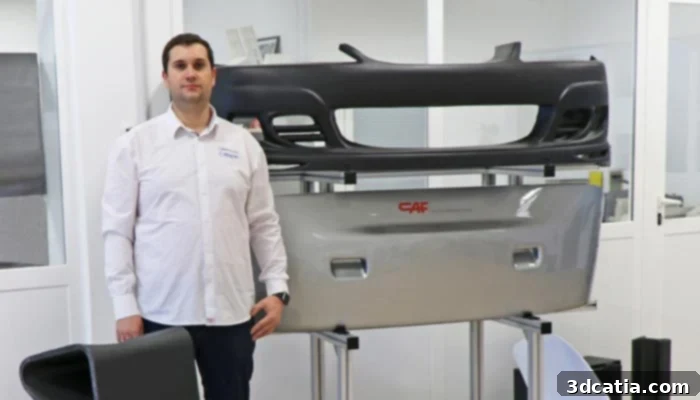
Francisco Barcenas, Director of R+D+I at CNC Bárcenas / Discovery 3D Printers.
3DN: What is Discovery 3D Printers and how was the company founded?
Discovery 3D Printers is the dedicated additive manufacturing division of CNC Bárcenas, a reputable company we established in 2009. Our headquarters are located in Valdepeñas, Ciudad Real, Spain. CNC Bárcenas itself has a strong foundation, specializing in the manufacturing of robust industrial CNC machinery. The journey to create Discovery 3D Printers was the result of an intensive and focused period of internal Research, Development, and Innovation (R+D+I). This dedicated effort culminated in a significant milestone: the successful acquisition of our very first client in the industrial sector, the BSH Group, specifically for their Montañana plant in Zaragoza. This initial success solidified our position, and we are proud to continue serving them as a key supplier across various technological domains.
Building on this momentum, in 2020, we forged a crucial collaboration with Gaggenau, a highly innovative company within the BSH Group, based in Lipsheim, France. For Gaggenau, we meticulously manufactured a completely tailor-made CNC machine specifically designed for their R&D laboratory, demonstrating our capacity for bespoke solutions. One of our most significant differentiating values, and indeed a core strength, is precisely this ability: our unparalleled capacity to provide highly customized solutions. We excel at integrating and combining different cutting-edge technologies, such as FDM (Fused Deposition Modeling), FGF (Fused Granular Fabrication), and advanced post-processing techniques like milling, all within a single, cohesive piece of equipment. This holistic approach ensures that our clients receive not just a machine, but a comprehensive, optimized manufacturing solution designed to perfectly fit their unique requirements and challenges.
3DN: Can you explain what your technology consists of? What are the large format solutions that you have developed?
Our journey into large-format additive manufacturing began in 2016 with the launch of our original Discovery 3D Printer. This innovative machine was a large format 3D printer leveraging FDM technology. Since its introduction, we have continuously refined and enhanced its performance through rigorous R&D, culminating in the advanced 2020 model. This high-performance machine boasts an impressive printing volume of up to 1m³, making it ideal for manufacturing both small intricate components and substantial large parts with exceptional resolution and speed. Its versatility extends to material compatibility, as it can operate with virtually any filament available on the market, offering unparalleled flexibility to users.
Building on this success, in 2017, we pioneered further by introducing our Super Discovery 3D Printer. This equipment was revolutionary, becoming one of the first in Europe to utilize direct pellet extrusion technology, also known as FGF (Fused Granular Fabrication). FGF technology is a game-changer for large-scale production, enabling the rapid manufacturing of very large parts while significantly reducing costs. This cost efficiency is achieved by using raw materials in the form of industrial pellets, or “chaff,” which are far more economical than traditional filaments. The Super Discovery 3D Printer was initially designed and developed for Navantia, a leading shipbuilding company. As part of their strategic “Shipyard 4.0” initiative, Navantia has been at the forefront of adopting the most innovative technological solutions available in the market for several years. Our collaboration with Navantia remains strong and ongoing, encompassing numerous projects, and we are proud to serve as their official additive manufacturing solutions provider. As I mentioned previously, our current offerings go beyond standard models; we specialize in providing completely tailored solutions that seamlessly combine different additive manufacturing technologies and diverse printing volumes, ensuring optimal performance for each client’s specific application.

The Super Discovery 3D Printer, a pioneering FGF large-format solution.
3DN: What is the competitive advantage of 3D printing with pellets? What “limitations” does it have?
When discussing the competitive advantages of 3D printing with pellets, several key benefits come to the forefront. The most immediately apparent advantage is the unparalleled capability to manufacture exceptionally large parts in significantly shorter timeframes and at a substantially lower cost compared to using traditional filament. This economic efficiency and speed are transformative for industrial production. However, another incredibly interesting aspect is the vast array of thermoplastics that can be utilized, including high-performance technical polymers. This expansive material choice unlocks a wide spectrum of potential applications, particularly in areas like mold making, where pellet printing offers numerous advantages over conventional manufacturing processes.
With a keen focus on diverse sectors such as industry, construction, visual communication, and food processing, our Super Discovery 3D Printer, available in various configurations—Standard, Compact, Hybrid, and Workstation—is engineered to facilitate flexible, fast, and remarkably cost-effective production of large parts. This includes critical items such as molds, specialized tooling, short series of original or spare parts, and functional prototypes. Importantly, it can readily utilize high-performance, fiber-reinforced, and mineral-reinforced materials when required, ensuring compliance with stringent regulations, such as fire safety standards, applicable in each specific sector. This adaptability makes it an invaluable asset for various industrial needs.
Furthermore, in the specialized field of R+D+I for new materials, pellet extrusion printers are perfect tools for the development and continuous improvement of innovative additive manufacturing materials. They allow for rapid adaptation to market demands and rigorous validation of mechanical, physical-chemical, technological, and increasingly important ecological properties. The ability to quickly iterate and test new material formulations accelerates material science advancements significantly. Instead of focusing on “limitations,” I prefer to characterize them as “special characteristics” of this advanced technology. For example, it necessitates certain adjustments in 3D modeling practices to account for factors such as layer adhesion, material flow, and cooling for large geometries. Additionally, for specific applications, post-processing techniques like polishing or applying specialized coatings to surfaces may be required to achieve the desired aesthetic finish or functional properties. As is often the case, no single solution is universally suitable for all additive manufacturing applications. Our strategic approach has been to concentrate on the large-format segment, effectively utilizing standard thermoplastic materials, and integrating technical polymers as needed to meet the most demanding industrial requirements.
3DN: For which application sectors are your solutions interesting? Can you mention any of your clients?
It’s challenging to identify any secondary sector that wouldn’t benefit immensely from the capabilities of large-format additive manufacturing, and indeed, we proudly serve clients across nearly every one of them. Our clientele spans a broad spectrum of industries, reflecting the versatility and robustness of our solutions. Beyond our foundational relationships with BSH and Navantia, we actively collaborate with global leaders suchin aerospace, such as AIRBUS, assisting them in the efficient manufacture of complex molds and specialized tools. In the power grid sector, we work with our client Hitachi ABB Power Grids, providing solutions for manufacturing parts with dielectric properties superior to those currently achievable through other means, addressing critical infrastructure needs. Within the construction industry, we partner with the Belgian Willy Naessens Group, facilitating innovation in large-scale building components. In the vital field of land transport, the CAF Group stands out as one of our most representative clients, utilizing our technology for various transportation components.

Beyond direct industrial applications, we cannot overlook the significant role that several prestigious universities, technology centers, and research institutions play in our success stories. These partnerships are crucial for advancing the field and pushing the boundaries of what’s possible with additive manufacturing. For instance, we maintain a very special and productive relationship with the Faculty of Mechanical Engineering at the University of Leuven (KU LEUVEN) in Belgium, engaging in collaborative research and development. Closer to home in Spain, we have fostered a very close link for several years with the R&D&I services specialized in additive manufacturing from the University of Cádiz, contributing to academic and applied research that shapes the future of the industry.
3DN: Can you highlight a project related to additive manufacturing in which you have collaborated?
While we are immensely satisfied with our recent agreement with UROVESA, a leading Spanish company renowned for its special vehicles used in civil and military missions, I would particularly like to highlight our latest success story involving the Chair of Light Design based on Polymers (PbL) at the Brandenburg University of Technology (b-tu) in Germany. Our collaboration with them has spanned many months, focusing on an exceptionally innovative project: the intricate manufacturing of wind turbine blades. This groundbreaking work showcases the transformative potential of large-format additive manufacturing. The b-tu now proudly utilizes our Super Discovery 3D Printer Workstation, a sophisticated system that seamlessly integrates FGF technology with an advanced post-processing system employing milling capabilities. This hybrid approach allows for unparalleled precision and versatility in their research.
From the customer’s perspective, this collaboration has addressed a critical technological need. They required the ability to rapidly and inexpensively manufacture molds for autoclaves that operate at high temperatures and pressures. Additionally, they needed to produce other large, complex parts they design, all while utilizing the high-performance materials essential for their demanding projects. Our solution provided them with exactly that: a completely customized solution, meticulously tailored in both size and performance to meet their precise specifications. It is also important to underscore the significance of how our Super Discovery 3D Printer Workstation was chosen. It emerged victorious through a rigorous public bidding process, open to all manufacturers in Germany, demonstrating our technical superiority and competitive offering. We are incredibly proud of this achievement.
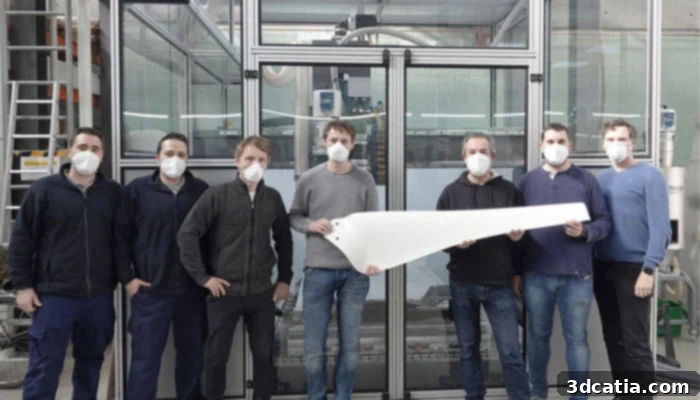
We are sincerely proud and deeply grateful for this partnership. Not only did we successfully outperform other manufacturers in terms of technical performance, coupled with a highly competitive price offer, but we also received commendations for our collaborative and proactive attitude throughout the entire project management lifecycle. This positive feedback extended from our initial commercial contact right through to the successful completion of delivery in Brandenburg and the subsequent ongoing technical support. This project holds additional significance as it was their first 100% digital project, conducted entirely without any physical visits or in-person interactions prior to delivery, a necessity imposed by the prevailing global pandemic situation. This accomplishment highlights our adaptability and the robust digital capabilities of our team.
3DN: Any last words for readers?
We warmly encourage all Spanish and international companies, as well as research centers across the globe, to reach out to us. We invite them to share their concerns, challenges, and aspirations within the dynamic world of large-format industrial additive manufacturing. We are confident that with our extensive expertise and innovative solutions, we can provide invaluable assistance. Our team is fully equipped to help lead their R+D+I projects and guide their transformative journey towards adopting these new industrial processes. These advanced manufacturing techniques are undeniably shaping a significant portion of the future of additive manufacturing, offering unprecedented opportunities for efficiency, cost reduction, and design freedom. We are here to partner with you in navigating this exciting future.
For more comprehensive information about Discovery 3D Printers and our innovative technologies, please visit our official website here. What are your thoughts on the groundbreaking technology developed by Discovery 3D Printers? Let us know your insights and feedback in a comment below, or connect with us on our social media channels: Facebook, Twitter, and LinkedIn! For the very latest news and updates in the world of 3D printing, remember to sign up for our free weekly Newsletter here, delivered straight to your inbox!
* Credits for all photos: Discovery 3D Printers