
Revolutionary Volumetric Resin 3D Printing: EPFL Unlocks Opaque Materials and Unprecedented Speed
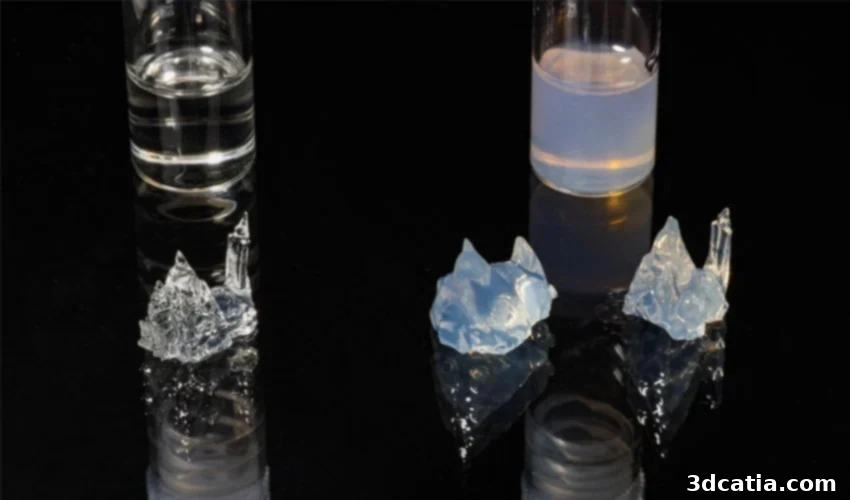
The world of resin 3D printing has long been admired for its exceptional precision and ability to fabricate intricate designs. However, traditional methods, which typically solidify materials layer by layer, have often contended with inherent limitations in terms of speed and the range of materials they can effectively process, particularly when it comes to challenging opaque resins. A groundbreaking innovation from the Laboratory of Applied Photonic Devices (LAPD) at EPFL in Switzerland is poised to revolutionize this landscape. Engineers there have successfully developed a novel volumetric 3D printing technology that promises to redefine additive manufacturing. This advanced system is not only capable of producing complex three-dimensional objects in mere seconds but, crucially, can also work with opaque resins – a significant hurdle that has historically restricted the widespread adoption and versatility of light-based printing methods.
Innovations within resin-based additive manufacturing processes are continuously pushing the boundaries of what’s technically feasible. Indeed, five years prior, this same team of visionary engineers had already laid crucial groundwork for considerably accelerating the printing process. While conventional resin printers can often require several hours to produce a final, high-quality part, manufacturers globally are relentlessly seeking ways to optimize machine speed, enhance throughput, and improve overall efficiency. The EPFL team’s latest breakthrough directly addresses these demands by leveraging a sophisticated volumetric method, which fundamentally alters the approach to solidification. Professor Christophe Moser from EPFL provides a clear explanation of this ingenious mechanism: “We pour the resin into a container and spin it. Then we shine light on the container at different angles, causing the resin to solidify wherever the accumulated energy in the resin exceeds a given level. It’s a very precise method and can produce objects at the same resolution as existing 3D-printing techniques.” This innovative approach stands in stark contrast to traditional layer-by-layer stereolithography (SLA) or digital light processing (DLP) by solidifying an entire volume of resin simultaneously, which dramatically reduces overall print times and often eliminates the necessity for the complex support structures typically required in many resin printing applications.
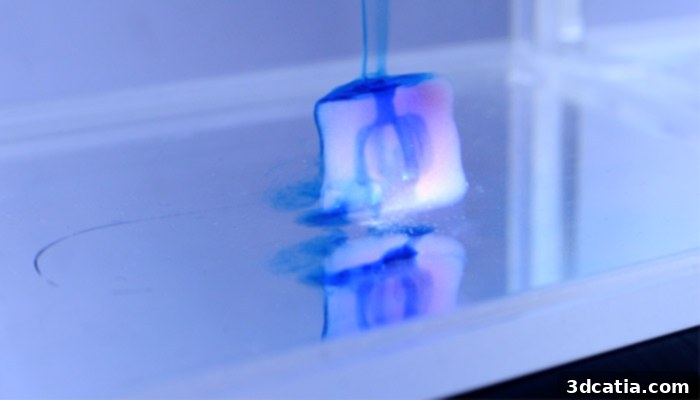
Photo Credits: EPFL
Unprecedented Speed and the Breakthrough with Opaque Resins
Beyond simply achieving parts with commendable resolution, the most compelling aspect of this new volumetric printing process is its astonishing speed. To vividly demonstrate this capability, the EPFL engineers successfully printed a remarkably detailed tiny Yoda figurine in an astounding 20 seconds. This breathtaking speed positions volumetric 3D printing as a genuine game-changer for rapid prototyping, on-demand manufacturing scenarios, and any application where extremely quick turnaround times are paramount. However, the true technical marvel and the cornerstone of this innovation lies in the material successfully utilized for this feat: an opaque resin. The ability to effectively process and cure opaque materials within a volumetric process represents a monumental leap forward, addressing a long-standing and significant challenge that has hindered advancements in the broader field of light-based resin 3D printing.
The inherent difficulty associated with using opaque resins in light-based additive manufacturing systems stems from the complex way light interacts with such materials. Unlike transparent or even translucent resins, where light can propagate relatively smoothly and predictably, opaque resins intensely scatter and absorb light much more aggressively. This severe scattering effect significantly diminishes the amount of light energy that successfully reaches the intended solidification points within the resin volume, leading to a cascade of problems. Firstly, it drastically reduces the overall efficiency of the photo-curing process. Secondly, and more critically for precision applications, it severely compromises resolution and accuracy. When light scatters uncontrollably, the boundaries of the solidified areas become blurred and indistinct, resulting in a noticeable loss of fine detail and geometric accuracy. This limitation has traditionally made volumetric printing with opaque materials impractical and often undesirable for many high-precision industrial and medical applications. Consequently, volumetric techniques have largely been confined to utilizing clear or lightly tinted resins, thereby restricting their adoption in crucial industries that require robust, functional parts fabricated from materials specifically designed to block or interact with light in unique ways.
EPFL’s Ingenious Solution: Dynamic Light Trajectory Correction
To effectively circumvent the complex and pervasive problem of light scattering within opaque resins, and to ensure that light could precisely penetrate and solidify the material with high fidelity, the ingenious EPFL engineers devised a brilliant multi-step solution rooted in computational optics and real-time correction. Their innovative approach transforms a seemingly intractable optical problem into a manageable and highly controlled one. The first crucial step involved the meticulous study of the actual trajectory of light as it attempted to pass through the opaque resin. Utilizing a combination of high-resolution video cameras and advanced optical sensors, the team was able to empirically observe, quantify, and map the exact distortions, scattering patterns, and light attenuation caused by the resin’s inherent opacity. This comprehensive empirical data provided the foundational insights necessary for the development of their sophisticated corrective algorithms.
Following this detailed observation and data collection, the team leveraged sophisticated computer calculations to precisely map and compose a comprehensive understanding of the distortion of the light rays. This involved the development of intricate algorithms capable of predicting, with remarkable accuracy, how light would scatter within a given volume of opaque resin based on its specific optical properties. Essentially, they engineered a robust computational model that could accurately simulate the light’s intricate journey through the dense material and precisely identify where it would deviate from its intended path. With this powerful predictive model established, the 3D printer was then programmed to actively perform these complex calculations in real-time and dynamically correct the trajectory of the projected light during the printing process itself. This is far from a static calibration; it’s an adaptive, closed-loop system that continuously adjusts the incoming light patterns to counteract the scattering effects. The overarching objective is to intelligently redirect the light to the exact desired locations within the resin vat, thereby ensuring that sufficient energy accumulates precisely where it is needed to solidify the resin accurately and consistently, despite the material’s inherent opacity. This dynamic compensation mechanism effectively allows the system to “see through” the opaque material, precisely guiding the light to form the desired 3D shape with unprecedented fidelity and detail.
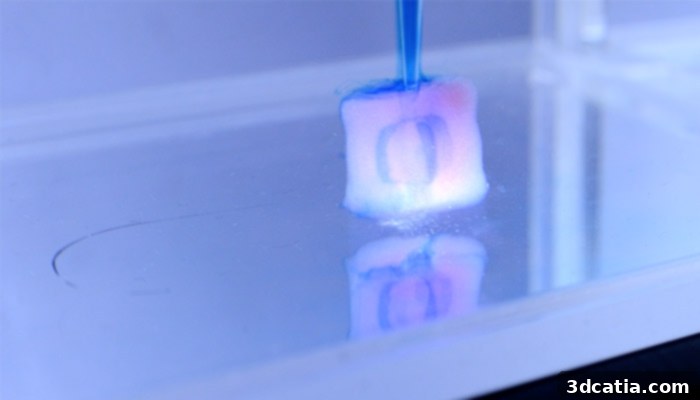
A visual representation of the resin solidifying over time, eventually forming the complete object (photo credits: EPFL)
Transformative Applications in Medical and Industrial Fields
The implications of this innovative volumetric 3D printing technique, particularly its groundbreaking ability to efficiently handle opaque resins, are profound and far-reaching, especially within the critical medical field. Engineers at EPFL are highly optimistic about its immediate potential to design and produce artificial arteries, as well as other complex biological structures and intricate medical devices. Procedures necessitating artificial arteries often demand materials that are not only biocompatible but also exhibit precise mechanical properties and, crucially, can be opaque for specific diagnostic visibility or to block light in situ. Traditional layer-by-layer additive manufacturing methods frequently struggle with achieving the combined precision, speed, and material versatility needed for such delicate and critical structures, or are severely limited by the inherent transparency requirements of their resins. This new EPFL technology opens vast new avenues for rapidly fabricating patient-specific implants and prosthetics, highly accurate surgical guides, and even complex microfluidic devices for advanced drug delivery systems or diagnostics – all utilizing materials previously deemed exceptionally challenging for light-based additive manufacturing techniques.
Beyond the burgeoning medical applications, the newfound capability to print rapidly and accurately with opaque resins holds immense promise for a diverse array of industrial sectors. Industries that require functional prototypes or specialized end-use parts with unique optical properties, such as the automotive, aerospace, or consumer electronics sectors, stand to benefit significantly. Imagine the rapid production of durable, high-resolution components for advanced sensors, robust electronic housings, or intricate mechanical parts that can fully leverage the unparalleled speed and the advantageous material properties offered by opaque polymers. The volumetric nature of the process also inherently offers substantial advantages in producing parts with more isotropic mechanical properties, as the entire volume of material is cured simultaneously, thereby reducing the anisotropic weaknesses often observed in parts produced by conventional layer-by-layer printing methods.
Future Horizons: Multi-Material Printing and Micrometer Resolution
The ambitions of the EPFL team extend far beyond their current achievements. Their next significant developmental steps involve further advancing the technology to seamlessly incorporate several different materials simultaneously within a single print. This multi-material capability would unlock an entirely new realm of possibilities for advanced functional prototyping and complex manufacturing. Multi-material 3D printing allows for the creation of components with spatially varying mechanical, electrical, or optical properties within a single integrated object – for instance, flexible hinges combined with rigid structural elements, or the direct integration of functional electronic circuits. This complex undertaking will necessitate even more sophisticated control over light interaction and precise material deposition, but its successful implementation would represent a truly monumental leap forward for the entire additive manufacturing industry.
Furthermore, the dedicated engineers are committed to dramatically increasing the resolution of their volumetric system, aiming to move from the current impressive tenth of a millimeter scale down to the elusive micrometer scale. Achieving micrometer resolution would undoubtedly position this technology at the absolute forefront of precision manufacturing, enabling the creation of extraordinarily fine details and exceptionally miniature components. This unparalleled level of precision is absolutely critical for advanced fields such as micro-robotics, complex micro-optics, highly integrated microfluidic systems, and next-generation, ultra-detailed medical implants. Such forthcoming advancements would not only cement EPFL’s esteemed position as a global leader in cutting-edge additive manufacturing research but would also provide invaluable tools for industries constantly striving for extreme miniaturization, unprecedented accuracy, and revolutionary functional integration. We eagerly anticipate keeping you fully informed about any upcoming developments and groundbreaking breakthroughs that emerge from this fascinating and highly impactful project!
What are your thoughts on this truly revolutionary opaque resin 3D printing method and its profound potential to transform numerous industries? We’d genuinely love to hear your insights and perspectives! Feel free to share your comments and opinions below, or engage with us actively on our LinkedIn, Facebook, and Twitter pages! And don’t forget to sign up for our free weekly Newsletter here to receive all the latest and most impactful 3D printing news directly to your inbox! You can also find all our compelling videos and more in-depth content on our dedicated YouTube channel. For more information directly from the source, you can find further details HERE.