
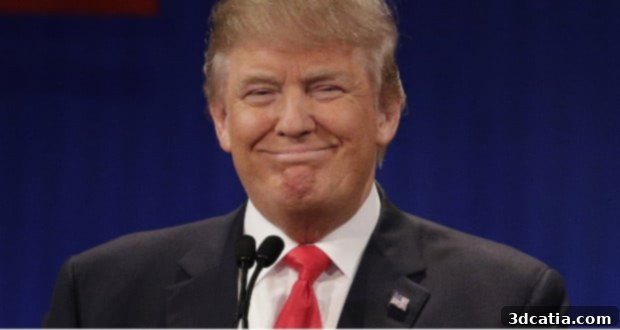
Trump’s Bold Move: The Shockwave of a Nationwide 3D Printing Ban and its Looming Impact
In an unprecedented and highly controversial move that sent immediate shockwaves across the technology sector and beyond, then-President Donald Trump announced a sweeping ban on the “Commercialization of projects, instruments and tools having any link with 3D printing and additive manufacturing.” This drastic measure, slated to take effect in the fall of 2017, immediately plunged the future of countless innovative entrepreneurs, startups, and established companies within Silicon Valley and across the nation into profound uncertainty. The news ignited a firestorm of debate, with an influx of distressed statements from various companies and industry leaders echoing widespread concern over the potential implications for technological advancement, economic growth, and America’s competitive standing on the global stage.
The President’s rationale behind this contentious policy centered on a perceived “value crisis” within American society. Trump asserted that the ban would “Raise moral and bring back jobs to those who would/have potentially lost them due to the increase of this technology being used throughout the different sectors of American business.” He specifically targeted factories, which he described as “the cornerstone of American jobs,” claiming that 3D printing was eroding traditional manufacturing employment. He further lambasted additive manufacturing as “Fake technology” that was “Sucking the American out of the American dream.” In a brief public address, Donald Trump drew a direct link between 3D printing and what he characterized as a growing culture of indolence, stating emphatically, “Playful abstract technology takes away from the hard work Americans thrive on.” This sentiment was subsequently reinforced by the White House, which issued a statement articulating Mr. Trump’s perspective: “New technologies are only good as long as they help contribute to the development of society and to the economy. This technology takes away from Americans, therefore it hinders both society and the economy.” This perspective painted a stark picture of a government viewing advanced digital fabrication not as a tool for progress, but as an existential threat to traditional American labor values and economic stability.
The immediate repercussions of such a ban would be far-reaching, crippling industries that have increasingly relied on 3D printing and additive manufacturing for innovation, rapid prototyping, and even end-use parts production. Sectors from aerospace and automotive to medical devices, consumer electronics, and even fashion have integrated these technologies into their core operations. For instance, in aerospace, 3D printing allows for the creation of lightweight, complex components with superior performance, reducing fuel consumption and manufacturing lead times. A ban would force companies to revert to older, less efficient, and more costly manufacturing methods, stifling innovation and significantly increasing time-to-market for new products. Medical device manufacturers, who utilize 3D printing for custom prosthetics, implants, and surgical guides, would face immense challenges in providing personalized patient care. The economic ripple effect would extend to the vast ecosystem of companies that supply materials, software, and services to the 3D printing industry, leading to widespread job losses in a sector that was once seen as a burgeoning source of high-tech employment.
Mr. Trump looking stoic with the US flag as a backdrop
Despite Mr. Trump’s efforts to cultivate relationships within Silicon Valley since taking office, this sweeping declaration seemed poised to irrevocably damage those ties and ignite an unprecedented backlash from the tech community. The initial reactions were swift and unequivocally critical, illustrating the deep chasm between the administration’s policy and the industry’s vision for technological progress. Elon Musk, the visionary founder of Tesla and SpaceX, was among the first to voice his dismay, releasing a powerful statement early that morning. “A sad step backwards has been made today,” Musk asserted. “By putting a stop to technological developments in the 21st century, you are only fostering an ideology that belongs in the 1900s. It is time to continue forwards, not backwards.” Musk’s companies heavily rely on 3D printing for everything from rocket engine components to advanced automotive parts, making his condemnation particularly poignant and illustrative of the direct threat to his enterprises.
Other titans of the technology world quickly followed suit. Jeff Bezos, the founder of Amazon, known for his company’s relentless pursuit of innovation, released a terse statement late Friday night, labeling the measure as “An absurd measure in a sequence of absurdity from Mr. Trump.” Amazon, which leverages advanced manufacturing techniques for its logistics infrastructure and potential drone delivery systems, would undoubtedly face significant operational hurdles. Tim Cook, CEO of Apple, expressed profound disappointment and frustration, revealing that the ban would necessitate the abandonment of future Apple projects deeply reliant on 3D printing technology for prototyping and specialized component development. The collective outcry from these influential figures underscored the sentiment that the ban was not only economically detrimental but fundamentally misguided, placing ideological concerns above technological progress and global competitiveness.
Elon Musk
The immediate consequence of such a restrictive policy was an urgent search for alternative environments. Luckily for those American businesses and innovators determined to continue their developments in 3D printing and additive manufacturing, Europe swiftly extended an open invitation. Many American businesses and startups, facing the prospect of being stifled or entirely shut down domestically, began actively exploring potential new homes for their projects and operations across the Atlantic. This looming “brain drain” and “capital flight” threatened to transfer American innovation, expertise, and investment to more technologically welcoming nations, potentially solidifying Europe’s position as a global leader in advanced manufacturing and further isolating the United States from critical technological advancements. The policy, intended to bolster American jobs, seemed instead destined to export them.
Observing Mr. Trump’s track record as president thus far, marked by frequent policy announcements that often underwent significant revisions or faced legal challenges, it remained uncertain whether this particular measure would ever be fully implemented or withstand the inevitable legal battles and industry lobbying. The practical enforcement of such a broad ban on a technology deeply embedded in various industries also presented immense logistical and definitional challenges. How would one strictly define “commercialization” or “any link with 3D printing” without crippling vast segments of the economy? The sheer scope of the ban made it appear almost unenforceable in a modern, interconnected industrial landscape. One thing, however, seemed definitively clear: with Mr. Trump expressing such strong sentiments against 3D printing, the much-speculated possibility of a grand, 3D-printed border wall would certainly not materialize after all, adding a touch of irony to an otherwise serious debate.
A Twitter post made by Mr. Trump early Friday evening
However, before allowing concerns about the future of American innovation to fully consume you, a closer look at the “official statement” reveals a crucial detail that tempers the alarm. This extensive discussion, while based on a premise that highlights very real debates about technology and labor, was, in fact, an elaborate thought experiment designed to provoke discussion. To read the official statement that inspired this analysis and discover the true nature of this particular announcement, you can find it here. And for continuous, genuine updates on the additive manufacturing industry, cutting-edge innovations, and actual policy developments, don’t forget to check in with us regularly here or on our active communities on Facebook and Twitter!