
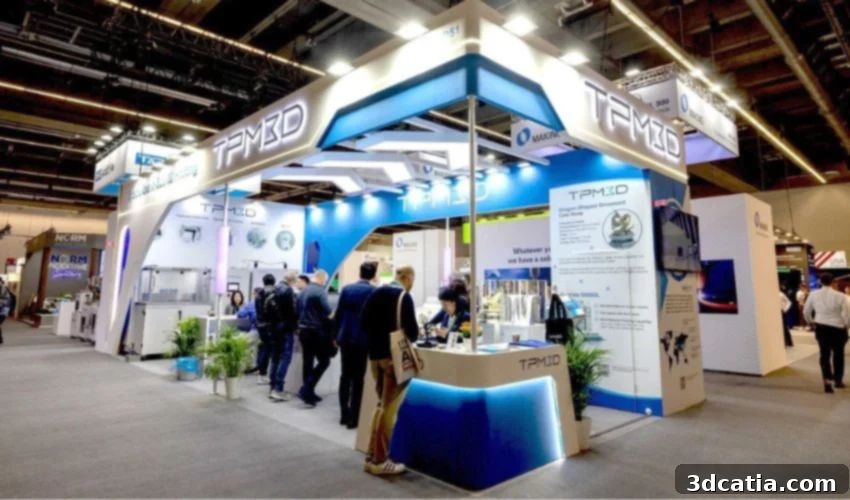
TPM3D: Driving Industrial SLS 3D Printing Innovation from China to the Global Market
China has emerged as a significant powerhouse in the global additive manufacturing landscape, experiencing remarkable growth that continues to accelerate. While the perception of the Chinese market often leans towards desktop 3D printing solutions, particularly extrusion-based FDM or vat photopolymerization, an increasing number of manufacturers are now offering robust industrial-grade solutions. Many of these companies have a long history of innovation within China and are now strategically expanding their reach into the international market. Among the most prominent of these pioneers is TPM3D. This leading provider of Selective Laser Sintering (SLS) 3D printing solutions has firmly established its reputation in its home country and is now making substantial strides in international expansion. To delve deeper into the company’s fascinating journey, its core mission, and its ambitious plans for the future, we had the privilege of speaking with TPM3D’s CEO.
Meet Lucy Zhai: CEO of TPM3D and a Visionary in Additive Manufacturing
My name is Lucy Zhai, and I serve as the CEO of TPM3D. My journey into the world of industrial technology and manufacturing began with a strong academic foundation, earning both an engineering bachelor’s degree and an MBA from Peking University. Following my studies, I accumulated invaluable experience across various critical functions within Fortune 500 companies, including product development, applications engineering, manufacturing operations, and sales and marketing, all focused on industrial markets. Notably, I held several leadership roles at General Electric (GE), contributing to both their Industrial & Consumer Division and the Energy Division. These roles provided me with profound insights into the intricacies of industrial markets across China and the broader Asia-Pacific region, shaping my understanding of manufacturing challenges and opportunities.

TPM3D CEO, Lucy Zhai
My extensive background ultimately led me to join Stratasys in 2016, where I served as the General Manager for Greater China. During this period, I became increasingly convinced of the transformative potential of 3D printing. Given the vast and expanding range of applications of this technology in various industrial sectors, I firmly believed that additive manufacturing could significantly accelerate research and development processes in manufacturing while simultaneously reducing production costs. This conviction laid the groundwork for a pivotal moment in 2018 when our dedicated founder team successfully acquired a company share from Stratasys. We subsequently rebranded the entity as “TPM3D,” embarking on an independent journey with a focused mission: to spearhead the development, innovation, and widespread promotion of advanced SLS technology.
The Genesis of TPM3D and Its Enduring Mission in SLS 3D Printing
From its very inception, TPM3D has been resolutely committed to advancing the development and application of Selective Laser Sintering (SLS) 3D printing technology. In its formative years, the company primarily concentrated on delivering high-quality 3D printing services, leveraging the inherent advantages of SLS technology to produce complex and durable parts for various industries. This initial phase allowed us to deeply understand market needs and the practical applications of SLS. Building upon this foundation, we progressively transitioned to developing our own proprietary SLS equipment and specialized powder materials. This strategic shift marked a crucial evolution, as our focus broadened from service provision to becoming a leading manufacturer of advanced SLS systems and a pioneer in material science for additive manufacturing.
Our dedication to innovation quickly yielded significant results. In 2005, we proudly launched the first generation of our Precimid high-performance nylon powders, which set new benchmarks for material properties in SLS. This achievement was swiftly followed in 2007 by another monumental milestone: the successful development and manufacturing of Asia’s first industrial-grade SLS laser sintering 3D printer. This groundbreaking achievement solidified our position as a technological leader in the region and demonstrated our capacity for profound innovation.
Between 2014 and 2018, TPM3D engaged in a strategic joint venture with Stratasys, a collaboration that further enhanced our technological capabilities and market reach. During this period, our SLS additive manufacturing systems successfully obtained the prestigious TÜV CE certification, a testament to our adherence to the highest international safety and quality standards. As mentioned previously, the latter part of 2018 saw another transformative event: we repurchased all shares from Stratasys, enabling us to rebrand and operate independently under the distinguished “TPM3D” brand. To this day, our core mission remains steadfast: to drive continuous innovation, expand the applications, and promote the widespread adoption of SLS 3D printing technology across global industries.
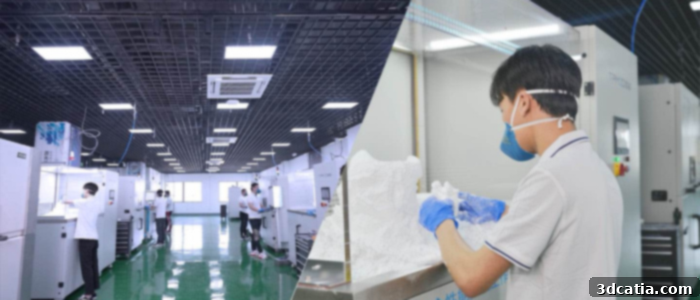
Exploring the Advanced Features and Advantages of TPM3D’s SLS 3D Printing Solutions
At TPM3D, our unwavering focus on SLS 3D printing technology has allowed us to develop a comprehensive ecosystem of solutions, encompassing state-of-the-art SLS 3D printing equipment, an extensive portfolio of high-performance polymer powder materials, and premium printing services, including capabilities for large parts and high-functional material printings. Our commitment to innovation ensures that our offerings consistently meet and exceed the evolving demands of industrial applications.
We currently offer two distinct series of SLS printers, meticulously designed to cater to a broad spectrum of industrial requirements: the S Series (Superior) and the P Series (Performance). The S Series represents our pinnacle of industrial-grade equipment, engineered and manufactured to adhere to the most rigorous EU safety standards. These machines are specifically tailored to address the needs of the high-end advanced manufacturing market, where precision, reliability, and robust performance are paramount. In contrast, the P Series is renowned for its exceptional cost-effectiveness, making it an ideal choice for small and medium-sized printing service providers, as well as burgeoning industrial markets seeking high-quality SLS capabilities without the extensive investment associated with top-tier industrial systems.
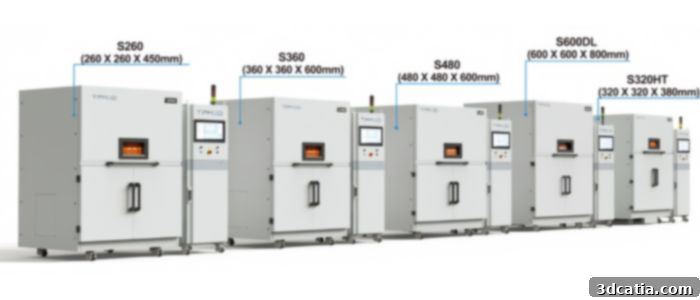
TPM3D S Series SLS Printers
To further accommodate diverse customer needs and application complexities, our printer lineup includes seven distinct models, offering a wide range of build volumes. These volumes start from a compact 260 x 260 x 450mm and scale up significantly to an impressive 600 x 600 x 800mm. Our advanced configurations encompass everything from efficient single-laser systems to high-throughput dual-laser systems, alongside specialized models featuring ultra-high-temperature printing capabilities for advanced engineering polymers. Beyond the printers themselves, we have innovatively developed the Parts and Powder Post-Processing Station (PPS). This integrated system streamlines the entire post-processing workflow, combining part cleaning, efficient powder recycling, precise material adding and mixing, and automatic powder feeding. The PPS is instrumental in creating a remarkably clean, safe, and highly efficient working environment, embodying our commitment to efficient, clean, and environmentally responsible production – a distinctive advantage among SLS 3D printer manufacturers.
TPM3D takes pride in offering some of the largest SLS dual-laser 3D printing solutions currently available on the market. These large-format systems empower users to produce substantial parts for demanding industries such as automotive and healthcare, facilitating the creation of components that were previously challenging or impossible to produce additively. Looking ahead, our dedication to pushing the boundaries of technology continues; a revolutionary quadruple laser printer, boasting an expansive build chamber exceeding 1 meter, is actively under development and scheduled for release this year, promising even greater capacity and speed for future industrial applications.
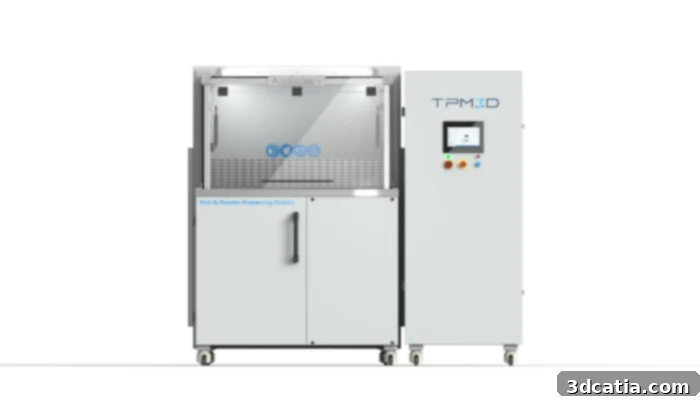
TPM3D PPS(Part & Powder Processing Station)
Furthermore, TPM3D distinguishes itself with an extensive and diverse material portfolio, offering more than 20 types of advanced polymer powders and composite materials. This includes widely used options such as PA12, PA11, PA6X, TPU, and PP, alongside high-temperature and high-performance engineering materials like PEEK and PEKK. This broad material selection enables us to provide highly tailored and optimized solutions for a vast array of specialized applications, ensuring that our customers can achieve the exact mechanical and thermal properties required for their innovative products.
An Optimistic Outlook on the Evolving SLS 3D Printing Market
I hold a profoundly optimistic view regarding the future development prospects for the Selective Laser Sintering (SLS) 3D printing industry. This technology is undergoing a period of rapid and dynamic advancements, particularly with the continuous emergence of new and improved powder materials. These material innovations are not only enhancing the capabilities of existing applications but are also driving a significant expansion into entirely new market segments. The inherent technical characteristics of SLS, such as its ability to produce highly complex geometries without support structures and its excellent mechanical properties, align perfectly with the broader trend of 3D printing transitioning from primarily prototyping and trial production to robust, end-product manufacturing. As this shift gains momentum, the distinct advantages of SLS in scalable batch production are becoming increasingly self-evident and critical for industrial adoption.
SLS technology is uniquely well-suited for efficient small-scale batch production, offering unparalleled design freedom and high-quality output. Its ability to create parts with superior mechanical properties, coupled with the elimination of support structures, makes it an ideal choice for the production of customized end products. This includes a wide array of applications such as precision tooling and fixtures, intricate parts with complex internal structures, and highly personalized consumer goods like customized sports equipment – think tailored helmets, performance footwear components, bespoke eyewear frames, and specialized rehabilitation support devices. To meet these burgeoning needs, we anticipate the emergence of advanced production line equipment specifically designed for batch manufacturing, incorporating fundamental requirements such as modularity for flexible adaptation, unattended operation for increased efficiency, and sophisticated automated control systems for precision and reliability.
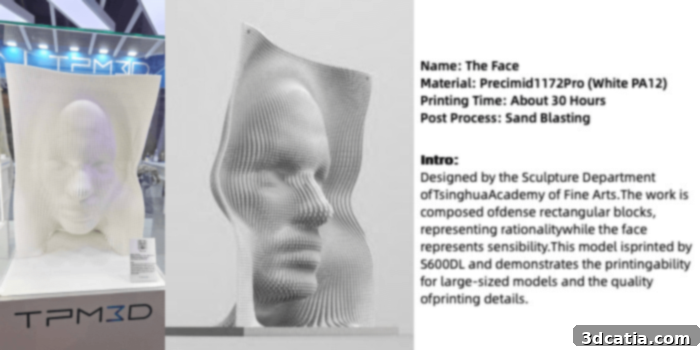
Furthermore, significant progress is being made in the post-processing of SLS printed parts, which is crucial for enhancing both aesthetics and performance. Advanced techniques such as chemical vapor smoothing (CVS), precision dyeing, and innovative foaming processes are continually being refined. These post-processing applications do more than just improve the visual appearance and tactile texture of the printed products; they also profoundly enhance their functional performance. For instance, CVS and dyeing can create a denser, stronger, and tougher surface on the part, improving durability and finish. Conversely, the foaming process offers tremendous potential for lightweighting components, which is critical in industries like automotive and aerospace, while also significantly reducing overall printing costs by using less material.
We are observing a noticeable trend where SLS technology is gradually expanding its reach beyond traditional high-end industrial markets. It is increasingly being adopted by small businesses, academic institutions, and even individual design studios. In recent years, compact and user-friendly small and medium-sized SLS printers, exemplified by solutions from companies like Formlabs, have gained considerable popularity due to their more accessible build sizes, streamlined design, and intuitive operation. I firmly believe this trend will persist and intensify, with low-cost, easy-to-use small and medium-sized SLS devices attracting an even broader base of small businesses, entrepreneurs, and individual users, democratizing access to this powerful additive manufacturing technology.
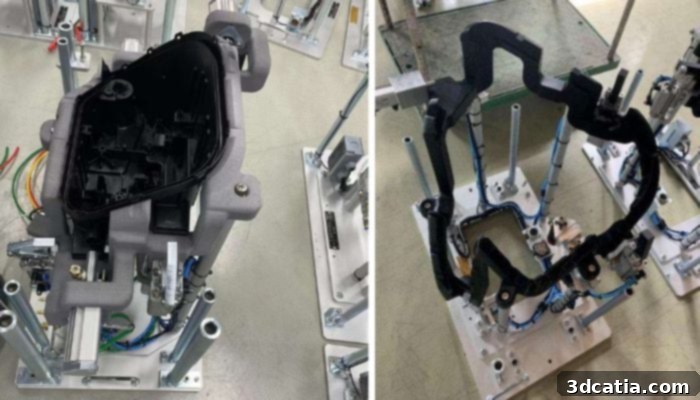
On the left, the jig made with SLS 3DP of PA12 material compared to the traditional metal casting one on the right.
With the accelerating proliferation of sophisticated AI design tools and the increasing consumerization of 3D printing devices, the industry stands on the cusp of a profound transformation. 3D printing technology is indeed poised to transition from being primarily confined to specialized industrial markets to becoming a ubiquitous tool for small and medium-sized enterprises (SMEs) and even commonplace in households, much like conventional household appliances. This overarching trend is expected to act as a powerful catalyst, driving exponential growth across the entire 3D printing market and bringing about transformative impacts on design, manufacturing, and consumer product accessibility across various sectors.
TPM3D’s Strategic Development Plans for a Future-Forward Approach
At this crucial stage of our growth and market expansion, TPM3D is prioritizing three main strategic initiatives to solidify our leadership in the SLS 3D printing sector:
- Ongoing Research & Development (R&D): Our core commitment is to the continuous development of innovative products and advanced applications that are precisely aligned with evolving market trends and customer needs. This commitment spans both the expansion of our popular small and medium-sized SLS equipment lines, which cater to a growing segment of businesses and individuals, and the ambitious development of large-scale production line devices designed for high-volume industrial manufacturing. Our R&D efforts are focused on improving speed, precision, material versatility, and system integration.
- Cost Optimization (Cost Out): To truly foster the large-scale industrial application and widespread adoption of SLS technology, making it more economically viable is absolutely essential. Our fundamental mission and vision at TPM3D include making this powerful technology significantly more affordable and thus accessible to a much broader user base, encompassing various industries and business scales. We are constantly striving to optimize our design and production processes, enhance material utilization through advanced recycling and innovative material development, and actively explore more economical manufacturing and operational solutions without compromising on quality or performance.
- Expanding Overseas Markets and Enhancing Service Levels: In recent years, we have observed a consistent and encouraging increase in our international customer base. While our primary team and operational infrastructure are predominantly based in China, we currently rely heavily on a network of dedicated reseller partners for our overseas promotion and service delivery. To robustly support our accelerating international business growth and to better serve our global customers, we have concrete plans to gradually establish strategically located overseas service centers. These centers will enable us to respond quickly and efficiently to equipment service needs, foster closer relationships with our international customers, and develop highly localized applications that are specifically suited to the unique demands and characteristics of local markets.
In summary, TPM3D’s strategic development plan for the future is meticulously designed to enhance the quality and accessibility of our products and services. We aim to achieve this through a relentless focus on innovation, proactive cost reduction initiatives, and the establishment of strengthened local services to effectively meet the diverse and evolving needs of our global customer base. We eagerly anticipate collaborating with customers and partners worldwide, working together to advance this exciting and transformative additive manufacturing technology, shaping the future of industrial production.
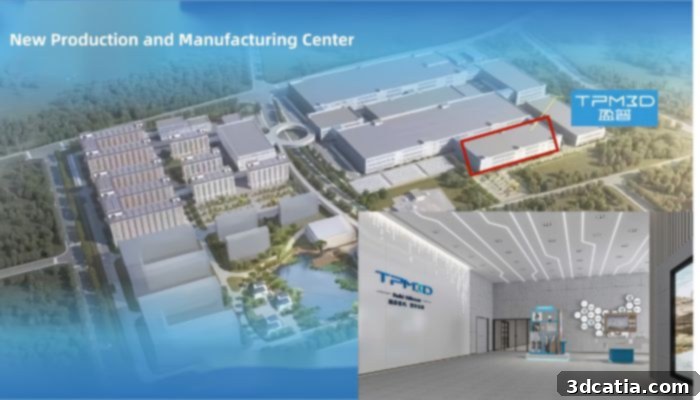
Connect with TPM3D: Your Gateway to Advanced SLS Solutions
We invite you to discover more about TPM3D, our innovative SLS 3D printing solutions, and our commitment to industrial excellence by visiting our official website HERE. Should you wish to delve deeper into our cutting-edge technology and tailored additive manufacturing solutions, please do not hesitate to contact us directly. Our expert team is ready to assist you with any inquiries. For the latest company updates, groundbreaking insights, and industry news, we encourage you to follow us on LinkedIn.
We value your insights and feedback! What are your thoughts on TPM3D’s contributions to the additive manufacturing industry? Share your comments below or engage with us on our social media platforms: LinkedIn, Facebook, and Twitter pages! Don’t miss out on the latest 3D printing news; subscribe to our free weekly Newsletter here to get updates delivered straight to your inbox! You can also explore all our informative videos and technology showcases on our YouTube channel.