
Exploring the Cutting Edge: Top 3D Printing Innovations This Week
Welcome to your weekly dose of additive manufacturing brilliance! As the world of 3D printing continues its rapid evolution, we at 3Dnatives are thrilled to bring you the most compelling and inspiring videos from the past week. From ground-breaking technological advancements to imaginative applications, these stories highlight the dynamic potential of 3D printing across various industries. This week, prepare to embark on an exclusive tour of Prusa Research’s impressive headquarters and print farm in Prague, get an up-close look at Ireland’s pioneering 3D printed homes, and discover how additive manufacturing is revolutionizing everything from musical instruments with Forte3D’s carbon fiber cellos to advanced wearables like HBD’s metal 3D printed VR spectacle frames. We’ll also delve into the future of design with Siemens’ latest updates to their generative design software. So, settle in, and get ready to witness the incredible possibilities unlocked by 3D printing. Happy watching!
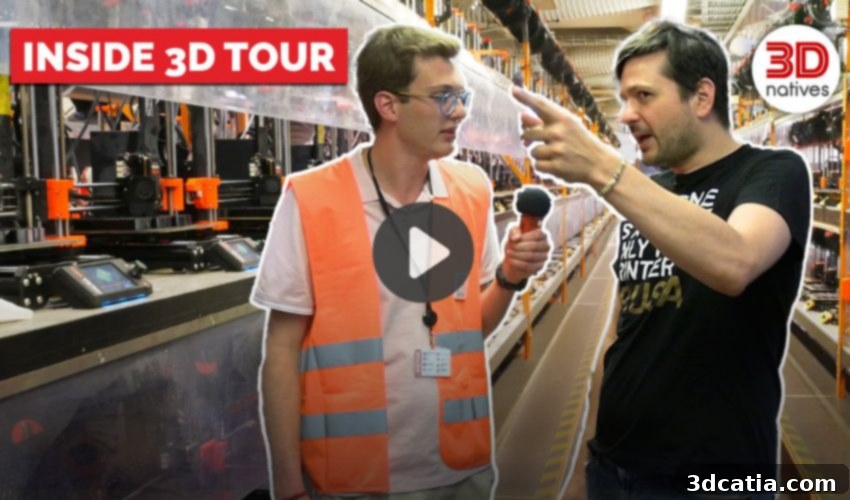
3Dnatives Takes an Exclusive Look Inside Prusa Research in Prague
It’s hard to imagine the world of desktop 3D printing without mentioning Prusa Research. This beloved Czech company has not only set the standard for accessible and reliable FDM 3D printers but has also cultivated a massive, supportive global community around its open-source philosophy and continuous innovation. Their commitment to quality, user experience, and affordability has made Prusa a household name for hobbyists, educators, and small businesses alike. However, their ambition extends beyond the desktop. This week, our very own Elliot Saldukaite had the extraordinary opportunity to visit Prusa’s sprawling headquarters and state-of-the-art 3D print farm in Prague, offering an unprecedented look behind the scenes of one of additive manufacturing’s most influential companies.
Elliot’s visit wasn’t just a tour of their impressive facilities; it was a chance to witness the unveiling of their first professional solution, the Prusa Pro HT90. This move signifies a major milestone for Prusa, signaling their entry into the industrial 3D printing sector with a machine designed for more demanding applications. The video provides invaluable insights into the scale of Prusa’s operations, from the meticulous assembly lines for their renowned i3 MK4 and MINI+ printers to the extensive print farm where thousands of parts are produced daily, showcasing their commitment to in-house manufacturing excellence. Discover what makes Prusa Research a leader in the industry, and get a detailed introduction to the capabilities and vision behind the new Prusa Pro HT90, designed to push the boundaries of professional additive manufacturing. This exclusive content reveals not just the technology, but the passion and innovation driving Prusa’s global success.
Ireland Pioneers Sustainable Living with First 3D Printed Homes
The concept of 3D printed homes has rapidly transitioned from a futuristic dream to a tangible global reality, addressing critical needs in housing, sustainability, and construction efficiency. Across continents, additive construction is demonstrating its power to build structures faster, more affordably, and with reduced waste compared to traditional methods. This week, Ireland proudly joined the growing list of nations embracing this transformative technology, showcasing its very first 3D printed homes in Dundalk. This landmark project by HTL represents a significant step forward for the country’s housing sector, particularly in providing innovative solutions for social housing.
The video provides a captivating glimpse into the construction process, illustrating how a specialized concrete 3D printer meticulously layers material to form the walls of these innovative homes. Completed over an impressive two-week period, these structures are set to become vital social housing units, demonstrating the speed and efficiency inherent in 3D printing technology. The projection is that these houses can be built approximately three times faster than conventional homes, a crucial advantage in tackling housing shortages. Beyond speed, 3D printing in construction offers unparalleled design flexibility, allowing for unique architectural forms and optimizing material usage, which contributes to greater sustainability. With keys slated for handover to Louth County Council in October 2024, this project not only offers immediate housing solutions but also paves the way for a more sustainable and efficient future in Irish construction, potentially inspiring similar initiatives nationwide and showcasing the tangible benefits of additive manufacturing for community development.
Forte3D Revolutionizes Musical Instruments with a 3D Printed Carbon Fiber Cello
The realm of 3D printed musical instruments has witnessed an astonishing surge in innovation, with everything from guitars and saxophones to flutes and maracas being brought to life through additive manufacturing. The capacity of 3D printing to create complex geometries, experiment with new materials, and offer unprecedented customization has opened up a new frontier for instrument makers and musicians alike. This week, we add another remarkable creation to this growing list: Forte3D’s groundbreaking 3D printed carbon fiber cello, a testament to the technology’s transformative power in the arts.
In this insightful video, Alfred Goodrich, the visionary founder and CEO of Forte3D, shares the inspiring journey behind his company’s mission: to produce affordable and accessible cellos. Traditional cellos are often prohibitively expensive, limiting access for aspiring musicians. By leveraging the efficiencies and material innovations of 3D printing, Forte3D aims to democratize the instrument, making it available to a wider audience. A key element of their innovation lies in the choice of material. Goodrich explains the critical importance of turning to 3DXTECH’s advanced carbon fiber filament for these instruments. Carbon fiber offers an exceptional strength-to-weight ratio, superior stiffness, and excellent acoustic properties, which are crucial for producing a rich, resonant sound. Furthermore, 3D printing allows for intricate internal structures and optimized designs that would be impossible or exceedingly difficult to achieve with traditional woodworking, potentially enhancing both the instrument’s performance and durability. Forte3D’s approach not only makes cellos more affordable but also explores new acoustic possibilities, marking a significant step forward in blending traditional artistry with cutting-edge additive manufacturing.
HBD Additive Manufacturing Unveils Lightweight VR Spectacle Frames Using Metal AM
HBD Additive Manufacturing, a prominent Chinese manufacturer of metal 3D printers, consistently pushes the boundaries of what’s possible with advanced manufacturing solutions. This week, they are showcasing an exciting application that highlights the precision, strength, and design freedom offered by their technology: innovative VR spectacle frames produced using metal additive manufacturing. As the virtual reality market expands, the demand for comfortable, durable, and aesthetically pleasing accessories like spectacle frames becomes paramount, and traditional manufacturing often struggles to meet these complex requirements.
The video provides an in-depth look at these meticulously crafted VR spectacle frames, manufactured with HBD’s advanced HBD400 laser-based metal AM solution. A key highlight is the use of titanium as the printing material. Titanium is renowned for its exceptional strength-to-weight ratio, biocompatibility, and corrosion resistance, making it an ideal choice for wearable technology where comfort and durability are critical. By utilizing titanium in a 3D printing process, HBD has been able to create frames that are incredibly lightweight yet robust, enhancing the user experience for prolonged VR sessions. This application brilliantly demonstrates the core benefits of metal 3D printing: unparalleled design freedom allows for complex geometries and optimized structures that drastically reduce material usage while maintaining or even improving mechanical performance. The ability to customize each frame for perfect fit and comfort, combined with the material advantages of titanium, positions metal AM as a leading solution for the next generation of high-performance, lightweight components in consumer electronics and beyond.
Siemens NX Integrates Advanced AI and Generative Design for 3D Printing Optimization
In the rapidly evolving landscape of product design and engineering, software tools are becoming increasingly sophisticated, leveraging artificial intelligence and advanced algorithms to unlock new levels of innovation. Siemens, a global leader in industrial software, is at the forefront of this revolution with its NX software. This week, Siemens has released a highly anticipated video detailing the latest updates to NX, showcasing how these enhancements are empowering engineers and designers with unparalleled capabilities, especially for applications intertwined with additive manufacturing.
The core of these updates lies in the deeper integration of AI-enabled and generative design tools. Generative design is a paradigm-shifting approach where engineers define design objectives and constraints, and the software, powered by AI, autonomously explores countless design permutations to find the optimal solution. This process often yields organic, highly optimized geometries that would be impossible for a human designer to conceive manually. The video specifically highlights significant advancements in features such as topology optimization, which allows for the creation of lightweight yet strong components by strategically removing unnecessary material; implicit modeling, enabling the easy creation and manipulation of highly complex, mathematically defined shapes; and lattice designing, crucial for producing intricate internal structures that offer superior strength-to-weight ratios and enhanced functional properties. These tools are particularly transformative for 3D printing, as they allow designers to create components that fully leverage the capabilities of additive manufacturing, enabling intricate designs, mass customization, and performance improvements that were previously unattainable. Siemens NX’s latest updates solidify its position as a critical platform for innovators looking to push the boundaries of design and manufacturing in the age of additive production.
We hope you enjoyed this week’s dive into the fascinating world of 3D printing innovations! From Prusa’s professional expansion and Ireland’s pioneering 3D printed homes to Forte3D’s accessible carbon fiber cellos, HBD’s lightweight VR frames, and Siemens’ cutting-edge generative design software, the potential of additive manufacturing continues to amaze and inspire. Each story underscores the transformative power of this technology to reshape industries, solve complex challenges, and foster unprecedented creativity.
Which of these incredible videos captivated your imagination the most this week? We’d love to hear your thoughts! Share your favorite video and what impressed you in a comment below, or join the conversation on our LinkedIn, Facebook, and Twitter pages! To stay informed about all the latest breakthroughs and essential news in the 3D printing industry, don’t forget to sign up for our free weekly newsletter here, delivered straight to your inbox. You can also explore our extensive library of videos and discover more incredible content by visiting our official YouTube channel. Thank you for joining us on this journey through the forefront of additive manufacturing!