
The Global 3D Printing Market: Unveiling Explosive Growth, Innovations, and Future Potential
The global 3D printing market is currently undergoing a period of unprecedented expansion, driven by a convergence of rapid technological advancements, the burgeoning array of applications across diverse industries, and an ever-increasing demand for highly customized and specialized products. This transformative growth is not merely anecdotal; it is substantiated by robust market projections. According to a recent insightful article published on MarketWatch, a renowned platform specializing in financial news and comprehensive stock market analysis, the market is poised to demonstrate a remarkable compound annual growth rate (CAGR) of 24.3% throughout the forecast period spanning from 2020 to 2030. This impressive growth projection serves as a powerful testament to the immense untapped potential and a wealth of opportunities inherent within the broader field of additive manufacturing, positioning it as a pivotal force in the future of global production.
The meteoric rise of the 3D printing market can be primarily attributed to a series of significant and ongoing technological breakthroughs that have profoundly enhanced both the capabilities and the economic accessibility of 3D printers. Recent years have witnessed dramatic improvements in printer speed, allowing for quicker production cycles, alongside a substantial boost in accuracy, which enables the creation of intricate and precise components. Furthermore, the expansion of available material options has been a game-changer, moving beyond basic plastics to include advanced polymers, diverse metals, ceramics, and composite materials. These collective advancements have collectively elevated 3D printing from a niche prototyping tool to a robust, viable, and often superior solution for a vast multitude of industries, addressing complex manufacturing challenges and opening new avenues for innovation.
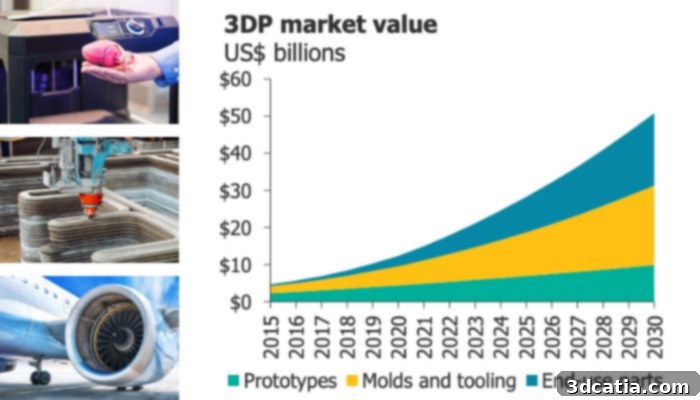
3D Printing has the potential to become a billion dollar industry (Photo credits: Lux research, shutterstock, Leslie Lok )
Driving Forces: Advancements, Diverse Applications, and Unprecedented Customization
The MarketWatch report prominently highlights that the exponential growth in the 3D printing market is fundamentally fueled by these aforementioned technological advancements and the subsequent increase in market demand. This has led to a constantly expanding array of practical applications across a wide spectrum of industrial sectors. Industries such as automotive, aerospace, healthcare, consumer products, and architecture are increasingly leveraging the transformative power of additive manufacturing.
Within the automotive industry, 3D printing has moved beyond mere rapid prototyping. It is now extensively utilized for producing complex tooling, jigs, and fixtures, significantly streamlining production lines. More critically, it’s increasingly employed in the direct manufacturing of end-use parts, particularly for low-volume, high-performance vehicles or customized components. This capability translates directly into substantial cost savings, drastically reduced lead times, and much shorter production cycles, offering a competitive edge. Similarly, in the dynamic and critical healthcare sector, 3D printing is not just innovating but revolutionizing several key areas. From the efficient manufacturing of medical devices to the creation of highly personalized prosthetics and patient-specific implants, tailored precisely to individual anatomical requirements, additive manufacturing is leading to vastly improved patient care, better surgical outcomes, and a new era of personalized medicine. The ability to create intricate, biomechanically optimized structures opens doors to breakthroughs in drug delivery systems, anatomical models for surgical planning, and even the frontier of bioprinting for tissue and organ regeneration.
Beyond these established applications, the unparalleled ability of 3D printing to create highly customized, geometrically complex, and functional designs is a profoundly significant driver for its widespread expansion. This capability fundamentally transforms traditional manufacturing paradigms. With additive manufacturing, businesses and designers can effortlessly produce unique products tailored precisely to individual customer specifications, needs, or aesthetic preferences. Such personalized production was previously deemed either economically impractical or prohibitively costly with conventional manufacturing methodologies, which typically favor mass production of identical items. This inherent customization capability holds particular appeal in sectors like the packaging industry, where bespoke designs can enhance brand identity and product protection. It is also a powerful force in the consumer products market, where items like personalized jewelry, bespoke fashion accessories, and distinctive home decor elements are rapidly gaining immense popularity, catering to a growing consumer desire for individuality and unique expression. The versatility of 3D printing allows for rapid iteration and design flexibility, enabling companies to quickly respond to market trends and consumer feedback, further solidifying its position as a transformative technology.
The MarketWatch report also meticulously notes the integral role played by key players within the global 3D printing market. Industry leaders such as Stratasys Ltd., 3D Systems Corporation, and Materialise are continuously investing substantial resources into dedicated research and development initiatives. Their strategic aim is to not only introduce groundbreaking innovative products and proprietary technologies but also to aggressively expand their market presence and reach new customer segments. These companies are at the forefront of developing new printing materials, enhancing printer capabilities, and refining software solutions that make 3D printing more accessible and efficient. Beyond the scope of this particular study, it is abundantly clear that the market ecosystem is experiencing a surge in strategic collaborations and partnerships. These alliances are forming between established 3D printing companies and major global corporations, exemplified by partnerships with industry giants like Johnson & Johnson and BMW. This synergistic cooperation is crucial as it significantly accelerates the adoption of 3D printing technology across various industries. Such strategic integration fosters its seamless incorporation into existing manufacturing processes, driving mainstream acceptance and unlocking even greater potential for innovation and efficiency.
Promise Over Peril: Navigating Challenges and Embracing a Revolutionary Future
While the long-term outlook for 3D printing appears exceptionally promising and poised for continued growth, it is essential to acknowledge that there are still inherent challenges that the industry must actively address and overcome. Among these hurdles, the relatively high initial cost associated with industrial-grade 3D printers remains a significant barrier for many smaller businesses or those with limited capital. Additionally, while material options have expanded considerably, the range and availability of materials suitable for specific high-performance applications are still somewhat limited compared to traditional manufacturing processes. Furthermore, scalability issues present a challenge, particularly when transitioning from prototyping or low-volume production to true mass manufacturing, where speed and cost-effectiveness become paramount. The complexities of ensuring consistent quality control and post-processing for large batches also contribute to these scalability concerns. However, it is crucial to recognize that intensive and ongoing research and development efforts across the globe are specifically focused on tackling these very challenges. These initiatives aim to make 3D printing technology more accessible, demonstrably more cost-effective, and ultimately, more universally applicable across a broader spectrum of manufacturing needs.
Looking ahead, the 3D printing market is unequivocally expected to maintain its robust upward trajectory and accelerating momentum. Future advancements will not only encompass breakthroughs in novel materials, including smart materials, multi-material printing capabilities, and sustainable options, but also significant leaps in printing technologies themselves. This includes faster, more precise, and larger-scale printing platforms. Coupled with increasingly sophisticated software solutions for design, simulation, and process optimization, the market is poised to witness an even wider array of transformative applications and a marked increase in adoption across virtually every industrial sector. As 3D printing becomes more deeply integrated into fundamental manufacturing processes, its potential to fundamentally revolutionize global supply chains becomes increasingly evident. It enables true on-demand production, drastically reducing reliance on extensive inventories and storage, minimizing transportation costs and carbon footprints, and significantly cutting down on material waste. This shift towards localized, agile, and responsive manufacturing models holds the key to greater efficiency, sustainability, and resilience in a rapidly changing global economy.
The projected impressive CAGR of 24.3% powerfully underscores the immense, untapped potential of the 3D printing market. With leading industry players consistently investing heavily in groundbreaking research and development, and forging strategic partnerships with major global corporations, the future landscape of 3D printing is not just promising but truly transformative. Successfully overcoming existing challenges related to initial costs, expanding the breadth and certification of advanced materials, and enhancing scalability will serve as critical catalysts, further boosting widespread adoption and fueling the market’s continued explosive growth. As the industry persistently innovates, matures, and refines its capabilities, 3D printing is positioned to fundamentally reshape the entire manufacturing landscape, redefining traditional production methods, fostering unparalleled design freedom, and driving a new era of personalized and efficient global production.
What are your predictions for the future of the 3D printing industry as we approach the year 2030? We invite you to share your insights and engage in the conversation by leaving a comment below, or by connecting with us on our LinkedIn, Facebook, and Twitter pages! Don’t miss out on the latest advancements and breaking news; make sure to sign up for our free weekly Newsletter here, delivering the most relevant 3D printing news straight to your inbox! You can also explore all our informative videos and engaging content on our YouTube channel.
*Cover photo credits: Getty Images