
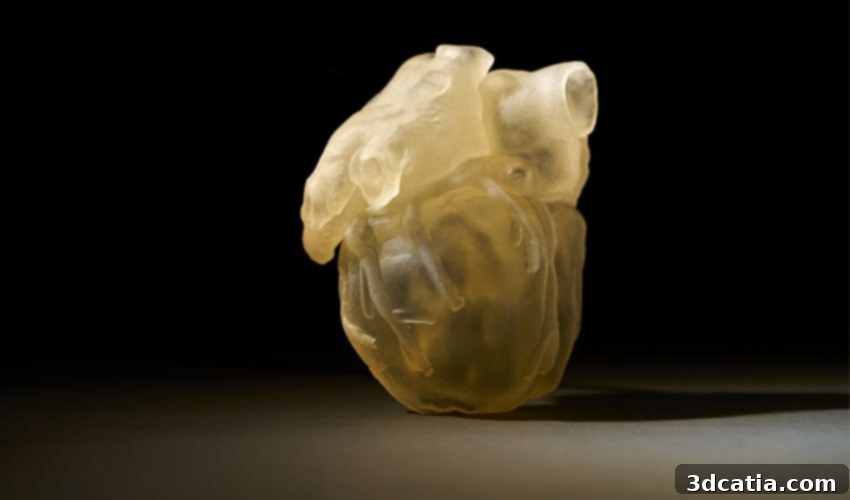
Revolutionizing Medical Training: The Stratasys J750 Digital Anatomy 3D Printer and Hyper-Realistic Surgical Simulation
For decades, medical professionals have relied on a range of traditional methods to hone their surgical skills and prepare for complex operations. These methods typically included training on cadavers, animal models, and more recently, traditional or virtual anatomical models. While these approaches have served their purpose, they all come with significant limitations. Cadavers, for instance, are scarce, expensive to procure and maintain, and do not accurately replicate the feel of live tissue or its response to surgical instruments. Ethical considerations also play a role. Animal models present similar ethical dilemmas and often lack the precise physiological and anatomical fidelity to human subjects. Traditional and virtual models, while offering some advantages, frequently fall short in providing the tactile feedback and biomechanical realism crucial for truly immersive and effective surgical preparation.
The landscape of medical education and surgical training is now undergoing a profound transformation, thanks to advancements in additive manufacturing, more commonly known as 3D printing. This innovative technology is fundamentally changing how medical professionals prepare for critical operations, offering an unprecedented level of accuracy and realism. The ability to avoid mistakes during high-stakes surgery is paramount, and 3D printed alternatives offer a solution far superior to previous methods that could only approximate human anatomy. Leading the charge in this groundbreaking area is Stratasys, a prominent player in the 3D printing market. Stratasys is actively expanding its commitment to the medical sector by introducing a revolutionary new solution designed to provide even greater fidelity and responsiveness in anatomical models.
This newest solution from Stratasys is engineered to enable the creation of designs that meticulously replicate the feel, responsiveness, and complex biomechanics of human anatomy. Known as the J750 Digital Anatomy 3D Printer, this advanced system transcends mere visual accuracy. It can, for example, recreate the actual tissue response that surgeons would encounter in a live operating room environment, allowing users to focus intently on specific pathologies and challenging surgical scenarios. This level of realism is a game-changer for surgical training. Eyal Miller, Head of the Stratasys Healthcare Business Unit, emphasizes the profound impact: “We’re giving surgeons a more realistic training environment in no-risk settings. This allows them to practice procedures repeatedly, refine their techniques, and build confidence without any danger to a patient. We also anticipate this will enable medical device makers to significantly improve how they bring products to market by performing robust design verification, validation, usability studies, and failure analysis with these new, highly realistic models, accelerating innovation and ensuring safer, more effective devices reach patients faster.”
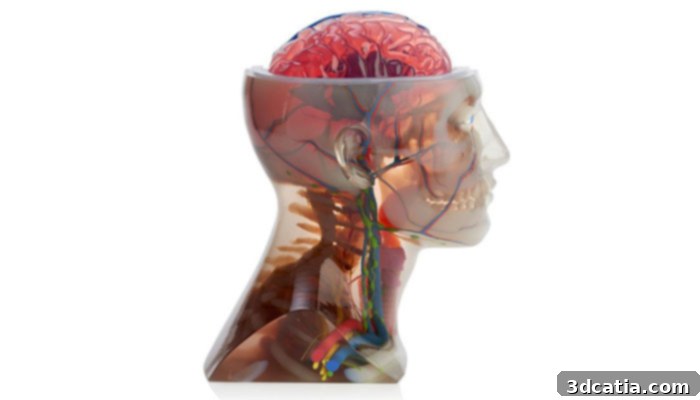
The J750 Digital Anatomy 3D Printer defines colors, transparencies, textures and finishes, it is possible to create an anatomical model that’s as close to the real thing as possible | Image via Stratasys
Complementing the J750 Digital Anatomy 3D printer, Stratasys is also launching a suite of three innovative new materials crucial for achieving this unprecedented realism. These materials, named TissueMatrix™, GelMatrix™, and BoneMatrix™, are specifically formulated to address diverse applications across cardiac, vascular, and orthopedic surgical training and device development. TissueMatrix is designed to mimic the intricate composition and tactile properties of soft human tissues, essential for simulating procedures involving organs, muscles, and complex vessel structures. GelMatrix offers unique properties ideal for creating intricate geometries and soft, compliant sections, often found in vascular models. BoneMatrix replicates the distinct density, texture, and mechanical response of human bone, enabling realistic simulation of orthopedic surgeries, including drilling, cutting, and plating. Furthermore, recognizing the complexity of vascular models, a dedicated blood vessel cleaning station is also being released. This specialized unit efficiently removes support material from the delicate interior of 3D printed blood vessels, ensuring patent lumens and highly accurate vascular models for training and testing. These integrated solutions collectively push the boundaries of what is possible in medical simulation, paving the way for advanced surgical preparation and accelerated medical device innovation.
Who will adopt the J750 Digital Anatomy 3D printer?
The potential impact and broad applicability of the J750 Digital Anatomy 3D printer are expected to generate significant interest and widespread adoption across various segments of the medical field. Medical device companies are particularly poised to benefit from this cutting-edge solution. The ability to rapidly produce highly accurate and biomechanically realistic prototypes means drastically faster lead times for product development and iteration. This accelerates the design cycle, improves testing phases, and streamlines the regulatory approval process, ultimately bringing safer and more effective medical devices to market much quicker. Engineers and product designers can now perform rigorous testing on models that behave exactly like real human tissue and bone, providing invaluable insights into device performance and potential failure points long before clinical trials.
Academic medical centers and teaching hospitals also stand to gain immensely from integrating the J750 Digital Anatomy system into their curricula. These institutions are facing increasing pressure to provide comprehensive and high-quality surgical training environments that minimize risk to actual patients. By conducting a significant portion of training outside the operating room using these hyper-realistic models, they can offer residents and fellows invaluable hands-on experience in a safe, repeatable, and controlled environment. This allows for deliberate practice of complex procedures, simulation of rare conditions, and mastery of new techniques without the inherent risks associated with live surgery. This system empowers medical educators to create tailored training modules for specific pathologies, allowing trainees to repeatedly practice intricate maneuvers until proficiency is achieved. The Jacobs Institute in New York, a leading medical innovation center, exemplifies this transformative potential, having collaborated with Stratasys’ technology to create key vascular components essential for advanced testing and training. This partnership highlights the printer’s capability to support sophisticated medical research and education.
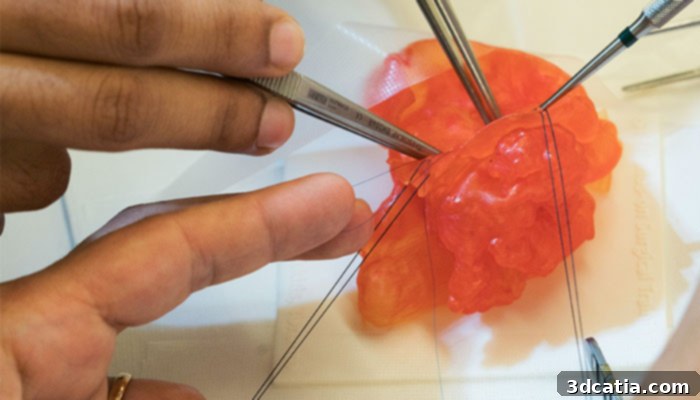
J750 Digital Anatomy solutions allow live-tissue feel and biomechanical realism | Image via Stratasys
The experience at the Jacobs Institute further underscores the profound benefits of this technology. Doctors at the Institute have expressed significant satisfaction with the J750 Digital Anatomy system, recognizing its unparalleled capabilities for medical innovation and training. Dr. Adnan Siddiqui, Chief Medical Officer at the Jacobs Institute, elaborates on the critical advantages: “3D printing has been wonderful for recreating patient-specific anatomy compared to cadavers or animal models; however, the final frontier for organ model realism has been live-tissue feel and biomechanical realism. That’s exactly what the Digital Anatomy 3D Printer gives us. For years, we’ve sought to bridge the gap between visual accuracy and functional fidelity. These models offer a revolutionary leap forward, allowing us to not only see but also feel and interact with anatomical structures in a way that truly mimics the human body. We believe these models give us the best opportunity to recreate human physiological conditions to simulate actual clinical situations and to study new devices to establish their effectiveness before introducing them to patients. This capability is invaluable for refining surgical approaches, testing novel instruments, and ensuring optimal patient outcomes, all within a completely safe and controlled environment.” The ability to simulate patient-specific pathologies with realistic haptic feedback allows surgeons to practice delicate procedures, understand the nuances of a patient’s unique anatomy, and anticipate challenges, significantly enhancing preparedness and reducing intraoperative risks. This transformative technology represents a paradigm shift in medical simulation, setting new standards for realism and effectiveness in surgical training and device development. Its adoption is expected to foster an era of improved patient safety, accelerated medical innovation, and more confident, highly skilled medical professionals across the globe.
What are your thoughts on the revolutionary J750 Digital Anatomy from Stratasys and its potential to reshape medical training and device development? We invite you to share your insights in a comment below or join the conversation on our Facebook and Twitter pages! To stay informed about the very latest advancements in 3D printing technology and its diverse applications, remember to sign up for our free weekly Newsletter, delivering all the essential news straight to your inbox!