
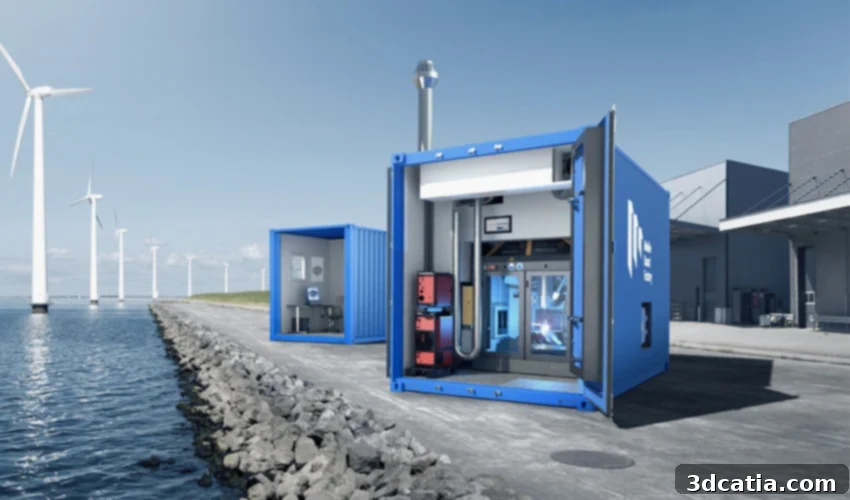
Mobile Smart Factory: Redefining On-Demand 3D Printing and Portable Manufacturing
Imagine a fully operational parts factory capable of producing high-quality components, nestled entirely within a standard shipping container. This visionary concept, known as the Mobile Smart Factory, represents a revolutionary leap forward in manufacturing. It offers a practical and highly adaptable solution for bringing advanced metal and plastic 3D printing capabilities directly to the point of need, anywhere in the world. Engineered as a series of modular containers, this intelligent factory is equipped with state-of-the-art devices that enable flexible, secure, and efficient on-site production, covering the entire additive manufacturing workflow from initial design to post-processing.
Additive manufacturing, commonly known as 3D printing, has long been heralded as a transformative technology for optimizing the production of both end-use components and essential spare parts. Its inherent ability to produce parts on demand significantly reduces the need for extensive physical inventories and consequently lowers production costs. Despite these compelling benefits of 3D printing, widespread adoption has faced considerable hurdles. Traditional additive manufacturing systems often demand substantial capital investment, specialized infrastructure, and a skilled workforce to operate and maintain, making them less accessible for many businesses, particularly those operating in remote or challenging environments. The Mobile Smart Factory directly addresses these critical challenges, offering a robust, self-contained, and economically viable solution. The company behind this groundbreaking initiative, which shares its name with the innovative module, is dedicated to paving the way for truly independent, cost-effective, and reliable 3D printed parts production, wherever it is required.
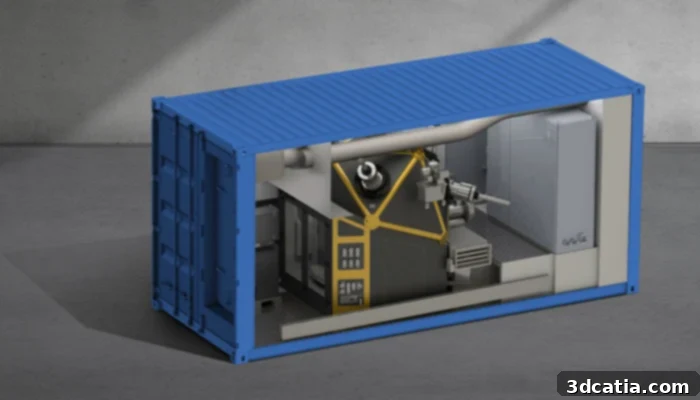
The 3D printing module for spare parts | Credits: Mobile Smart Factory
Mobile Smart Factory: Standard Containers, Unique Solutions for Global Manufacturing
The concept of a portable, self-sufficient factory holds immense potential for a diverse range of industries. Consider, for instance, companies operating on the high seas—such as naval vessels, oil rigs, or large cargo ships—where access to spare parts can mean the difference between seamless operation and costly downtime. For these critical sectors, the Mobile Smart Factory represents a paradigm shift. This transportable production unit can dramatically accelerate part fabrication and enhance supply chain resilience by introducing unparalleled flexibility. It minimizes logistical complexities, reduces reliance on vulnerable global supply chains, and provides an immediate solution for critical component needs. But what exactly constitutes this innovative Mobile Smart Factory, and how does it manage to compress advanced manufacturing capabilities into a compact, transportable format?
The ingenious design integrates all the necessary technology for manufacturing essential spare parts within two interconnected, standard shipping containers. Each container is meticulously configured to perform specific functions, ensuring a streamlined and highly efficient additive manufacturing workflow. This modular approach not only facilitates easy transportation but also allows for rapid deployment in virtually any location, from urban industrial zones to remote operational sites.
Container One: The Control and Polymer Production Unit
The first container serves as the primary control unit and houses capabilities for pre-processing and polymer 3D printing. Measuring 6 meters (20 feet) in length and weighing approximately 12 tons, this robust module is engineered to be a comprehensive digital fabrication hub. It is equipped with an advanced workstation featuring high-performance computing power, essential for complex design tasks, simulation, and slicing operations. This powerful computer workstation is the brain of the factory, allowing engineers and technicians to prepare digital models, optimize print parameters, and manage the entire production schedule efficiently.
Integral to this unit is an industrial-grade 3D printer specifically designed for polymers. This machine enables the rapid production of a wide array of plastic parts, including prototypes, jigs, fixtures, tooling, and even functional end-use components. The versatility of polymer printing is crucial for many applications, offering solutions for lightweight parts, electrical components, and ergonomic designs. Furthermore, the container includes a sophisticated 3D scanning system. This technology is vital for reverse engineering existing parts, performing quality control checks, and capturing highly accurate digital representations of physical objects. This capability is particularly useful for reproducing obsolete parts or for inspecting the dimensional accuracy of newly printed components. Complementing these technologies is a dedicated storage area, organized to safely house materials, tools, and finished polymer parts, ensuring a clean and efficient workspace within the confined environment.
Container Two: The Advanced Metal Parts Production Unit
The second, larger container is dedicated to the heavy-duty task of metal parts production and precision finishing. This unit measures 12 meters (40 feet) in length and weighs a substantial 15 tons, reflecting the robust machinery it contains. At its core is a multi-optional 6-axis machining center, a marvel of engineering provided by the esteemed company METROM. METROM elaborates on their innovative design, stating: “Based on a patented parallel kinematics concept, the machine combines an additive arc-wire manufacturing module (WAAM) with a precision milling and drilling unit.” This integration signifies a crucial advancement in portable manufacturing, allowing for the creation of complex metal parts with both additive and subtractive capabilities in a single, compact system.
The Wire Arc Additive Manufacturing (WAAM) module is particularly noteworthy. WAAM is a direct energy deposition process that uses an electric arc to melt wire feedstock, building up metal parts layer by layer. This method is highly efficient for producing large-scale metal components quickly and cost-effectively, utilizing materials such as steel, aluminum, and titanium. The integration of a milling and drilling unit is equally critical. While WAAM excels at rapid deposition, it often produces parts with a rough surface finish and less precise dimensions. The integrated subtractive machining capabilities allow the system to perform high-precision finishing operations, such as milling, drilling, and tapping, directly after the additive process. This hybrid approach ensures that the manufactured parts meet stringent dimensional tolerances and achieve the required surface quality for demanding applications. The entire welding and machining process is meticulously controlled through an NC (Numerical Control) program, operating based on pre-qualified parameters to ensure consistent quality and reliability. The machine’s main spindle is strategically positioned centrally, providing the necessary reach and stability to handle and machine even very large workpieces within the container’s confines.
Unlocking New Possibilities: Applications and Benefits of On-Demand Manufacturing
The ability to manufacture parts on demand is a critical and often challenging process, yet it is absolutely essential for profitable business operations in today’s dynamic global landscape. Traditional manufacturing and supply chains are frequently plagued by issues such as uncertain and volatile demand, extended lead times, high inventory carrying costs, and ever-increasing customer expectations for rapid delivery and customization. These challenges can severely impact operational efficiency, financial performance, and customer satisfaction.
The Mobile Smart Factory 3D printing module emerges as an exceptionally effective solution to these pervasive issues. Its distributed manufacturing model offers numerous benefits across various industries:
- Enhanced Supply Chain Resilience: By enabling on-site production, it drastically reduces reliance on complex, extended global supply chains, mitigating risks associated with geopolitical events, natural disasters, or logistics disruptions.
- Cost Efficiency: Eliminates the need for vast inventories, reducing warehousing costs, obsolescence, and the capital tied up in stock. On-demand production also cuts down on shipping expenses and lead times.
- Speed and Agility: Facilitates rapid prototyping and the immediate production of critical spare parts, minimizing downtime for essential machinery and operations. This agility is invaluable for emergency repairs or rapid product development cycles.
- Global Accessibility: Brings advanced manufacturing capabilities to remote locations, disaster zones, military outposts, or maritime operations where conventional supply lines are impractical or too slow.
- Customization and Innovation: Supports the creation of highly customized, specialized, or one-off parts without the prohibitive costs and lead times associated with traditional bespoke manufacturing. This fosters innovation and allows for rapid iteration of designs.
- Sustainability: Reduces the carbon footprint by minimizing transportation distances and potentially optimizing material usage through additive processes, leading to less waste.
- Rapid Deployment: The containerized nature allows for quick setup and relocation, offering unparalleled flexibility to adapt to changing production needs or market demands.
This innovative approach to manufacturing is particularly beneficial for sectors such as maritime (on-board repair of vessels, offshore platforms), defense (field repairs and maintenance for military equipment), heavy industry (mining, construction equipment repairs in remote areas), and even humanitarian aid (producing critical components for infrastructure or medical devices in crisis regions). The integrated hybrid manufacturing capability, combining WAAM with precision machining, ensures that even complex, high-performance metal parts can be produced to exact specifications on demand, transforming logistics and operational efficiency.
The Mobile Smart Factory is not just a collection of machines in a box; it represents a vision for the future of decentralized, responsive, and intelligent manufacturing. It empowers organizations to take control of their production processes, ensuring continuity and adaptability in an ever-changing world. For more in-depth information about this groundbreaking solution and its capabilities, you can find further details HERE. What are your thoughts on this revolutionary production module? We invite you to share your insights in a comment below or join the discussion on our Facebook and Twitter pages! And to stay informed about the latest advancements, research, and entrepreneurial ventures in the world of 3D printing, remember to sign up for our free weekly Newsletter, delivering all the essential news straight to your inbox!